Author: Hayden Richards

  • Why Trade Shows Fail to Capture Intent Before Procurement Starts

    Why Trade Shows Fail to Capture Intent Before Procurement Starts

    Trade show buyer intent often masks the true procurement timeline, with many organisations attending simply out of habit rather than genuine readiness to purchase. By the time decision-makers arrive at exhibition stands, the critical intention-setting phase has already passed, leaving suppliers competing for engagement that’s already too late.

    Trade show buyer intent capture has become one of the most misunderstood parts of industrial marketing, and the numbers back this up: in research by event platform Certain, 94% of marketers said their company fails to convert event leads into opportunities. For UK manufacturers of tooling, machinery, and precision engineering equipment, this isn’t a minor inefficiency. It’s a structural problem with how procurement actually works.

    Key Takeaways

    • Procurement starts internally, months before a show. By the time a buyer walks the aisles, specs are often written and shortlists are already drawn up.
    • Badge scans record attendance, not readiness to buy. A scan tells you someone stood at your stand, not that they need what you sell.
    • 94% of marketers admit their company fails to convert event leads into opportunities. Presence and intent are two different things.
    • Most trade show leads never get followed up. Industry research puts the figure as high as 80% — volume of contacts is being prioritised over qualification and timing.
    • Intent-based demand capture works alongside shows, not instead of them. Our breakdown of intent data providers covers how manufacturers identify in-market accounts before the show floor opens.

    How Procurement Actually Starts Long Before Show Season

    Industrial procurement rarely begins at a stand. It begins with an internal trigger: a machine reaching end of life, a new production line, a compliance requirement, or a capacity constraint that engineering has flagged internally.

    From there, the buying committee moves into spec research. Someone drafts a technical requirement, checks tolerances, reviews compatibility with existing tooling, and starts building a shortlist of suppliers who can plausibly meet it.

    This stage can run for weeks or months before anyone books a stand pass. By the time the buyer arrives at a show, they usually already know which two or three vendors they’re seriously considering.

    Trade show buyer intent capture, done properly, has to account for this timeline. If your first touchpoint with a buyer is the moment they scan their badge at your stand, you’re not at the start of their journey. You’re somewhere in the middle, possibly near the end.

    Badge Scans Measure Presence, Not Trade Show Buyer Intent

    Trade Show Buyer Intent | Why Trade Shows Fail to Capture Intent Before Procurement Starts

    A badge scan tells you a person walked past, stopped, and let you record their details. It tells you almost nothing about where they are in the procurement cycle.

    According to the Center for Exhibition Industry Research (CEIR), 81% of trade show attendees have buying authority — which sounds encouraging until you realise this is exactly why conversion still fails. Decision-makers are present in large numbers, but presence alone doesn’t reveal whether they’re evaluating your product line, comparing you against an incumbent supplier, or simply gathering background information for a project that’s eighteen months out.

    In most industrial B2B contexts, the gap between a show conversation and a closed deal runs to months, not days. That gap only makes sense if you accept that the show itself rarely originates the buying decision. It sits inside a longer process that started before the exhibition and continues well after it.

    Real trade show buyer intent capture requires distinguishing between a browsing engineer collecting datasheets and a procurement lead actively comparing quotes. Most stands can’t tell the difference in real time, which is exactly the gap this article is addressing.

    The Cost Asymmetry: Exhibiting Versus Intent-Based Demand Capture

    CEIR’s 2026 Marketing Spend Decision Report found that B2B exhibitions capture 41% of exhibitors’ total marketing budgets — the single largest channel. That’s a significant commitment of spend for a channel that, by the industry’s own admission, converts poorly.

    The follow-up gap

    Industry research widely attributed to CEIR puts the share of trade show leads that never receive any follow-up as high as 80%.

    Compare that to the cost of monitoring in-market signals continuously throughout the year. Intent data platforms, content engagement tracking, and account-level research signals cost a fraction of a stand, travel, staffing, and show materials combined, yet they operate every week rather than for the three or four days a show runs.

    This is the cost asymmetry in plain terms: manufacturers spend heavily on a channel with a short window and poor tracking, while cheaper, always-on intent signals go under-resourced. Reviewing where your budget currently sits is something we cover directly in our marketing services, particularly for manufacturers weighing show spend against digital demand capture.

    Why UK Industrial Manufacturers Feel This Gap Most Acutely

    Tooling, machinery, and precision engineering purchases are technical, high-value, and infrequent. A single tooling upgrade or machinery investment might happen once every few years for a given buyer.

    That infrequency raises the stakes of every procurement cycle and pushes buyers to do more upfront research, not less. Technical specification documents, tolerance requirements, and compliance standards (ISO certifications, CE and UKCA marking, industry-specific approvals) are usually locked down before a single vendor conversation happens.

    UK manufacturers in the West Midlands and other industrial clusters often exhibit at the same regional and national shows every year, treating them as a fixed calendar event rather than reassessing whether the format still matches how their buyers actually research. Our work through fractional CMO support for West Midlands manufacturers frequently starts with exactly this question: is show spend matched to where buyers actually are in their journey?

    What Trade Show Buyer Intent Capture Should Actually Look Like

    Structured lead qualification conversation at an industrial trade show booth

    Capturing genuine intent means qualifying interest at the point of contact, not just after the show when the trail has gone cold.

    A workable qualification framework at the booth typically covers:

    • What triggered their visit to this specific stand (spec match, referral, existing supplier issue)?
    • Where they are in their internal buying process (early research, active shortlist, final approval stage)?
    • Who else is involved in the decision, and what their timeline looks like?
    • What specific technical requirement they’re trying to solve?

    Few exhibitors run a defined qualification process like this at the stand, and many still rely on manual capture — paper forms, handwritten notes, business cards in a bowl. Manual capture makes it almost impossible to score intent in real time or route hot leads to sales before the show even closes.

    Always-On Intent Monitoring: The Alternative to Waiting for Show Season

    If procurement starts with internal triggers and spec research, then the highest-value moment to reach a buyer is before they’ve shortlisted anyone, not after.

    Always-on intent monitoring tracks signals like technical content downloads, repeated visits to spec pages, competitor comparison searches, and account-level research activity throughout the year. This gives manufacturers visibility into which accounts are actively researching long before any show floor opens.

    We’ve put together a detailed comparison of platforms in this space in our guide to intent data providers, covering which tools suit industrial B2B sellers specifically rather than generic SaaS use cases.

    The goal isn’t to replace human judgement with software. It’s to know which accounts to prioritise before your sales team spends a day walking a show floor hoping to bump into the right people.

    Pre-Show Outreach: Turning In-Market Accounts Into Meetings Before the Doors Open

    Pre-show outreach planning for in-market industrial accounts ahead of an exhibition

    Once you know which accounts are actively researching, pre-show outreach becomes far more precise than a generic “come visit our stand” email blast.

    Booking a short meeting with an in-market account before the show, even a 15-minute call, means the stand conversation on the day starts from an existing relationship rather than a cold introduction. It also means your sales team isn’t relying on chance encounters to find the buyers who matter.

    This approach flips the usual failure point. Instead of hoping the right people find your stand, you’ve already identified them and secured time on their calendar before the show even begins.

    Treating Shows as Acceleration, Not Discovery

    The most useful mental shift for exhibitors is to stop treating shows as a discovery channel and start treating them as an acceleration point in a procurement cycle that’s already underway.

    Under this model, a show stand exists to move known, qualified accounts forward, confirm technical fit, resolve final objections, and get commercial terms discussed face to face. It’s not there to generate cold awareness from a standing start.

    This reframing changes how you measure success. Instead of counting badge scans, you count how many pre-identified in-market accounts you actually met, and how many of those conversations moved a deal closer to a decision.

    If you want a clear view of how your current show strategy compares against this model, requesting a pipeline diagnosis maps out where intent is being missed across your existing funnel, both online and at events.

    Conclusion

    Trade show buyer intent capture fails most often because it starts too late — at the stand — rather than earlier, when the buyer’s internal trigger and spec research first began. UK industrial manufacturers in tooling, machinery, and precision engineering are especially exposed to this timing gap because their purchases are infrequent, technical, and shortlisted well before any exhibition hall opens its doors.

    Fixing this doesn’t mean abandoning shows. It means pairing them with always-on intent monitoring, structured pre-show outreach, and a booth qualification process that actually distinguishes browsers from buyers.

    If you’d like to see where intent is currently leaking out of your funnel, request a pipeline diagnosis or get in touch to talk through your current show and demand generation strategy.

    Frequently Asked Questions

    What is trade show buyer intent capture?

    Trade show buyer intent capture refers to identifying and qualifying genuine purchase intent from attendees, rather than simply recording who visited a stand. It involves understanding where a buyer sits in their procurement journey, not just that they stopped to talk.

    Why do most trade show leads fail to convert?

    Most trade show leads fail to convert because exhibitors capture attendance data (badge scans) without qualifying actual buying intent or timeline. Industry research puts the share of leads that never receive follow-up as high as 80%, and few exhibitors run a defined qualification process at the booth.

    Is exhibiting at trade shows still worth it in 2026?

    Exhibiting is still worth it in 2026, but only when treated as an acceleration point for accounts already identified through pre-show research, not as a primary discovery channel. Combining show attendance with always-on intent monitoring gets far better results than relying on the stand alone.

    How can manufacturers identify buyer intent before a trade show?

    Manufacturers can monitor account-level research signals such as technical content downloads, spec page visits, and competitor comparisons throughout the year. This always-on intent monitoring reveals which accounts are actively researching well before show season, allowing for targeted pre-show outreach.

    What’s the difference between a badge scan and real buyer intent?

    A badge scan only confirms someone stood at your stand, while real buyer intent reflects where they actually sit in their procurement decision — whether they’re early in their research or ready to shortlist. CEIR research shows 81% of attendees have buying authority, but that alone doesn’t tell you if they’re ready to buy from you specifically.

    What should exhibitors do differently to improve lead qualification?

    Exhibitors should build a defined qualification process at the booth that asks about buying triggers, decision timeline, and technical requirements rather than just scanning badges. Scoring leads while they’re still at the stand lets sales prioritise in-market accounts before the show closes, instead of working through an undifferentiated list weeks later.


  • 2026 UK Industrial Manufacturing Lead Conversion & Sales Benchmarks

    2026 UK Industrial Manufacturing Lead Conversion & Sales Benchmarks

    Every UK industrial manufacturer we speak to asks a version of the same question: are our numbers normal? This reference guide collects the manufacturing lead conversion benchmarks worth trusting in 2026 — website-to-lead rates, MQL-to-SQL conversion, buying-committee size, and sales cycle length — with sources attached, so your board can compare your funnel against evidence rather than folklore.

    One honesty note before the table: most published benchmark datasets are US-weighted or global. UK industrial deals — particularly capital equipment and tooling with 6–18 month cycles — tend to sit at the slower, lower-volume end of every range below. Treat the ranges as calibration, not targets.

    Manufacturing lead conversion benchmarks reviewed in a UK boardroom pipeline meeting

    2026 Manufacturing Lead Conversion Benchmarks: The Reference Table

    Metric Manufacturing / Industrial Benchmark Cross-Industry Comparison Source
    Website visitor → lead 1.5–2.2% typical; 3–5% is a strong stretch goal 5.13% average across 13 industries Ruler Analytics 2026 (110M+ sessions)
    MQL → SQL Mid-20s to mid-30s percent reported for manufacturing ~13% cross-industry average FirstPageSage; Data-Mania 2026
    MQL → SQL by channel SEO-sourced leads convert at roughly double the rate of paid-ad leads ~51% (SEO) vs ~26% (PPC) in the strongest datasets FirstPageSage
    Buying committee size 6–10 stakeholders on considered B2B purchases Rises with deal value Martal 2026 compilation
    Sales cycle length 6–18 months for UK capital equipment and tooling (CMOxpert engagement data) 75–180 days for general B2B Martal 2026; CMOxpert client base
    Speed to lead Following up within the first hour materially lifts conversion; some datasets report rates above 50% for first-hour contact Effect decays sharply after 24 hours Data-Mania 2026

    Where a cell says “CMOxpert engagement data”, the number is our own view from UK industrial clients, not an independent study — we label it so you can weigh it accordingly.

    How to Read Manufacturing Lead Conversion Benchmarks Without Fooling Yourself

    The most important pattern in the table is the one most manufacturers misread: industrial funnels look weak at the top and strong in the middle. A 1.5–2.2% website conversion rate looks poor next to the 5.13% cross-industry average — but manufacturing’s MQL-to-SQL rate runs at roughly double the cross-industry figure.

    Both numbers are telling you the same thing about your buyer. Industrial buying committees research for months before identifying themselves, so few visitors convert on any given visit — but the ones who do convert are serious. The commercial implication: chasing top-of-funnel volume is usually the wrong investment for a UK manufacturer. Improving what happens after someone raises a hand — qualification speed, technical nurturing, first-hour follow-up — compounds against a much higher base rate.

    The Number That Matters
    Manufacturing MQLs convert to sales-qualified leads at roughly double the cross-industry average — the industrial funnel is weakest at the top and strongest in the middle.

    The Channel Split Most Boards Never See

    Buried in the MQL-to-SQL data is the finding with the largest budget implication: where a lead comes from changes how well it converts. SEO-sourced leads convert to sales-qualified at roughly twice the rate of paid-advertising leads in FirstPageSage’s dataset. Organic search finds buyers who are actively researching a problem; paid ads interrupt people who may only be curious.

    For a manufacturer with a finite commercial budget, that means technical authority content — the material that makes you visible during the buyer’s private research phase — is not a branding expense. It is the highest-converting acquisition channel you can own. It is also, increasingly, what determines whether AI-generated supplier shortlists include you at all — what we call Share of Model.

    Turning Benchmarks Into Board Metrics

    Benchmarks calibrate; they do not manage. A board pack built on manufacturing lead conversion benchmarks alone tells you where you stand, not what to do. The three numbers we report monthly for UK industrial clients — detailed on our Autonomous Pipeline System page — are:

    1. Pipeline Velocity — how fast qualified opportunities move from first signal to signed contract, measured against your own baseline rather than an industry average.
    2. Cost Per Acquisition — the fully-loaded commercial cost of winning an account, by product line.
    3. Conversion by stage — visitor → lead → MQL → SQL → contract, so a stall shows up at a specific stage with a specific owner, not as a vague “pipeline is slow”.

    Held against the reference table above, those three numbers answer the board’s real question — not “are we normal?” but “where is the constraint, and what is it worth to fix it?”

    What Good Looks Like for a £10M–£50M UK Manufacturer

    • Website → lead at 3%+ on commercial pages (not blog traffic) — the top of Ruler’s industrial stretch range.
    • MQL → SQL at 30%+ — achievable with qualification rules that filter by budget and authority before anything reaches sales.
    • First response inside one hour during business hours — the cheapest conversion lift in the entire table.
    • A visible stage-by-stage funnel — if you cannot produce conversion by stage for last quarter within a day, the constraint is your reporting infrastructure, not your marketing.

    If your numbers sit meaningfully below these manufacturing lead conversion benchmarks — or you simply cannot produce them — request a pipeline diagnosis. It maps your funnel stage by stage, identifies where the cycle stalls, and models what closing the gap is worth at your contract values.

    Frequently Asked Questions

    What is a good MQL-to-SQL conversion rate for manufacturing in 2026?

    Published datasets put manufacturing in the mid-20s to mid-30s percent — roughly double the ~13% cross-industry average. If yours is below 20%, the usual culprits are weak qualification criteria or slow follow-up rather than lead quality.

    Why is our website conversion rate so much lower than the B2B average?

    Because industrial buyers research anonymously for months. A 1.5–2.2% rate is normal for manufacturing against a 5.13% all-industry average. The leverage is in converting and qualifying the serious minority, not inflating the top of the funnel.

    Are these benchmarks UK-specific?

    Mostly no — the underlying datasets are US-weighted or global, which is why we present them as ranges and label our own UK engagement data separately. UK capital-equipment cycles typically run longer than the general B2B figures.

    Which single improvement moves conversion most for an industrial manufacturer?

    Speed to lead. First-hour follow-up shows the largest measured lift in the conversion datasets, and it is an infrastructure fix — routing and automation — rather than a budget increase.

    How should a board use manufacturing lead conversion benchmarks?

    As calibration once or twice a year, alongside monthly tracking of Pipeline Velocity, Cost Per Acquisition, and stage-by-stage conversion against your own baseline. Benchmarks locate you; your own trend line manages you.

  • Tungsten Price Pressure and the UK Tooling Sector: Why Demand Visibility Is Now a Board Issue

    Tungsten Price Pressure and the UK Tooling Sector: Why Demand Visibility Is Now a Board Issue

    In February 2025, China put tungsten exports behind a licensing wall. In January 2026 it went further, centralising exports through a short list of authorised companies. Chinese tungsten export volumes have since fallen by roughly 40% year on year, ammonium paratungstate prices have more than doubled, and some tooling manufacturers report drill-bit production costs up 20–50% in a year. China supplies around four-fifths of the world’s tungsten, substitution is close to impossible for most carbide applications, and new Western mines are years from production.

    If you manufacture cutting tools, inserts, or machinery that depends on tungsten carbide, none of this is news to your procurement team. What is less obvious is that tungsten price pressure is now a commercial problem as much as a purchasing one — and it belongs on the board agenda, not just the buyer’s desk.

    Tungsten price pressure: carbide cutting tools on a UK precision engineering shop floor

    Key Takeaways

    Question Direct Answer
    What has changed in the tungsten market? Chinese export licensing (2025) and centralised exporter lists (2026) have cut export volumes sharply and pushed carbide input prices to multi-year highs.
    Why is this a board issue rather than a procurement issue? When input costs surge, margin depends on which deals you pursue, at what price, and how early you see them — commercial decisions, not purchasing ones.
    Can UK manufacturers pass the cost increases on? Far more easily with buyers engaged at the specification stage than with buyers who arrive at commercial negotiation with three quotes in hand.
    What does intent data have to do with tungsten? Nothing directly — and beware anyone who says otherwise. Its role is indirect: demand visibility makes margin protection possible when input costs are volatile.
    What should we do first? Model your carbide cost exposure by product line, then rank product lines by margin resilience and demand evidence before committing next year’s commercial budget.

    What Is Driving Tungsten Price Pressure in 2026

    The mechanics are simple. Tungsten sits on the UK’s critical minerals list precisely because supply is concentrated: China accounts for roughly 75–80% of global production. Export licences introduced in February 2025 slowed shipments; the January 2026 move to a centralised list of authorised exporters tightened them further. Export volumes of ammonium paratungstate — the intermediate that becomes tungsten carbide — fell by almost 70% between 2024 and late 2025, and prices have risen more than 120% over the year, according to metals-market analysts at Fastmarkets.

    The Number That Matters
    Chinese tungsten export volumes are down roughly 40% year on year since export controls were introduced — while substitution remains close to impossible for most carbide applications.

    For a UK tooling manufacturer, tungsten price pressure lands directly on the P&L: carbide is the single largest material input for most cutting-tool product lines, and its cost has become both higher and less predictable. Downstream, buyers are already reporting tooling price increases of 20–38% on tungsten-heavy lines over a matter of months.

    Why an Input-Cost Crisis Becomes a Demand Problem

    Here is the part most manufacturers miss. When input costs rise this fast, three commercial questions decide whether your margin survives:

    1. Which deals do you pursue? A pipeline full of low-margin, price-sensitive work is a liability when your cost base jumps. Deal selectivity — knowing which enquiries deserve engineering hours — becomes a survival skill.
    2. When do you meet the buyer? Price increases are a conversation you can win at the specification stage, when the buyer is choosing on technical merit. They are a conversation you usually lose at commercial negotiation, when three quotes are already on the table.
    3. How early do you see demand shifting? If a product line’s demand is softening while its input costs are rising, you want to know this quarter — not at year-end when the margin damage is already booked.

    This is where demand visibility earns its place in the conversation. To be clear about what that means: buyer intent data tracks demand-side research signals — which accounts are investigating your product category, what they are specifying, and when. It has nothing to do with securing physical shipments or tracking cargo. Its value in a tungsten squeeze is indirect but real: it tells you where the margin-worthy demand is forming, early enough to act on it.

    Buyer intent signals surfacing at the specification stage of an industrial procurement cycle

    The Specification Window Is Where Margin Is Won

    Industrial buying committees research privately, compare suppliers through technical documentation and, increasingly, AI-generated shortlists, and only then make contact. By the time an RFQ arrives, the shortlist — and much of the price expectation — is already set.

    Under sustained tungsten price pressure, being present during that research phase is the difference between defending your price on technical authority and discounting to stay on the list. The framework we install for manufacturers is the same three stages detailed on our Autonomous Pipeline System page:

    1. Diagnose market and buyer intent — identify where demand is forming and which product lines deserve commercial focus as costs shift.
    2. Install qualification and nurture infrastructure — so engineering hours go to opportunities that clear margin thresholds, not to every enquiry.
    3. Report commercial movement to the board — Pipeline Velocity and Cost Per Acquisition, tracked against a moving cost base.

    What to Do About Tungsten Price Pressure This Quarter

    • Model your exposure. Rank product lines by carbide content and current margin. The lines where high tungsten exposure meets thin margin are where unqualified pipeline hurts most.
    • Set margin floors for qualification. Put a commercial rule in front of the sales team: below a defined margin threshold, an enquiry gets a polite decline, not a quotation.
    • Prioritise accounts researching now. Demand signals identify buyers at the specification stage — engage them before the pricing conversation hardens. Our 2026 comparison of intent data providers covers the practical options for mid-market manufacturers.
    • Re-time your price increases. Sequence increases product line by product line, led by the lines where demand evidence is strongest.

    Board-level reporting on pipeline velocity and cost per acquisition for a UK manufacturer

    Where CMOxpert Fits

    We install pipeline architecture for UK industrial tool and machinery manufacturers — market intelligence, qualification infrastructure, and boardroom reporting — on a retainer from £3,000 per month, with no hourly billing and no vanity metrics. If you want to see the reporting layer before committing, the Mission Control demo is a read-only preview.

    If tungsten pressure is compressing your margins and you cannot say with confidence which product lines and accounts will carry you through it, request a pipeline diagnosis. It maps where your sales cycle stalls — specification, negotiation, or procurement approval — and what that is costing you at today’s input prices.

    Conclusion

    Tungsten price pressure is not a temporary spike; licensing regimes, concentrated supply, and years-away Western mines make elevated, volatile carbide costs the operating reality for the rest of this cycle. Procurement can hedge some of it. The rest is a commercial problem: deal selectivity, early buyer engagement, and board-level visibility of where margin-worthy demand is forming. The manufacturers who treat demand visibility as board infrastructure — rather than a marketing expense — will be the ones who come out of this cycle with their margins intact.

    Frequently Asked Questions

    How exposed are UK tooling manufacturers to tungsten price pressure?

    Heavily, if carbide is a primary input. China supplies roughly 75–80% of global tungsten, and UK manufacturers buy at prices set by that constrained supply. Exposure varies by product line, which is why modelling carbide content against margin is the first step.

    Can we simply pass the increases on to customers?

    Partially, and unevenly. Increases hold best with buyers engaged early on technical merit and worst in competitive quoting situations. The earlier in the buying cycle you meet the buyer, the stronger your pricing position.

    Does intent data help with supply-chain security?

    No — and claims that it does confuse two different things. Intent data tracks buyer research behaviour on the demand side. Its role in a supply squeeze is helping you choose and win the right deals while your cost base is volatile.

    What should a board ask for each month during a cost squeeze?

    Pipeline Velocity and Cost Per Acquisition by product line, reported against current input costs — not impressions, clicks, or lead counts. That is the reporting layer we install as standard.

    Where should a mid-market manufacturer start with demand visibility?

    Not with an enterprise platform. Start by diagnosing where your cycle stalls and which product lines justify investment, then choose signal infrastructure to fit — the practical comparison is in our intent data providers guide.

  • How to Compare Intent Data Providers for UK Industrial Sectors: A 2026 Comparison

    How to Compare Intent Data Providers for UK Industrial Sectors: A 2026 Comparison

    If you manufacture industrial tools or machinery in the UK, you need a working method for evaluating intent data providers for UK industrial sectors: a 2026 comparison that goes beyond vendor brochures. One enterprise platform in this space starts at $35,000 a year and still needs three to six months of dedicated RevOps resource before it produces a usable signal. That is the reality most manufacturers are not told before they sign.

    Intent Data Providers | How to Compare Intent Data Providers for UK Industrial Sectors: A 2026 Comparison

    Key Takeaways

    Question Direct Answer
    What is intent data, in industrial terms? Signals showing which accounts are researching specification, procurement, or supplier switching before they ever contact you.
    Do UK industrial manufacturers need a specialist provider? Yes. Generic B2B intent tools rarely map committee-level buying behaviour specific to engineering procurement cycles.
    Is enterprise software like 6sense worth it for SMEs? Usually not. The commercial cost and implementation timeline outweigh the pipeline gain for most sub-£20m manufacturers.
    Should we use one provider or several? Multi-source strategies improve signal coverage by 20% to 30% over single-vendor approaches.
    What matters more: the tool or the system around it? The system. A tool without a qualification engine behind it just generates noise, not pipeline.
    Where should we start before buying anything? Request a pipeline diagnosis before you commit budget to any intent platform.
    What is the real cost of getting this wrong? Payroll bloat, wasted retainers, and accounts lost to competitors who reached the specification stage first.

    Why UK Industrial Buyers Are Shortlisting You Before the First Enquiry

    Buying committees in industrial procurement do not start with a phone call. They start with research, specification checks, and AI-assisted shortlisting long before your sales team hears a name.

    This is what we call Share of Model: the degree to which your business shows up when a buyer’s research tools and AI models are compiling a shortlist. If you are absent from that information layer, you are absent from the decision, regardless of how good your engineering is.

    Intent data providers for UK industrial sectors exist to close that gap. They tell you who is researching, what they are researching, and when the window to act is still open.

    How to Compare Intent Data Providers for UK Industrial Sectors in 2026

    Comparison starts with a question most manufacturers never ask: where is the cycle stalling? Specification stage, commercial negotiation, or procurement approval, and what does that tell us about the qualification and messaging infrastructure we need to adjust?

    Use these criteria when comparing any provider:

    • Signal source depth: firmographic, technographic, and content-consumption data, or just one of these.
    • Committee mapping: does the platform track multiple stakeholders, or just a single contact?
    • Implementation timeline: how long before the system produces usable pipeline data.
    • Fully-loaded commercial cost: licence fee plus RevOps hours plus integration work.
    • Industrial relevance: does the provider understand long, multi-stakeholder engineering procurement cycles, or was it built for SaaS?

    The average B2B buying committee for deals over $50,000 now runs to 11.2 stakeholders. A provider that only tracks one contact is not comparing intent, it is guessing.

    Comparison criteria for evaluating intent data providers in industrial procurement

    Intent Data Providers for UK Industrial Sectors: A 2026 Comparison Table

    Below is a straightforward comparison across the three categories most UK manufacturers are choosing between this year.

    Category Typical Starting Cost Implementation Time Best Fit
    Enterprise intent platform (e.g. 6sense) From $35,000/year 3 to 6 months Large manufacturers with dedicated RevOps teams
    Multi-source intent aggregators Varies by vendor and volume Weeks, not months Mid-market firms needing broader signal coverage
    Fractional pipeline architecture retainer From £3,000/month Weeks, integrated with existing CRM UK industrial manufacturers without in-house marketing infrastructure

    Notice the pattern. Cost and complexity climb fast once you move into enterprise territory, and the return only justifies itself at scale.

    Did You Know?
    Multi-source intent strategies improve signal coverage by 20% to 30% compared to relying on a single provider.
    Source: Databar.ai

    6sense and the Enterprise Tier: Is It Right for UK Manufacturers?

    6sense is the name most people mean when they say “intent data platform.” It is powerful, and it is not built for most UK industrial firms.

    Starting price sits around $35,000 a year. Implementation runs three to six months and requires a RevOps function most sub-£20m manufacturers do not have.

    If you are a large machinery group with an existing data team, this may be the right tool. If you are a mid-sized manufacturer trying to shorten a six to eighteen month sales cycle without adding headcount, the fully-loaded commercial cost of this platform will outweigh the pipeline it produces in year one.

    Buying enterprise software before you have a qualification engine to act on the signal is buying a dashboard, not a pipeline.

    Multi-Source Intent Data Providers for UK Industrial Sectors: Why One Vendor Is Never Enough

    No single provider sees the whole buyer journey. One tracks content consumption. Another tracks technographic footprint. A third tracks review-site research behaviour.

    Stack them, and coverage improves by 20% to 30% over any single source. Industrial buying committees average 11.2 stakeholders on larger deals, and no one vendor tracks all of them consistently.

    This is why we do not recommend picking “a provider.” We recommend architecting a stack, then wiring it into your CRM so intent becomes a qualification trigger, not a report nobody reads.

    Multi-source intent data stack feeding CRM qualification triggers

    Turning Intent Signals Into Pipeline Architecture, Not Dashboards

    Data without infrastructure is noise. This is the single biggest failure point we see across UK industrial manufacturers evaluating intent data providers for UK industrial sectors in 2026.

    A signal that an account is researching your product category is worthless if there is no qualification sequence, no lead scoring, and no CRM integration to act on it within hours, not weeks.

    Our own approach is built on three pillars:

    1. Market Intelligence Infrastructure: competitive position mapping and addressable market sizing so you know which high-margin product categories to prioritise.
    2. Pipeline Architecture & Qualification Engine: automated intent-signal tracking with CRM lead scoring filtered by budget and authority.
    3. Commercial Reporting & Attribution: closed-loop attribution from first digital touch to CRM, reported as Pipeline Velocity and Cost Per Acquisition, not impressions.

    Pipeline architecture, not marketing services. That distinction is the entire point.

    What to Ask Before You Buy: The Pipeline Diagnosis Checklist

    Before signing any contract with an intent data provider, ask yourself the questions that actually matter.

    • What is the fully-loaded commercial cost of winning a new account in your highest-margin product categories?
    • Where does your current cycle stall: specification stage, commercial negotiation, or procurement approval?
    • Does your CRM already have the messaging infrastructure to act on a signal within 24 hours?
    • Are you buying a tool, or buying a system that builds your technical authority into the information layer where buying decisions actually originate?

    If you cannot answer these with numbers, not opinions, you are not ready to buy intent software yet. This is exactly why we tell manufacturers to request a pipeline diagnosis before signing anything.

    Did You Know?
    82% of large UK businesses that have digitised their data now report using AI for at least one business purpose.

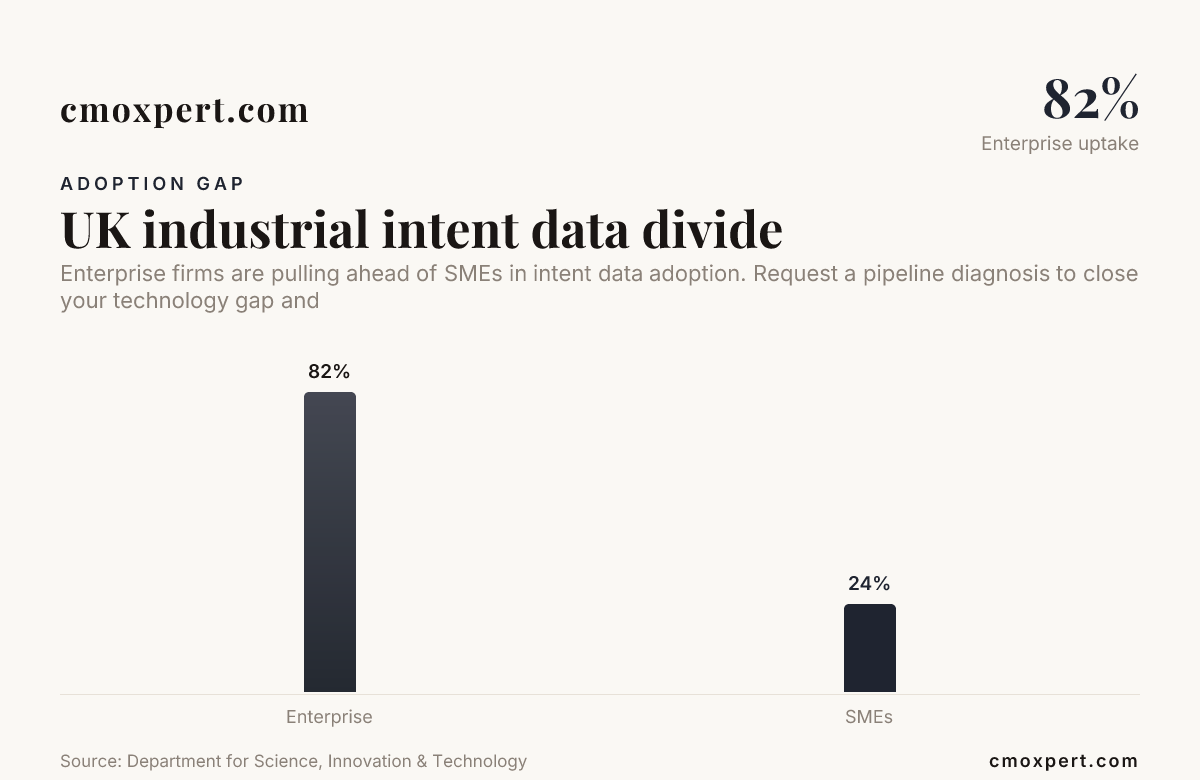
    UK industrial intent data divide — data from Department for Science, Innovation & Technology

    Enterprise firms are pulling ahead of SMEs in intent data adoption. Request a pipeline diagnosis to close your technology gap and stay competitive.

    Pipeline architecture reporting on velocity and cost per acquisition

    The Fully-Loaded Commercial Cost of Getting This Wrong

    The manufacturing sector’s median marketing budget sits at 5.7% of revenue in 2026, a clear pivot toward account-based programmes and AI tooling. Spending that budget on the wrong intent stack does not just waste money, it hands the account to a competitor who reached the specification stage first.

    ABM-led programmes generate 2.6x more pipeline per marketing dollar than broad-reach demand generation, with win rates up 41% over traditional methods. Those numbers only hold if the underlying data feeding the ABM programme is accurate and mapped to the right committee members.

    No vanity metrics. No impressions. No reach reports. If your provider cannot show Pipeline Velocity and Cost Per Acquisition, not Cost Per Click, you are paying for noise.

    We are not the right firm for every manufacturer. We are the right firm for the ones who are serious about winning, and serious enough to request a pipeline diagnosis before spending another pound on unverified intent software.

    Conclusion

    Comparing intent data providers for UK industrial sectors in 2026 is not about picking the platform with the most impressive logo wall. It is about matching signal depth, committee mapping, and implementation cost to the reality of your sales cycle.

    Enterprise platforms like 6sense work for firms with the resource to run them. Multi-source stacks close coverage gaps for everyone else. Neither works without pipeline architecture behind it.

    If this does not describe your business, we are not the right firm for you. If it does, request a pipeline diagnosis before you spend another quarter guessing at intent.

    Frequently Asked Questions

    What are intent data providers for UK industrial sectors, and how do they work in 2026?

    They are platforms and data stacks that track digital research behaviour, such as content consumption and technographic signals, to show which accounts are actively researching your product category. In 2026, the strongest providers combine multiple sources rather than relying on one.

    Is 6sense worth it for a UK industrial manufacturer?

    Only if you have the RevOps resource to manage a three to six month implementation and can justify a starting cost around $35,000 a year. For most mid-sized manufacturers, a fractional pipeline architecture retainer delivers better fully-loaded commercial cost outcomes.

    How much does intent data software cost for industrial companies?

    Enterprise platforms start from roughly $35,000 annually, while multi-source aggregators and fractional retainers can start from around £3,000 a month depending on scope. The right comparison always factors in implementation time and internal resource, not just the licence fee.

    Do I need more than one intent data provider?

    Yes, in most cases. Multi-source strategies improve signal coverage by 20% to 30% compared to single-provider setups, which matters when buying committees average 11.2 stakeholders on larger deals.

    What is the difference between intent data and traditional lead generation?

    Traditional lead generation waits for a form fill or a trade show conversation. Intent data identifies research activity before that contact happens, giving you visibility at the moment of intent rather than the moment of enquiry.

    How long does it take to see results from an intent data platform?

    Enterprise platforms typically need three to six months before producing usable signal. Fractional pipeline architecture retainers integrated with your existing CRM can start generating qualified pipeline data within weeks.

    Should industrial manufacturers request a pipeline diagnosis before buying intent software?

    Yes. A genuine pipeline diagnosis identifies where your sales cycle actually stalls, specification stage, commercial negotiation, or procurement approval, before you spend budget on a platform that may not address the real bottleneck.

  • HNW Mortgage Specialist UK: Why High-Net-Worth Borrowers Need Forensic Case Packaging in 2026

    HNW Mortgage Specialist UK: Why High-Net-Worth Borrowers Need Forensic Case Packaging in 2026

    A HNW mortgage specialist UK is not a luxury add-on for people with complicated money. It is a necessity, and the numbers explain why: under MCOB 1.2.10R, the Financial Conduct Authority defines a high net worth individual as someone with an annual net income of at least £300,000 or net assets of at least £3 million, a threshold that pushes most borrowers straight out of standard high-street affordability models.

    Once you cross that line, your income rarely looks like a payslip. It looks like retained profits, dividends, day rate contracts, overseas earnings, or a mix of all four, and that is exactly where a specialist approach to complex income mortgage UK cases becomes essential rather than optional.

    Your home may be repossessed if you do not keep up repayments on your mortgage. This article is general information for UK readers and does not constitute regulated financial advice.

    High Net Worth Individual | HNW Mortgage Specialist UK: Why High-Net-Worth Borrowers Need Forensic Case Packaging in 202

    Key Takeaways

    Question Short Answer
    Who needs a HNW mortgage specialist UK? Directors, contractors, freelancers, and anyone with income the High Street cannot read from a single payslip.
    Does it replace a mortgage broker? No. It is a specialist form of complex income broking, focused on manual underwriting rather than automated scoring.
    What income counts? Retained profits, day rate contracts, dividends, bonuses, overseas earnings, and multiple income streams combined.
    Is a bigger deposit always required? Not necessarily. Some lenders may consider higher loan-to-value ratios for high-value cases with strong income evidence.
    What about adverse credit or CCJs? Some specialist lenders may still consider applications from borrowers with older complex mortgage cases, including historic CCJs or defaults.
    How long does it take? Specialist HNW cases typically take between 4 and 8 weeks from feasibility check to completion.
    Does the process protect my credit file? A structured pre-application audit is designed to avoid unnecessary hard searches before a lender is confirmed as viable.

    High Net Worth Individual Mortgages: Why You Need a Specialist

    Most brokers fill in forms and wait for a computer to say yes or no. That works fine if your income is one salary, one payslip, one straight line on a spreadsheet.

    It falls apart the moment your income has more than one source. A HNW mortgage specialist UK does not rely on computer-score lending.

    Instead, the case is built manually, argued to a human underwriter, and backed by evidence the automated systems never see. That is the difference between a declined application and an approved one, and it is why our 2026 lender comparison matrix exists: to map which lenders actually read complex income the way it deserves to be read.

    Up to 90% LTV on high-value mortgages — data from Fox Davidson / UK Finance

    HNW specialists may consider large loans with as little as a 10% deposit

    Self-Employed Mortgage UK: How an HNW Mortgage Specialist Reads Retained Profits

    Most lenders see your tax return. We see your retained profits, director’s loans, and growth trajectory.

    A standard self-employed mortgage assessment looks at three years of dividends and averages them down. That penalises exactly the borrowers who reinvest profit into their business rather than draw it out.

    Our approach to self-employed and sole trader mortgages is built around what your accounts actually show, not what a spreadsheet template expects them to show.

    Where trading history is short, some lenders may still consider a case built on one year of accounts and a credible forecast. We cover the mechanics of this in our guide to mortgages with one year of accounts, which is often the first document a specialist reviews before anything else.

    Freelancer mortgage cases sit in the same category. Irregular invoicing, staggered payment terms, and multiple clients are not red flags to a HNW mortgage specialist UK. They are simply data points that need forensic case packaging before an underwriter sees them.

    Blog illustration

    Contractor Mortgage UK: Day Rate, CIS and IR35 Assessments

    The bank said no because your payslip does not reflect your contract value. We use your day rate to say yes.

    A contractor mortgage UK case is assessed on contract value rather than take-home pay. Whether you work inside or outside IR35, the calculation should start from your rate and your renewal history, not from a single month’s drawings.

    We cover the full range of arrangements through our dedicated day rate mortgage assessment, which is built specifically to translate contract terms into a lender-ready income figure.

    A day rate contractor mortgage is not the same product as a standard employed mortgage, and it should never be underwritten as one. Neither should a CIS contractor mortgage, where income arrives after deductions at source and rarely maps cleanly onto a P60.

    Our contractor mortgage specialist service is built around both scenarios, whether your contract sits inside or outside IR35, and whether your income runs through CIS, PAYE umbrella, or a limited company.

    Ltd Company Director Mortgage: Why an HNW Mortgage Specialist UK Looks Beyond Salary

    The High Street sees a low salary and assumes low affordability. We argue the opposite case.

    A Ltd company director mortgage should be built on retained profits, not just the modest salary many directors draw for tax efficiency. Retained profits left inside the business represent real financial strength, and a specialist case should present them that way.

    This is the exact gap our company director retained profits assessment is designed to close, and it is one of the clearest examples of where forensic case packaging changes an outcome.

    Did You Know?
    Certain high-street large-loan desks may apply a 6x income multiple for high-earning professionals, well above the standard 4.5x used by many mainstream lenders.

    For directors who purchase property through their trading entity, our business owner mortgage guidance sets out how lenders treat limited company purchases differently from personal ones, and what evidence an underwriter will expect to see first.

    Multiple Income Sources Mortgage: Complex Income Mortgage UK Cases We Package

    Complex income requires forensic case packaging, direct underwriter engagement, and a bespoke lender strategy. That statement applies most clearly when a borrower has more than one income stream feeding the same application.

    A multiple income sources mortgage might combine a salary, a rental portfolio, a dividend stream, and freelance invoicing all in one case. Automated systems struggle to reconcile four inputs at once, so they default to the lowest, most conservative figure.

    Manual underwriting does not have that limitation. It looks at the full picture and asks whether the combined position supports the loan, which is precisely how genuine complex income mortgage UK cases should be assessed.

    Where a household has one employed partner and one self-employed partner, the same logic applies. Our guidance on dual income mortgages for mixed employed and self-employed couples walks through how lenders blend two very different income structures into a single affordability figure.

    Blog illustration

    Overseas Income, Expat and Foreign National Cases for HNW Borrowers

    High-net-worth borrowers rarely earn in one currency alone. Many hold assets abroad, draw income from overseas businesses, or split their time between the UK and another jurisdiction entirely.

    Our overseas income and foreign currency mortgage service is built around exactly this profile, engaging private banks and specialist lenders who are comfortable underwriting cross-border earnings.

    Expats returning to buy in the UK face a related challenge: a thin or non-existent UK credit footprint. We set out the practical route through this in our expat and foreign national mortgage guidance.

    Foreign nationals living and earning in the UK, meanwhile, often need a lender who will look past a short residency history. Our foreign income mortgage page covers how that income is verified and presented.

    For a fuller breakdown of the documentation lenders expect from non-UK earners, our complete foreign national mortgage guide is worth reading before you approach any lender directly.

    Mortgage With Irregular Income: Credit History and CCJs

    A declined application from a lender who should never have seen your case is not just a disappointment. It is a mark on your file that makes the next attempt harder.

    That risk is highest when income is irregular and the borrower approaches the wrong lender first. A mortgage with irregular income needs pre-application validation before any formal submission goes anywhere near a credit search.

    Historic credit issues compound the problem if they are not framed correctly. Some specialist lenders may still consider applications where older CCJs or defaults sit on file, provided the wider case is strong, and our CCJ and defaults mortgage guidance explains how that evidence-based case is built.

    Did You Know?
    Around 1.8 million fixed-rate mortgages in the UK are due to end in 2026, making this a significant year for HNW borrowers to review their existing lending structure.
    Source: UK Finance

    Interest-Only and Self-Build Mortgages for HNW Borrowers

    Standard interest-only rules assume a straightforward repayment vehicle and a retirement age that fits a mainstream lending model. HNW borrowers often need something more flexible than that.

    Some lenders may consider interest-only structures for suitable borrowers well past the age brackets a high-street lender would apply, provided a credible repayment strategy is in place. Our interest-only mortgage guidance covers how that strategy is assessed.

    Self-build and renovation projects present a different problem entirely: staged funding rather than a single lump sum. Our self-build and renovation mortgage guidance sets out how lenders release funds against build stages rather than a completed valuation alone.

    Blog illustration

    The Logic Check: How an HNW Mortgage Specialist UK Validates Your Case

    We need to validate your data before we argue your case to underwriters. That is not a slogan. It is the actual first step in every case we take on.

    The Logic Check is a structured feasibility assessment, not a rate comparison tool. It exists to answer one question honestly: does your income structure pass lender criteria before you risk a credit search on a lender who was never going to say yes?

    Every case is treated as bespoke, and the next steps are only outlined once that audit is complete. You can run through the process directly via our complex income eligibility audit, which sits ahead of any formal application.

    The High Street does not have the tools to handle this. A HNW mortgage specialist UK does, because the entire model is built around manual review rather than an automated decision engine.

    Conclusion

    Finding the right complex income mortgage advisor is not a minor administrative task. It is the single most decisive factor in whether your application succeeds or fails.

    Your accounts tell a story. We make lenders listen, and that is the core function of a genuine HNW mortgage specialist UK: translating retained profits, day rate contracts, overseas earnings, and multiple income streams into a case an underwriter can actually approve.

    If your income does not fit a standard payslip, treat that as a starting point, not an obstacle. This article is general information and does not constitute regulated financial advice, so speak to a qualified mortgage broker or solicitor about your own circumstances before making any lending decision.

    Frequently Asked Questions

    What counts as an HNW mortgage specialist UK client in 2026?

    Under FCA rules, a high net worth borrower typically has an annual net income of at least £300,000 or net assets of at least £3 million. In practice, a HNW mortgage specialist UK also works with directors, contractors, and multi-income households whose finances simply do not fit a standard payslip model.

    Is a HNW mortgage specialist UK worth it for self-employed borrowers?

    For most self-employed borrowers with retained profits or short trading histories, yes. A specialist self-employed mortgage assessment looks at the whole financial picture rather than an averaged dividend figure from a standard lender.

    Can a contractor mortgage UK be assessed on day rate alone?

    Many lenders working with a HNW mortgage specialist UK will assess a day rate contractor mortgage on contract value and renewal history rather than payslips. This applies to both inside and outside IR35 contracts, and to CIS contractor mortgage cases where income arrives after deductions at source.

    Do HNW mortgage specialists in the UK accept retained profits instead of salary?

    Some lenders working through a specialist route will consider retained profits and director’s loans as evidence of affordability for a Ltd company director mortgage, rather than relying solely on the salary drawn for tax efficiency. This is one of the clearest advantages of manual underwriting over computer-score lending.

    What is the Logic Check and why does it matter before I apply?

    The Logic Check is a feasibility assessment that reviews your income structure before a formal application reaches a lender. It is designed to protect your credit file from unnecessary searches and to confirm which lenders are actually likely to consider a non-standard income mortgage before you commit to one.

    Can I get a mortgage with irregular income and a CCJ on file?

    Some specialist lenders may still consider a mortgage with irregular income where historic CCJs or defaults appear on file, provided the wider case is presented with supporting evidence. This is exactly the kind of complex income mortgage UK scenario that benefits from forensic case packaging rather than a standard high-street application.

    How long does an HNW mortgage specialist UK application take in 2026?

    Specialist cases handled through a HNW mortgage specialist UK typically take between 4 and 8 weeks from the initial feasibility review to completion. Timescales vary depending on the complexity of your income sources and how quickly supporting documentation can be gathered.

    Related guides: HNW Mortgages: Best Options for High Net Worth Borrowers in 2026

  • Expat Mortgages UK How to Buy Property While Living Abroad (2026 Guide for UK Residents)

    Expat Mortgages UK How to Buy Property While Living Abroad (2026 Guide for UK Residents)

    Buying property in the UK while living abroad presents unique challenges, but expat mortgages while living overseas have become increasingly accessible. This comprehensive guide explains how UK residents abroad can navigate the mortgage process and secure financing for their next property purchase.

    Expat mortgage applicants often face a different set of hurdles to lenders, and research suggests the average annual income for British expatriates applying for UK mortgages is £101,141, significantly higher than the UK domestic average. In Expat Mortgages UK How to Buy Property While Living Abroad, understanding how affordability checks, income evidence, and UK credit links work (especially for contractors, freelancers, and complex income) can make the process feel far more manageable.

    Blog illustration

    Key Takeaways

    What to focus on Why it matters
    Income evidence for a complex income mortgage UK Lenders may look at consistency, not just recent payslips or bank balances.
    Mortgage readiness before you house-hunt It helps you understand what lenders may consider for your situation, including affordability and deposits.
    Expats and overseas income Some lenders require extra checks when income is received outside the UK.
    UK credit history and addresses Where possible, maintaining UK credit links can reduce concerns for some applications.
    Paperwork for self-employed mortgage and contractors Lenders may consider accounts, tax evidence, and trading history, which can be more involved while abroad.
    Specialist support for non-standard income mortgage It is possible you may need manual underwriting rather than a simple automated route.

    Why buying a home from abroad can feel harder (and what lenders may consider in 2026)

    When you are living outside the UK, you still need a mortgage that meets lender affordability rules, but the evidence trail can change. In Expat Mortgages UK How to Buy Property While Living Abroad, we regularly see that lenders may want extra confirmation of income source, stability, and how you will manage repayments from abroad.

    Lenders may consider the type of income you earn and how it is evidenced. For example, a contractor mortgage UK application often needs consistent contractor history, while a freelancer mortgage application may rely on trading accounts and tax records. For higher complexity, a complex income mortgage UK case can require a more detailed review than standard “one size fits all” underwriting.

    We also find that “where you are resident” can affect how quickly you can supply documents and how lenders verify them. That does not mean expats are excluded, but it does mean planning matters. It is possible that some lenders may also look for signals of UK ties, such as a stable UK address history, UK bank activity, or other documented links, depending on the mortgage type.

    General information only: the criteria vary between lenders and depend on your circumstances. We cannot say what any lender will accept in advance.

    Getting mortgage-ready as an expat: income, deposits, and proof of affordability

    The most practical starting point in Expat Mortgages UK How to Buy Property While Living Abroad is to build a “lender-ready” file. Lenders may consider your affordability based on verified income and expenditure, and they may also look at your deposit and how it was sourced.

    For many UK buyers abroad, the deposit is not the only issue. The bigger challenge can be income evidence. A self-employed mortgage or contractor mortgage UK often needs careful document preparation, particularly if you are earning from multiple or irregular income streams, such as day work plus occasional contracts.

    It is possible that lenders may ask for things like:

    • Proof of income (for example, invoices, statements, payslips where relevant).
    • Account-based evidence, such as management accounts or tax records, for a non-standard income mortgage.
    • Bank statements that show income regularly received and how you manage payments.
    • Details of how you will repay the mortgage while abroad.

    If you are a contractor, a day rate contractor mortgage case may be assessed with reference to trading history and the reliability of income. If you are a CIS contractor mortgage applicant, lenders may also want clarity around how CIS deductions are reflected and evidenced.

    Important: Your home may be repossessed if you do not keep up repayments on your mortgage.

    Did You Know?
    As of early 2026, roughly 51.1% of expat mortgage applications are for residential use, while 48.9% are for buy-to-let (BTL) investments.

    Blog illustration

    Complex income and overseas life: contractors, freelancers, and multiple income sources

    In Expat Mortgages UK How to Buy Property While Living Abroad, many applicants are not “simple employed income” cases. We work with people who have multiple income sources mortgage situations, including mixed PAYE and self-employment, or switching between short-term contracts while living abroad.

    If you are a freelancer mortgage applicant, lenders may consider consistency over time. That means we often recommend presenting income evidence in a way that helps a lender understand trading patterns, not just snapshots.

    If you are a contractor, a contractor mortgage UK application can be supported with clear evidence of contract continuity. Some lenders may look at how your day rates translate into sustainable affordability, especially if your workload changes month to month.

    We commonly signpost specialist pages that match these profiles, including:

    Non-standard income and expat underwriting: how self-employed and company directors may be assessed

    If your income includes retained profits or dividends, your application can require a more detailed approach. In Expat Mortgages UK How to Buy Property While Living Abroad, directors and business owners may find that some lenders treat these cases as more complex, particularly when you are not physically present in the UK.

    For a Ltd company director mortgage, lenders may consider how you pay yourself and whether there is sufficient evidence to assess your income. If you are also drawing from retained profits, this can add complexity, and it is possible that lenders may ask for more detailed accounts evidence.

    If you are self-employed, a self-employed mortgage may require a structured set of documents. Some lenders may look at longer trading history, while others may consider alternative evidence depending on the case.

    Where it helps, we direct clients to specialist resources that align with these situations, including:

    For directors who only have limited UK credit activity while living abroad, it is possible that extra verification steps could be requested. Preparing the file early can reduce delays.

    Foreign income, foreign nationals, and building a UK credit picture from abroad

    Some expats have limited UK credit history, or their UK credit file may not reflect their current income. A recurring concern in Expat Mortgages UK How to Buy Property While Living Abroad is whether lenders may treat overseas circumstances differently and whether there is enough UK-based information to assess affordability.

    Research in 2026 has suggested that around 22% of overseas mortgage applicants cite a lack of UK credit history as a primary concern for rejection. While this does not mean every application fails, it highlights the importance of planning and evidence preparation when you live abroad.

    Depending on the lender and the mortgage type, it is possible you may be asked to demonstrate:

    • How your income is received and evidenced while overseas.
    • Links to the UK, such as documented address history.
    • Consistency of payments and ability to maintain repayment arrangements.

    If you have foreign income, or your situation includes residency outside the UK, we often review options via our guidance on:

    Note: We cannot guarantee outcomes. Lenders may consider your application differently based on how your income is evidenced and the details of your circumstances.

    Did You Know?
    The number of UK properties owned by individuals with an overseas correspondence address has reached approximately 202,568 across England and Wales.
    Source: Property118

    Planning the application timeline from outside the UK, including legal and survey steps

    Even with a strong income profile, expat purchases can be delayed if paperwork needs signatures and documents do not reach the right parties quickly. When you plan Expat Mortgages UK How to Buy Property While Living Abroad, we suggest treating the timeline as a project with clear owners.

    Typical stages include:

    1. Mortgage assessment, where lenders may consider affordability and evidence.
    2. Application submission, including income, identity, and deposit checks.
    3. Survey and valuation, which may require access arrangements.
    4. Legal conveyancing, including contract review and exchange.
    5. Completion, where you make sure funds and instructions are in place.

    Some lenders may also have their own turnaround times for document verification. If you are juggling UK house-viewing trips with overseas travel, it can help to line up a UK solicitor early and agree how you will provide signatures remotely where permitted.

    If you are exploring different product types, you may also want to consider how repayment strategies affect affordability. For instance, interest-only arrangements can change how lenders assess the overall risk, so you may want specialist guidance via interest-only mortgage options.

    Example: budgeting for an expat purchase with complex income

    Imagine a UK-based contractor living abroad with mixed earnings and occasional gaps between contracts. In 2026, it is common for lenders to focus on verified income patterns rather than optimistic projections, so we would typically encourage an evidence-based view before you proceed to the valuation stage.

    We would also help you plan for additional costs, such as survey fees, solicitor fees, and any needed documentation translations or confirmations, depending on your circumstances.

    Blog illustration

    Expats choosing the right mortgage route: residential, buy-to-let, and specialist case types

    Not all expat borrowing is the same. Some people buy to live in the UK again later, while others purchase as a long-term investment. In Expat Mortgages UK How to Buy Property While Living Abroad, lenders may treat residential and investment lending differently, and not every lender offers the full range of options.

    If your income is split between two people, or you have mixed income profiles within the household, your case can become a dual-income households scenario. It is possible lenders may still consider it positively, but they may want evidence that aligns with each applicant’s income type.

    For multi-person, multi-income situations, we often review scenarios like dual-income households alongside guidance on complex underwriting.

    If you have a wider range of issues, such as non-standard income, overseas residence, or other complexities, you may want a route that supports manual review. Our materials on complex cases and complex income mortgage solutions are designed to help you understand what “complex” often means in practice.

    We also use structured checks to avoid misunderstandings early in the process. For example, you can review the mortgage logic check approach when you want to stress-test your situation before submitting an application.

    Using lender comparisons and eligibility checks without over-applying

    When you are living abroad, delays can be frustrating, but repeated applications can still cause problems. In Expat Mortgages UK How to Buy Property While Living Abroad, we aim to improve the quality of your submission rather than encourage unnecessary reapplications.

    To support this, we often start with a clearer assessment of fit. Our lender comparison matrix can help you understand the landscape lenders use for different income types and case complexities.

    For those with a shorter evidence runway, or specific account circumstances, you may also want to review specialist guidance on one-year accounts mortgages. Some lenders may consider evidence on a different basis depending on how your business has traded, but it is still important to provide verified documentation.

    For any case involving overseas residence, foreign income, or foreign nationality considerations, it is also possible you may need guidance aligned to your exact situation. That is why we review options through our expat-focused landing pages such as UK mortgages for expats and foreign nationals and mortgages with foreign income.

    If you are building or renovating while living abroad

    Some expats do not buy an existing property, they buy land or renovate a property to make it habitable. If your plan includes self-build or significant renovation, mortgage criteria can differ from standard purchases.

    It is possible that a self-build or renovation route may require additional information on build stages, contractors, and how the project is funded. If this is your plan in 2026, review self-build and renovation mortgages and make sure your evidence pack is aligned early.

    If your income profile also sits in a complex bracket, it can become a combined case of non-standard income mortgage plus project finance style underwriting, so careful preparation becomes even more important.

    Blog illustration

    Important FCA-aware reminders (not regulated advice)

    This article is general information for UK readers and does not constitute regulated financial advice. Mortgage lending decisions depend on your circumstances and the lender’s criteria at the time of application.

    Your home may be repossessed if you do not keep up repayments on your mortgage.

    For official guidance about affordability and consumer protections, you can also refer to the Financial Conduct Authority (FCA) and for tax and income-related support, you can refer to HM Revenue and Customs (HMRC).

    Quick note on statistics and market context in 2026

    Mortgage rates and lender policies can change. Even if numbers in 2026 look reassuring, lenders may still focus on your verified affordability and evidence. We cannot predict the outcome of your application.

    Expat Mortgages UK How to Buy Property While Living Abroad: 5-step process infographic.

    Five-step visual guide to buying UK property as an expat. From mortgage readiness to completion, this infographic summarizes the essential steps.

    Conclusion: Expat Mortgages UK How to Buy Property While Living Abroad with clarity

    Expat Mortgages UK How to Buy Property While Living Abroad can be achievable, but it is rarely “plug and play” for contractors, freelancers, sole traders, and Ltd company directors with multiple or irregular income. Lenders may consider your evidence quality, your affordability, and how you will manage repayments while living outside the UK.

    If your income sits in a complex income mortgage UK category, or it is a non-standard income mortgage involving a self-employed mortgage, contractor mortgage UK, or a Ltd company director mortgage, we suggest treating preparation as part of the process. With careful documentation, realistic timelines, and specialist case review (including complex and overseas scenarios), you can reduce uncertainty and focus on a route that fits your situation in 2026.

    Frequently Asked Questions

    Can I get an Expat Mortgages UK How to Buy Property While Living Abroad mortgage if I have no UK employment?

    It is possible, but lenders may consider verified income evidence rather than UK employment alone. In Expat Mortgages UK How to Buy Property While Living Abroad situations, you may need to show overseas income and demonstrate affordability clearly.

    How do lenders assess a complex income mortgage UK case when I am abroad?

    Lenders may consider consistency, evidence type, and how your income is calculated, especially for mortgage with irregular income and multiple income sources mortgage cases. For Expat Mortgages UK How to Buy Property While Living Abroad applicants, manual underwriting can be relevant where criteria vary.

    What documents are usually needed for a self-employed mortgage when buying in the UK from overseas?

    Commonly, lenders may ask for accounts, tax evidence, bank statements, and details that show income continuity. For Expat Mortgages UK How to Buy Property While Living Abroad applications, you may also be asked to confirm how repayments will be managed while you are abroad.

    Is a CIS contractor mortgage possible under Expat Mortgages UK How to Buy Property While Living Abroad?

    Some lenders may consider CIS arrangements when the income can be evidenced and affordability can be supported. In Expat Mortgages UK How to Buy Property While Living Abroad cases, preparation of contract history and clear documentation can be important.

    Do I need UK credit history for an overseas expat mortgage?

    Not every lender will treat this the same way, but around 22% of overseas applicants have cited a lack of UK credit history as a key concern for rejection in 2026 reporting. For Expat Mortgages UK How to Buy Property While Living Abroad, it can help to maintain or rebuild UK credit links where possible.

    Can a day rate contractor mortgage be approved while I live outside the UK?

    It is possible that some lenders will consider day rate contractor mortgage applications if your income evidence supports stability and affordability. In Expat Mortgages UK How to Buy Property While Living Abroad scenarios, delays can happen if documents are slow to reach the UK, so early preparation matters.

  • Shared Ownership for Self-Employed Contractors: A 2026 Guide to Applying with Complex Income

    Shared Ownership for Self-Employed Contractors: A 2026 Guide to Applying with Complex Income

    Self-employed contractors face unique hurdles when pursuing shared ownership self-employed schemes, particularly when demonstrating variable income to lenders. This 2026 guide navigates the complexities of applications for those with non-traditional earnings patterns.

    Shared ownership for self-employed contractors is often dismissed by the High Street before a human being has even looked at the file. Yet the average deposit for a shared ownership property sits at just £22,200, a figure that makes the scheme genuinely accessible for contractors who have been told their day rate, retained profits, or multiple income streams make them “too complicated” to lend to.

    This guide sets out how shared ownership works for contractors, Ltd company directors, freelancers, and sole traders with non-standard income. It is general information, not personal financial advice, and is written for a UK audience considering their own affordability position with a qualified mortgage broker.

    Your home may be repossessed if you do not keep up repayments on your mortgage or any home loan secured against it.

    Shared ownership for self-employed contractors

    Key Takeaways

    Question Answer
    Can contractors get shared ownership mortgages? Yes, in principle. Some lenders assess day rate income, retained profits, or CIS earnings when reviewing a contractor mortgage application for shared ownership.
    What deposit is typically needed? Deposits for shared ownership tend to be lower than for open-market purchases, often calculated against the share being bought rather than the full property value.
    Do Ltd company directors qualify? Some lenders will consider retained profits and director’s loans, not just salary and dividends. See our company director mortgage guidance.
    How is contractor income assessed? Lenders vary. Some use day rate multiples, others require full accounts. A feasibility assessment can help identify which approach suits your case.
    What if I only have one year of accounts? Some lenders will still consider applications based on a single year of trading, particularly where projections are supported by an accountant. Read more on mortgages with one year of accounts.
    Can I use foreign or overseas income? Some specialist lenders factor in overseas income as part of a wider affordability picture.
    What about staircasing later on? Staircasing (buying further shares over time) is a long-term consideration and affordability may need reassessing as income changes.

    What Is Shared Ownership and Why It Suits Contractors With Irregular Income?

    Shared ownership allows a buyer to purchase a percentage of a property, typically between 25% and 75%, and pay rent on the remaining share to a housing association.

    For contractors, freelancers, and sole traders, this structure can lower the entry barrier. A mortgage with irregular income does not need to stretch across the full property value, only the share being purchased.

    According to Ministry of Housing, Communities & Local Government data, the average initial equity stake bought in England was 38%. That is a meaningfully smaller mortgage than a full open-market purchase, which matters when a lender is trying to model a fluctuating day rate against a 25-year term.

    Nearly half of all shared ownership purchases (46%) were made by single adult households. That statistic matters for contractors and freelancers applying alone, on a single income stream, without a second applicant’s salary to lean on.

    How Lenders Assess Contractor Mortgage UK Applications for Shared Ownership

    Most lenders start with a payslip. Contractors do not have payslips. They have day rates, contracts, and retained profits sitting inside a limited company.

    The High Street does not have the tools to handle this. Most brokers fill in forms and wait for a computer to say yes or no, and a computer-score system built around PAYE income will often struggle to interpret a contractor mortgage UK application correctly.

    This is where manual underwriting becomes relevant. Specialist lenders on our panel will look at:

    • Day rate multiplied by contracted days per year
    • Retained profits within a limited company, not just drawn salary
    • Contract history and renewal patterns
    • IR35 status, inside or outside
    • Multiple income sources, including CIS earnings or freelance invoices

    Your accounts tell a story. We make lenders listen, using forensic case packaging that presents contractor income in a format underwriters can actually assess rather than reject on sight.

    Who actually uses shared ownership? — data from Ministry of Housing, Communities & Local Government

    A ranked comparison of shared ownership purchasers in England, highlighting its role across different household types.

    Blog illustration

    The Logic Check: A Feasibility Assessment Before You Apply

    We need to validate your data before we argue your case to underwriters. That is the entire purpose of the Logic Check.

    The Logic Check is a structured feasibility assessment, not a rate comparison tool. It looks at your day rate, your retained profits, your contract length, and any secondary income, and produces a realistic picture of where shared ownership for self-employed contractors might be achievable, and where it might not.

    A declined application from a lender who should never have seen your case is not just a disappointment. It is a mark on your file that makes the next attempt harder, which is why credit file protection sits at the centre of our pre-application process rather than as an afterthought.

    Ltd Company Director Mortgage Applications: Using Retained Profits

    Most lenders see your tax return. We see your retained profits, director’s loans, and growth trajectory.

    For a Ltd company director mortgage application towards shared ownership, this distinction is significant. Many company directors deliberately keep profit inside the business for tax efficiency, which then makes their personal income look smaller on paper than the business is actually generating.

    The bank said no because of your tax efficiency. We use your Retained Profits and Day Rate to say yes, connecting directors with lenders who understand that a modest salary and dividend combination does not reflect the full financial picture of a growing limited company.

    Business owners considering a shared ownership purchase through a limited company structure may also want to review our guidance on business owner mortgages, which covers how retained profit is modelled differently to standard PAYE affordability.

    Did You Know?
    The average monthly outgoing for a 40% equity share is £745, compared with £1,086 for a typical open-market mortgage payment.

    CIS Contractors, Day Rate Contractors and Freelancers: What Documentation Is Needed?

    A CIS contractor mortgage application looks different to a day rate contractor mortgage application, and both look different again to a freelancer mortgage case built on invoices and mixed clients.

    Complex income requires forensic case packaging, direct underwriter engagement, and a bespoke lender strategy. There is no single template that fits a CIS subcontractor, an outside-IR35 day rate consultant, and a freelance graphic designer with six clients.

    Typical documentation requested across these profiles includes:

    1. SA302s and tax year overviews (usually two to three years, though one year may be considered by some lenders)
    2. Business bank statements showing income consistency
    3. Contract copies for day rate contractors, including IR35 status
    4. Accountant’s reference or projection letter
    5. CIS payment and deduction statements, where relevant

    Readers on an outside-IR35 contract may find it useful to review our dedicated contractor mortgage resource, which sets out how day rate income is typically annualised by specialist lenders.

    Blog illustration

    Multiple Income Sources and Mortgages With Irregular Income

    Many contractors do not rely on one income stream. A day rate contract might sit alongside rental income, a small consultancy sideline, or a partner’s PAYE salary.

    A multiple income sources mortgage application needs every stream evidenced separately, then combined into a single affordability picture. This is precisely the kind of case that computer-score lending declines 40% of viable borrowers on, simply because the system cannot process more than one income box at a time.

    Dual-income households, where one partner is employed and the other self-employed or contracting, face a related challenge. Our page on dual income households explains how lenders blend employed and self-employed income for joint shared ownership applications.

    Households with overseas earnings, expat status, or income paid in a foreign currency add a further layer. Some lenders will consider foreign income or expat applicants for UK shared ownership, though eligibility depends heavily on residency status and currency risk.

    Deposits, Affordability and Staircasing for Shared Ownership

    The average deposit for shared ownership in England was £22,200 in the 2024-25 period, a figure well below what most open-market first-time buyers put down.

    That said, affordability for a non-standard income mortgage is never just about the deposit. Lenders still need to be satisfied that ongoing rent to the housing association, service charges, and the mortgage payment together sit within a sustainable percentage of income.

    Staircasing, the process of buying further shares in the property over time, is worth planning for early. A contractor whose day rate has grown since the original purchase may find staircasing more straightforward than one whose income has become less predictable, so revisiting your self-employed mortgage position periodically is sensible practice rather than an afterthought.

    When the High Street Says No: CCJs, One-Year Accounts and Complex Cases

    The High Street Says “Retire”. We Say “Refinance.” The same pattern shows up whenever an application falls slightly outside a standard box, whether that is a past CCJ, a single year of trading accounts, or income drawn from more than one country.

    A CCJ or default does not automatically end a shared ownership application. Some specialist lenders on our panel will look at mortgages with CCJs and defaults where the circumstances and repayment history support a manual underwriting decision.

    Contractors with only one year of trading behind them are not automatically excluded either. Our guide to the one year accounts mortgage route explains how first-year net profit combined with an accountant’s second-year projection can sometimes be enough.

    Borrowers approaching retirement age, or considering an interest-only structure alongside a shared ownership purchase, may also want to review our page on interest-only mortgages, alongside independent guidance from a regulated mortgage broker.

    Did You Know?
    38% is the average initial equity stake buyers obtained through shared ownership in England during 2024-25.

    Blog illustration

    Comparing Lenders: Why a Lender Comparison Matrix Matters for Complex Income

    Not every lender assesses contractor income the same way. One might annualise a day rate at 46 weeks, another at 48. One might accept retained profits, another might insist on dividends drawn.

    Finding the right complex income mortgage advisor is not a minor administrative task. It is the single most decisive factor in whether your application succeeds or fails.

    Our lender comparison matrix sets out how different lenders across the market treat complex income mortgage UK cases, from day rate contractors to Ltd company directors, so a bespoke lender strategy can be built around your specific circumstances rather than a generic checklist.

    For borrowers whose complexity extends beyond income, perhaps a self-build project, a foreign national visa status, or a case that simply does not fit any standard category, our complex cases and complex income pages set out the wider lender landscape, alongside our foreign national mortgage advice and self-build mortgage guidance where relevant.

    Conclusion: Is Shared Ownership Worth Considering for Self-Employed Contractors?

    Shared ownership for self-employed contractors is not a shortcut and it is not automatic. It is, however, a genuinely lower-deposit route onto the property ladder that some specialist lenders are prepared to assess on manual underwriting rather than an automated score.

    Complex income requires forensic case packaging, direct underwriter engagement, and a bespoke lender strategy, whether you are a day rate contractor, a Ltd company director drawing modest dividends, or a freelancer juggling several clients. None of this is guidance to act on alone. Speak to a regulated mortgage broker before making any decision, and remember that your home may be repossessed if you do not keep up repayments on your mortgage.

    Frequently Asked Questions

    Is shared ownership worth it for self-employed contractors in 2026?

    It can be, particularly where a lower deposit and reduced monthly outgoing make the property ladder more accessible than an open-market purchase. Whether it suits your circumstances depends on your income stability, deposit, and long-term plans, so speak to a mortgage broker before applying.

    Can Ltd company directors use retained profits for a shared ownership mortgage?

    Some specialist lenders will consider retained profits alongside salary and dividends when assessing a Ltd company director mortgage application. Not every lender takes this approach, which is why lender selection matters as much as the application itself.

    Do I need two years of accounts for a contractor mortgage UK application?

    Many lenders prefer two to three years of accounts, though some will consider applicants with just one year of trading if supported by an accountant’s projection. This is covered in more detail in our one-year accounts mortgage guidance.

    How does IR35 status affect a shared ownership application?

    IR35 status can influence how a lender views the stability and structure of your income, whether you are inside or outside IR35. Specialist lenders tend to look at contract history and day rate alongside IR35 status rather than treating it as an automatic barrier.

    Can CIS contractors apply for shared ownership?

    Yes, a CIS contractor mortgage application for shared ownership is possible with some lenders, though CIS payment and deduction statements are typically required as supporting evidence. Income consistency across recent tax years tends to carry significant weight.

    What if my mortgage application has already been declined once?

    A previous decline does not automatically rule out shared ownership, but it does make careful lender selection more important the second time around. A feasibility assessment before reapplying can help identify whether the original lender was ever a realistic fit for your income profile.

    Can I combine foreign income with UK shared ownership?

    Some specialist lenders will factor in foreign or overseas income as part of a wider affordability assessment for UK shared ownership. Currency risk, residency status, and income consistency are all likely to be considered, so specialist advice is recommended before proceeding.

    Related guides: Mortgage options for contractors · CIS contractor mortgage guide

  • How to Prove Affordability Using Your Business Bank Statements

    How to Prove Affordability Using Your Business Bank Statements

    If you are self-employed, a contractor, or running your own limited company, knowing how to prove affordability using your business bank statements could be the difference between a successful mortgage application and an unnecessary rejection. Research suggests that around 24% of self-employed mortgage applicants experienced at least one rejection in 2025, yet the majority of those applicants had perfectly sound finances that simply were not being read correctly by automated lender systems.

    Blog illustration

    Key Takeaways

    • Business bank statements are one of the most powerful tools you can use to demonstrate genuine affordability to specialist lenders, particularly if you have a complex income mortgage UK situation.
    • High street lenders often rely on automated checks that cannot interpret self-employed income accurately. Specialist lenders use manual underwriting instead.
    • Contractors, freelancers, and Ltd company directors each have slightly different evidence requirements, but bank statements are central to all of them.
    • Lenders typically want 3 to 24 months of statements, depending on income type and the complexity of your case.
    • Preparation is critical: clean, well-explained statements can significantly improve how a lender views your affordability, particularly for a mortgage with irregular income.
    • A specialist mortgage broker can present your statements in a lender-friendly format, framing your income story effectively before submission.
    • Your IR35 status, contract length, and income structure all influence which lender is most appropriate for your circumstances.

    Why Business Bank Statements Matter for a Self-Employed Mortgage

    When you apply for a self-employed mortgage, lenders need to understand how money actually flows through your business. Tax returns and accounts tell part of the story, but business bank statements provide real-time, unfiltered evidence of income regularity, business health, and financial management.

    Many high street lenders apply blanket rules that can undervalue a contractor or director’s actual earnings by 50% or more. Specialist lenders who serve the non-standard income mortgage market take a different view, using manual underwriting to interpret what your statements genuinely show.

    For those with a freelancer mortgage application or a contractor mortgage UK case, statements showing consistent client payments, manageable outgoings, and clear business income patterns can carry considerable weight. This is particularly relevant in 2026, as more lenders are developing criteria specifically for people with non-PAYE income structures.

    Blog illustration

    What Lenders Look For When Proving Affordability Using Your Business Bank Statements

    Understanding what lenders are looking for helps you present your statements in the clearest possible way. Different lenders apply different criteria, but there are common themes across the complex income mortgage UK market.

    Income Consistency and Regularity

    Lenders may consider how consistently income arrives in your account. For a day rate contractor mortgage, they will often look for regular payments from one or more clients that align with your quoted day rate and working pattern.

    Gaps in income are not automatically disqualifying, but lenders will typically want to understand why they occurred. A brief gap between contracts, for example, is common in contracting and can be explained with supporting context.

    Business Income vs. Personal Drawings

    For a Ltd company director mortgage, lenders often need to see both business and personal bank statements. They may look at salary payments made from the business account to the personal account alongside any dividend distributions.

    Some specialist lenders will also consider retained profits within the business as part of the affordability calculation, rather than limiting their view to drawn income alone. This can substantially increase the borrowing potential for directors who choose to leave profits in the company.

    Business Expenses and Outgoings

    Lenders may examine your regular business outgoings to assess the net position. High, unexplained expenses or erratic outgoings can raise questions. Clean, well-categorised business accounts tend to present more favourably.

    VAT Receipts and Client Payment Patterns

    For a freelancer mortgage or CIS contractor mortgage, VAT receipts appearing in business statements can confirm the authenticity and scale of income. Regular client payment cycles also help demonstrate that income is sustainable, not sporadic.

    Did You Know?
    79% of self-employed individuals have never missed a payment on their financial commitments, despite being viewed as higher risk by some lenders.

    Blog illustration

    How to Prove Affordability Using Your Business Bank Statements: A Step-by-Step Guide

    Following a clear process when preparing your statements can help ensure lenders receive a coherent and complete picture of your finances. The steps below reflect what specialist brokers working in the complex income mortgage UK space typically recommend.


    Infographic detailing a 5-step process to prove affordability using your business bank statements.

    A visual guide outlining a simple five-step method to prove affordability using your business bank statements.

    Step 1: Gather the Right Number of Months

    Lenders vary in how many months of statements they require. Some may ask for 3 months, while others involved in non-standard income mortgage assessments may want 12 to 24 months to assess income trends across different trading periods.

    If your business is relatively new, reading our guide on lenders who work with newer businesses may help identify which lenders are likely to accept a shorter statement history.

    Step 2: Ensure Statements Are Complete and Unaltered

    Lenders require full, official statements, either downloaded directly from your bank or provided as originals. Edited PDFs or incomplete pages are likely to cause delays or trigger additional queries.

    This applies equally to a freelancer mortgage application as it does to a Ltd company director mortgage submission.

    Step 3: Reconcile Your Statements With Your Accounts

    Lenders may cross-reference your bank statements with your SA302s, tax year overviews, or company accounts. Any significant discrepancies may raise questions, so having a clear explanation ready is useful.

    For directors, your statements should align with the salary and dividend figures shown in your dividend and director income records. Any retained profits not drawn as salary or dividends may also need to be addressed separately.

    Step 4: Prepare a Supporting Narrative

    Business bank statements rarely tell the full story on their own. A brief written explanation, prepared with your broker or accountant, can help lenders understand seasonal variation, income gaps, or unusual transactions.

    This is especially relevant for those applying for a mortgage with irregular income or those whose income comes from multiple income sources. A letter from your accountant with income projections can complement your statements effectively.

    Step 5: Submit Through a Specialist Broker

    A specialist broker with experience in complex income mortgage UK cases will know which lenders are likely to view your statements most favourably. They can package your case before it reaches an underwriter, which may reduce the risk of an unnecessary decline.

    If you have previously been turned down by a high street bank, it is worth reading about why mainstream banks often reject self-employed applicants before reapplying elsewhere.

    Proving Affordability for Different Types of Complex Income

    The way you prove affordability using your business bank statements will differ depending on your income structure. Below, we outline the most common scenarios we encounter in the complex income mortgage UK market.

    Contractor Mortgage UK: Day Rate Income

    For a day rate contractor mortgage, some lenders will annualise your contract rate rather than relying on drawn income. A contractor earning £500 per day, for example, may have their income assessed on an annualised basis using a methodology such as the 46-week contractor multiplier, which reflects realistic working patterns.

    Business bank statements serve as supporting evidence that payments are arriving in line with the contract rate quoted. They also help confirm that there are no extended periods of non-activity that might otherwise concern a lender.

    For IT professionals specifically, our guidance on IT contractors with rolling contracts and freelance IT consultant mortgages covers how lenders interpret short-term and rolling arrangements.

    CIS Contractor Mortgage

    A CIS contractor mortgage presents its own challenges. Construction Industry Scheme workers often have income reported via CIS vouchers rather than traditional payslips, meaning bank statements play a particularly important role in confirming the regularity and volume of income received.

    Lenders sympathetic to CIS workers will typically look for consistent weekly or fortnightly credits alongside CIS deduction statements. Some lenders allow gross income (before CIS deductions) to be used for affordability purposes, which can significantly increase borrowing capacity.

    Ltd Company Director Mortgage

    For a Ltd company director mortgage, bank statements from both the business and personal accounts are usually required. Lenders need to see how salary and dividends flow from the company to the director, and specialist lenders may also consider net profit plus salary as a combined affordability figure.

    Some lenders will look at overall company performance rather than just drawn income. Understanding which lenders consider director dividends most favourably can help direct your application to the right place from the outset.

    Multiple Income Sources Mortgage

    Those applying for a multiple income sources mortgage face the additional challenge of presenting income from several streams in a coherent way. This might include a combination of PAYE employment, self-employed income, rental income, and contract work.

    Business bank statements help lenders trace each income stream separately, making it easier for underwriters to assess each component’s reliability. A lender comparison matrix can be useful in identifying which providers are experienced with multi-stream income cases.

    Umbrella Company Contractors

    Workers paid through umbrella companies occupy an interesting position. They receive payslips, but their actual income depends on contract value and hours worked. Bank statements showing consistent net pay from the umbrella, alongside the underlying contract details, help lenders build a picture of sustainable earnings.

    Our dedicated resource on umbrella company contractor mortgages covers how lenders treat this income type in 2026.

    Blog illustration

    Specific Situations Where Bank Statements Play a Critical Role

    Applying With One Year of Accounts

    If you have only been trading for one year, business bank statements become even more important as they may be the primary evidence of recent income. Some lenders will consider mortgage applications with just one year of accounts, particularly when bank statements demonstrate a strong and consistent trading pattern.

    Short-Term Contract Workers

    Lenders considering applicants on short-term contracts will often scrutinise bank statements carefully for evidence of gaps. Those with a track record of securing new contracts promptly, visible in the continuity of income credits on their statements, tend to be viewed more positively. Our page on lenders who accept short-term contracts provides further detail on relevant criteria.

    IR35 Status and Its Impact

    The way income reaches your business account can be affected by your IR35 status. Inside IR35 contractors typically receive income net of tax via their agency or end client, while outside IR35 contractors may invoice directly. This distinction affects how statements read to lenders, and understanding how IR35 status impacts your mortgage application is important before approaching lenders.

    Industry Experience as Supporting Evidence

    Some lenders factor in your length of experience in a given sector when assessing a contractor mortgage UK application. A contractor with 15 years in their field, for example, may be viewed as carrying lower income risk than someone newly self-employed. This is sometimes referred to as industry experience within mortgage criteria and can complement your bank statement evidence.

    Did You Know?
    24% of self-employed mortgage applicants reported experiencing at least one rejection in 2025, a significant improvement from 45% the previous year, yet still highlighting the gap that well-prepared bank statement evidence can help close.

    Common Mistakes That Weaken Your Affordability Case

    Even with strong income, certain patterns in business bank statements can raise unnecessary concerns with lenders. Being aware of these in advance allows you to address them proactively.

    • Large, unexplained credits: Lenders may question one-off deposits that are not obviously linked to business income. Being prepared to explain these (for example, a loan repayment, asset sale, or inter-account transfer) prevents delays.
    • Mixing personal and business expenses: Regular personal spending through a business account can muddy the affordability picture. Separating business and personal accounts well before application is advisable.
    • Inconsistent account naming: Statements should be in the name of the business or sole trader as it appears in your application. Discrepancies can cause queries.
    • Missing months in a statement sequence: Providing statements with gaps, even accidental ones, can trigger requests for further evidence and delay the process.
    • Declining balances over the period reviewed: A consistent downward trend in business account balances may concern lenders about the sustainability of your income. Where this reflects deliberate capital withdrawal or seasonal patterns, a supporting letter from your accountant can help.
    • Not disclosing all accounts: Lenders may ask for statements from all business accounts. Providing only your main account while omitting a secondary trading account can create inconsistencies.

    Blog illustration

    How to Prove Affordability Using Your Business Bank Statements With Professional Support

    Working with a specialist broker makes a meaningful difference to how your bank statements are presented and interpreted. A broker experienced in self-employed mortgage and complex income mortgage UK cases will know how to package your evidence in a way that suits specific lenders’ underwriting approaches.

    This is not simply about submitting documents. It involves understanding which lenders are likely to assess your income type most accurately, knowing how to frame your narrative, and selecting the right product at the right time.

    For professionals working in IT contracting and related fields, our resource on complex IT contractor pay structures and top mortgage options for professional contractors outlines lender preferences in that specific sector.

    If you are a director considering your options, reading about how to choose a specialist director mortgage broker provides practical guidance on what to look for in an adviser.

    Understanding How Your Day Rate Translates to Borrowing Power

    One of the most useful steps a contractor can take before applying is to understand how lenders will interpret their day rate. Our day rate mortgage calculator helps illustrate how an annualised day rate figure may translate into a borrowing estimate with appropriate lenders.

    This is relevant to both a day rate contractor mortgage and a broader non-standard income mortgage application, as it helps set realistic expectations before approaching lenders.

    Preparing Your Accounts and Projections

    For newer businesses, or those who have experienced an income shift, preparing your first year accounts carefully can directly support your bank statement evidence. Some lenders may also consider accountant-prepared income projections as supplementary evidence in a mortgage with irregular income case.

    “Lenders who engage with complex income cases do not simply count deposits. They assess the quality, consistency, and sustainability of the income your statements evidence. Presentation and context matter as much as the figures themselves.”

    Blog illustration

    Conclusion

    Knowing how to prove affordability using your business bank statements is one of the most practical steps you can take as a self-employed professional, contractor, or company director seeking a mortgage in 2026. Your statements are not just a record of transactions, they are evidence of how your business operates, how reliably income arrives, and how well you manage your financial affairs.

    Whether you are pursuing a self-employed mortgage, a freelancer mortgage, a CIS contractor mortgage, or a Ltd company director mortgage, the principles are similar: gather complete statements, ensure they align with your other financial evidence, and present them through an adviser who understands the complex income mortgage UK landscape.

    Specialist lenders exist specifically for people whose income does not fit a standard PAYE mould. With the right preparation and the right broker, proving affordability using your business bank statements is a manageable and achievable process.

    Your home may be repossessed if you do not keep up repayments on your mortgage. This article is intended as general educational information and does not constitute personal financial advice. Mortgage eligibility is subject to individual lender criteria, affordability assessment, and credit checks. Always seek independent advice tailored to your personal circumstances.

    Frequently Asked Questions

    How many months of business bank statements do I need for a self-employed mortgage in 2026?

    The number of months required varies between lenders. Many specialist lenders involved in complex income mortgage UK applications request between 3 and 12 months, while some may ask for up to 24 months for more unusual income structures. Speaking with a specialist broker can help identify which lender’s requirements best match the history you have available.

    Can I use my business bank statements instead of tax returns to prove affordability?

    Business bank statements are typically used alongside tax returns and accounts, not as a direct replacement. However, for some non-standard income mortgage applicants, particularly those early in their self-employment, statements can carry significant weight when other evidence is limited. Lenders may consider statements in combination with contracts, accountant letters, and other supporting documents.

    What if my business bank statements show irregular income? Will lenders reject me?

    Irregular income does not automatically prevent you from obtaining a mortgage with irregular income, but it does mean the right lender choice becomes more important. Specialist lenders use manual underwriting to assess patterns over time rather than applying blanket rules. A well-prepared case that explains the nature of income variation can be presented effectively to lenders who understand contractor and freelance income structures.

    How does a Ltd company director mortgage work if I leave profits in the business?

    Some specialist lenders will consider retained profits within your limited company as part of the affordability assessment, rather than limiting the calculation to drawn salary and dividends alone. Our guide on retained profit mortgages explains how this approach works and which types of lenders are likely to apply it.

    Do umbrella company contractors need to provide business bank statements for a mortgage?

    Umbrella company workers typically receive income as PAYE through the umbrella, so personal bank statements showing net pay are often the primary evidence. However, some lenders may also want to see the underlying contracts and client payment records to verify the basis of the income. Our resource on umbrella company contractor mortgages provides detail on how lenders handle this in practice.

    What can I do if I have been declined because of my business bank statements?

    A decline from one lender does not mean no lender will accept your application. High street lenders using automated systems may misread complex income, whereas specialist lenders applying manual underwriting may reach a very different conclusion with the same evidence. Reviewing the common reasons banks reject self-employed applicants can help you understand what went wrong and how to repackage your case.

    Is a day rate contractor mortgage assessed differently to a standard self-employed mortgage?

    Yes, lenders experienced with day rate contractor mortgages will often annualise the contract rate rather than using drawn income or accounts as the primary affordability metric. This can result in a significantly higher borrowing figure than a standard self-employed assessment would produce. Using a day rate mortgage calculation before applying can give a realistic indication of your potential borrowing capacity with appropriate lenders.

  • Specialist Director Mortgage Broker Guide for Limited Company Directors in 2026

    Specialist Director Mortgage Broker Guide for Limited Company Directors in 2026

    Choosing the right broker for specialist director mortgage advice is one of the most consequential decisions you can make as a limited company director seeking a mortgage in the UK. According to Legal and General Mortgage Services, 50% of self-employed mortgage applicants were rejected outright by lenders in a recent 90-day assessment period, which underlines exactly why a generalist broker is unlikely to serve your interests when your income does not fit neatly into a payslip.

    Blog illustration

    Key Takeaways

    • A specialist broker understands how lenders assess Ltd company director mortgage applications, including salary-plus-dividends, retained profits, and net profit structures. See our guide on net profit plus salary mortgages for more detail.
    • Not all brokers have access to specialist lenders who will manually underwrite complex income mortgage UK cases. Our 2026 lender comparison matrix shows exactly how different lenders treat non-standard income.
    • Your IR35 status can directly affect which lenders will consider your application. Read about how IR35 status impacts mortgage eligibility before speaking to any broker.
    • Day rate contractor mortgage applicants are often underassessed by high street lenders who use salary rather than contract value. Our day rate mortgage calculator guide explains how specialist lenders annualise your earnings differently.
    • CIS contractor mortgage applicants face unique evidencing challenges that a generalist broker may not know how to navigate with a lender.
    • Multiple income sources mortgage applications need careful presentation to underwriters. Choosing a broker skilled in proving affordability through business statements makes a material difference.
    • Brokers who work exclusively with complex income clients understand which lenders accept one year of accounts, accountant projections, and retained profits. Our guide on mortgages with one year of accounts is a useful starting point.

    Why Choosing the Right Broker for Specialist Director Mortgage Advice Matters So Much

    Most high street lenders assess income using automated systems that favour PAYE employment.

    If you are a limited company director drawing a combination of salary and dividends, or retaining profits in the business, these systems may significantly undervalue your true earning capacity.

    A broker who works regularly with complex income cases understands how to present your finances in a way that reflects your actual position, rather than allowing an algorithm to miscategorise you.

    This is not a minor administrative difference. It can affect the size of mortgage available to you by hundreds of thousands of pounds.

    For a fuller picture of how the high street mishandles this, it is worth reading why banks often reject self-employed applicants even when their finances are sound.

    Blog illustration

    What Makes a Broker Genuinely Specialist for Ltd Company Director Mortgages

    The term “specialist broker” is used loosely in the market, so it is worth understanding what genuine specialism looks like for an Ltd company director’s mortgage.

    A broker with real expertise in this area should be able to explain, clearly and without hesitation, how different lenders treat salary-plus-dividends versus net profit, whether retained profits can be included in affordability, and how they would present your case to underwriters manually rather than through an automated submission.

    They should also have established relationships with lenders who operate outside the high street, including building societies, challenger banks, and private lenders who are prepared to assess the full financial picture.

    Our dedicated guide on choosing a specialist director broker outlines the specific questions to ask before committing to any adviser.

    Look carefully at whether the broker has demonstrable experience with complex income mortgage UK applications. Ask how many director cases they have placed in the last twelve months, and which lenders they work with most frequently for non-standard income profiles.

    Did You Know?
    Intermediaries are projected to handle 91% of all UK mortgage business by 2026, up from 87% in 2024, reflecting growing borrower recognition that specialist cases require specialist guidance.

    How Specialist Brokers Assess Income Differently for Complex Director Profiles

    A specialist broker approaching a self-employed mortgage case for a director does not start with a salary figure. They start with the full business structure.

    They will look at how long the company has been trading, how profits are distributed or retained, whether dividends are paid consistently, and what the net profit trend shows over one to three years.

    For directors who retain significant profits within the business, some lenders may be willing to include those retained earnings as part of the affordability calculation. Our retained profits mortgage guide explains how this assessment works in practice.

    Where dividends form the bulk of declared income, the choice of lender matters enormously, since some lenders look at the average of two years of dividends while others may take a more generous view. The best lenders for director dividends vary depending on dividend consistency and company age.

    For newer businesses, some lenders may accept accountant projections alongside first-year accounts, provided the projection is credible and the business has demonstrable momentum. Our guide on best lenders for new businesses outlines the criteria that tend to apply in these situations.

    Blog illustration

    Choosing the Right Broker for Contractor Mortgage UK Applications

    Contractors and freelancers face a distinct set of challenges when applying for a mortgage, and the broker you choose needs to understand those challenges specifically.

    For a contractor mortgage UK application, the most important consideration is often how the lender treats day rate income. Many specialist lenders will annualise a contractor’s day rate using a 46-week working year multiplier, which can produce a substantially higher income figure than SA302s alone would show. Our guide to the contractor 46-week multiplier covers this method in detail.

    If you work through your own limited company as a contractor, your income may overlap with the director mortgage criteria above. If you work through an umbrella company, the treatment is different again. Umbrella company contractor mortgages require a broker who understands how that payslip structure maps to lender criteria.

    IT contractors with rolling contracts face specific questions around employment continuity. Our resource on IT contractors with rolling contracts explains how some lenders may view this favourably, provided the contract history shows sustained demand for your skills.

    A day rate contractor mortgage application is strengthened considerably when the broker calculates your annualised income correctly from the outset. Our guide to calculating your mortgage based on a day rate walks through the method step by step.

    For contractors who work under Construction Industry Scheme arrangements, a CIS contractor mortgage has its own lender landscape. Not all brokers are familiar with how CIS deductions affect the income evidence required, and choosing a broker with direct experience in this area reduces the risk of poorly packaged applications.

    Lenders who are comfortable with short-term contract arrangements also vary. Our page on lenders open to short-term contracts provides a useful overview of where appetite currently sits in the market.


    Infographic: 5 key criteria to choose a specialist director mortgage broker—experience, licensing, fees, referrals.

    Five criteria to help readers choose a specialist director mortgage broker. Use this quick reference to compare expertise, licensing, fees, and referrals.

    Freelancer and Non-Standard Income Applicants: What to Look for in a Broker

    A freelancer mortgage application sits in a similar territory to contractor and director cases, but with some distinct differences that the right broker will recognise immediately.

    Freelancers often have multiple income sources, including mortgage profiles, combining project fees, retained client retainers, platform income, and occasional PAYE work. This makes income evidence more complex and requires a broker who knows how to build a coherent narrative for an underwriter.

    IT and technology consultants working freelance face their own nuances. Our dedicated resource for freelance IT consultant mortgage applications explains how some lenders may be more receptive to this professional profile than others.

    Complex pay structures in the technology sector are explored further in our guide to complex IT contractor pay and mortgage eligibility, which is particularly useful for applicants whose income includes equity, bonuses, and project-based fees.

    A non-standard income mortgage application, regardless of your specific working arrangement, depends heavily on how the broker packages the case. Presenting income to a lender’s underwriting team is as important as the income figures themselves.

    For applicants whose income is genuinely irregular, a mortgage with irregular income may still be achievable if the broker selects lenders who average income over a period rather than relying solely on the most recent tax year. Our guide on how industry experience influences mortgage criteria shows how some lenders weigh professional track record alongside financial statements.

    Blog illustration

    Practical Considerations When Choosing the Right Broker for Specialist Director Mortgage Advice

    Beyond technical expertise, several practical factors are worth evaluating when selecting a broker for a complex income mortgage application in the UK.

    Whole-of-market access is important. A broker tied to a panel of lenders cannot compare the full market on your behalf. An independent, whole-of-market broker has access to a far wider range of products, including those from specialist lenders who do not advertise directly to consumers.

    Fee transparency matters. Some brokers charge a fee for their advice, while others are remunerated entirely by lender procuration fees. Neither model is inherently superior, but you should understand the arrangement before proceeding.

    Pre-application feasibility assessment is a marker of a genuinely capable broker. Rather than submitting an application speculatively, a strong specialist broker will conduct a thorough review of your income structure before approaching any lender. This reduces the risk of unnecessary credit searches and increases the likelihood of a successful outcome.

    For directors still in the early stages of building their accounts history, our guide on preparing your first year accounts for a mortgage application is worth reading before approaching any lender or broker.

    Our overview of top mortgage options for professional contractors provides a useful benchmark for what is achievable when the right broker is involved.

    Did You Know?
    79% of self-employed workers have a perfect record of meeting financial commitments, yet many are penalised by automated credit scoring systems that fail to reflect their actual creditworthiness.

    Blog illustration

    Questions to Ask a Broker Before Proceeding with a Director or Contractor Mortgage

    Before engaging any broker for a self-employed mortgage or director application, it is worth asking these questions directly.

    • How many Ltd company director mortgage applications have you placed in the last twelve months? A credible specialist should be able to provide a specific, confident answer.
    • Which lenders do you work with for complex income cases? If the answer is limited to two or three high street names, it may indicate limited specialist reach.
    • How do you treat retained profits in an affordability calculation? A knowledgeable broker should be able to explain this clearly without hesitation.
    • What is your process for packaging a complex income mortgage case in the UK for manual underwriting? A well-structured answer here indicates genuine process competence.
    • Are you FCA-authorised and regulated? This is non-negotiable. You can verify any broker’s FCA registration at the Financial Services Register on the FCA website.
    • Do you charge a broker fee? If so, when is it payable? Understanding fee structure upfront prevents surprises later in the process.

    IR35, Umbrella Companies, and the Broker’s Role in Navigating Complexity

    For contractors and directors alike, IR35 status is a factor that some lenders consider when assessing a mortgage application.

    Working inside IR35 may affect how your income is evidenced and which lenders are likely to offer favourable terms. Our guide to the impact of IR35 status on mortgage eligibility explains the practical implications in detail.

    A broker with genuine experience in the contractor mortgage UK market will understand how to position an inside-IR35 case, including how umbrella company payslips are treated differently from limited company income and where lender appetite sits for each structure.

    For a multiple income source mortgage application involving both inside-IR35 employment income and dividend income from a separate directorship, the broker’s ability to construct a clear income narrative becomes especially important.

    “Your home may be repossessed if you do not keep up repayments on your mortgage. The information on this page is general in nature and does not constitute regulated financial advice. Lenders may consider a range of factors when assessing applications, and outcomes will vary depending on individual circumstances. We recommend seeking advice from a qualified, FCA-authorised mortgage adviser.”

    Blog illustration

    Conclusion: Choosing the Right Broker for Specialist Director Mortgage Advice Requires Due Diligence

    Choosing the right broker for specialist director mortgage advice is not a decision to approach passively. The difference between a broker who understands complex income mortgage UK applications and one who does not can significantly affect both the outcome of your application and the terms you are offered.

    Whether you are a Ltd company director drawing salary and dividends, a day rate contractor mortgage applicant with a strong contract history, a freelancer managing a non-standard income mortgage application, or a CIS contractor mortgage seeker with irregular payment cycles, the broker you choose should have demonstrable expertise in your specific situation.

    We work exclusively with applicants whose income falls outside the standard payslip model, including those with a mortgage with irregular income, multiple income sources, mortgage needs, and self-employed mortgage applications that high street lenders have declined or underassessed.

    If you are ready to explore what may be possible for your situation, our specialist director broker guide is a practical next step, alongside our full specialist mortgage adviser guide for complex income applicants.


    Frequently Asked Questions

    How do I know if a mortgage broker genuinely specialises in director and complex income cases?

    A genuine specialist will be able to explain, clearly and without vagueness, how lenders treat retained profits, salary-plus-dividends, and non-standard income structures. Ask how many director cases they have placed in the last year and which specialist lenders they have direct relationships with. If the answers are hesitant or vague, it may indicate limited experience in this area.

    Can I get a Ltd company director mortgage with only one year of accounts?

    Some lenders may consider applications from directors with one year of accounts, particularly where the income trend is strong and the accounts are prepared by a qualified accountant. Our resource on getting a mortgage with one year of accounts covers which lenders are more open to this and what documentation typically strengthens the case. Outcomes vary depending on individual circumstances and lender criteria at the time of application.

    What is the difference between a self-employed mortgage and a standard mortgage application?

    A self-employed mortgage application requires income to be evidenced through SA302s, tax year overviews, company accounts, or bank statements rather than payslips. Lenders may consider different income calculations, such as net profit, salary-plus-dividends, or day rate annualisation. Choosing a broker familiar with this evidencing process is particularly important for non-standard income mortgage applicants.

    How does IR35 status affect my chances of getting a contractor mortgage UK in 2026?

    IR35 status can influence which lenders are willing to assess your application and how they calculate your income, particularly if you work inside IR35 through an umbrella company. Some specialist lenders are more comfortable with inside-IR35 employment income than others. Our dedicated guide on how IR35 impacts mortgage eligibility outlines the current lender landscape for contractors in different IR35 positions.

    Is a freelancer’s mortgage harder to obtain than a standard employed mortgage in the UK?

    Lenders may consider freelancer income less predictable than PAYE employment, which can make the process more complex. However, specialist lenders who understand freelance income patterns may assess applications based on average annual earnings, contract history, and professional track record rather than a single year’s figures. Working with a broker experienced in freelancer mortgage applications reduces the risk of being assessed by criteria that do not reflect your actual financial position.

    Can retained profits in my limited company be used toward my mortgage affordability?

    Some lenders may be willing to include retained profits held within a limited company in an affordability calculation, particularly where the director controls those funds and the business is financially healthy. This is not a standard high street approach, and it requires a specialist broker who can identify and approach the lenders where this treatment is available. Our retained profits mortgage guide provides a detailed explanation of how this assessment typically works.

    What documents should I prepare before speaking to a specialist mortgage broker?

    Most specialist brokers will want to review two to three years of company accounts, SA302 forms and tax year overviews, personal and business bank statements covering three to six months, and any relevant contract documentation if you are also a contractor. Our guide on proving affordability through business statements outlines the specific documents that tend to carry the most weight with underwriters. Preparing this material in advance allows the broker to conduct a more accurate pre-application assessment on your behalf.

  • Top Mortgage Options for Professional Contractors and Consultants in 2026

    Top Mortgage Options for Professional Contractors and Consultants in 2026

    Finding the right mortgage as a contractor or consultant can feel unnecessarily complicated, and understanding the top mortgage options for professional contractors and consultants is genuinely important: research from Pepper Money in 2026 reveals that 76% of self-employed adults believe their employment status makes it harder to secure a mortgage, even as lender flexibility has grown considerably in recent years.

    Blog illustration

    Key Takeaways

    • Specialist lenders exist for you. High street banks often use rigid employed/self-employed categories. Specialist lenders assess day rate income and contract history instead. This opens up far more options than many contractors realise.
    • Your income type determines your mortgage route. Whether you operate through a limited company, work via an umbrella company, or invoice direct as a freelancer, different lenders apply different criteria. Understanding which category applies to you is the starting point.
    • A complex income mortgage UK is designed for non-standard earners. These products are built around earnings that don’t fit the PAYE model, including day rates, dividends, retained profits, and bonus income.
    • One year of accounts may be sufficient. Some lenders will consider applications based on a single filed year of accounts, provided there is strong supporting evidence such as current contract terms and bank statements.
    • Your IR35 status can influence how lenders assess your income. Inside IR35 contractors may be assessed differently to those operating outside IR35, and it is worth understanding how IR35 status affects your mortgage application before applying.
    • Forensic case packaging matters. How your income is presented to a lender can be the difference between approval and rejection. A specialist mortgage broker who understands contractor income structures adds significant value here.
    • Industry experience counts with some lenders. Certain lenders factor in professional track record and sector experience, not just years of self-employment. This benefits experienced consultants who may be newer to contracting.

    Why Standard Mortgage Applications Fail for Contractors

    The majority of high street lenders build their affordability models around a consistent PAYE salary. For contractors and consultants, this creates an immediate mismatch.

    Common reasons banks decline contractor applications include: not being classed as employed, insufficient payslip history, income being considered “too variable”, or the lender requiring documentation that simply doesn’t apply to contract-based work.

    Understanding why banks reject self-employed and contractor applicants is a useful first step. Many rejections stem from a process issue rather than a genuine affordability problem. A contractor earning £600 per day may have significantly stronger financial capacity than their tax return alone suggests.

    The good news is that a growing number of specialist lenders and building societies do assess contractor income more fairly. The key is knowing where to look and how to present your case.

    Top Mortgage Options for Professional Contractors: Day Rate Assessment

    For IT contractors, management consultants, and professional service contractors, a day-rate contractor mortgage is often the most effective option. Rather than relying on your most recent tax return (which may show a low personal income figure due to tax-efficient structuring), some lenders will calculate your mortgage based on your day rate.

    The most widely used method is the 46-week multiplier. A lender takes your contracted day rate, multiplies it by 5 working days, then by 46 weeks (allowing for holidays and gaps), to arrive at an annualised figure. This often produces a much higher income figure than two years of SA302s would show.

    You can explore how the contractor 46-week multiplier works in practice to understand whether this approach would apply to your situation.

    For those working on rolling or short-term contracts, lenders’ criteria vary considerably. Some lenders are comfortable with shorter contract histories, while others require evidence of renewal or a minimum remaining contract term. Guidance on IT contractor mortgages with rolling contracts covers the specific criteria lenders apply in these cases.

    Did You Know?
    Approximately 79% of self-employed individuals have never missed a payment on their financial commitments, yet many still face stricter scrutiny than PAYE employees when applying for a mortgage.

    Blog illustration

    Ltd Company Director Mortgage Options

    Operating through a limited company is tax-efficient, but it creates a specific challenge for mortgage applications. A Ltd company director’s mortgage requires a lender who understands that your personal drawings (salary plus dividends) may not reflect the true profitability of the business.

    There are broadly three ways lenders may assess director income:

    1. Salary and dividends only: The most conservative approach, used by many high street lenders. This often underestimates income significantly.
    2. Net profit plus salary: Some lenders will consider the net profit plus salary method, which gives a fuller picture of what the business generates.
    3. Retained profits: A smaller number of specialist lenders will include retained profits held within the business as part of the affordability assessment, particularly for directors with established trading history.

    Directors who draw low salaries for tax efficiency are often in a stronger financial position than their SA302 suggests. The right lender, approached with well-prepared documentation, may assess the full dividend and income picture rather than salary alone.

    Business bank statements can be a powerful tool in demonstrating affordability. Guidance on how to use business statements to prove affordability explains what lenders typically look for and how to present this evidence effectively.

    Self-Employed Mortgage Routes for Sole Traders and Freelancers

    For sole traders and freelancers, a self-employed mortgage is the standard category most lenders apply. The typical requirement is two years of accounts or SA302 tax calculation documents, though some lenders will consider applications with just one year’s trading.

    A freelancer mortgage application often hinges on how income is averaged. Some lenders take the lower of two years’ income; others may average both years or use the most recent year if income is rising. This distinction can have a significant impact on how much you may be able to borrow.

    For freelancers in the early stages of trading, preparing your first year accounts correctly can make a substantial difference to your mortgage prospects. Accurate categorisation of income and expenses, supported by a well-structured accountant’s reference, strengthens your case considerably.

    Freelance IT consultants face specific considerations around contract continuity and income evidence. The guidance on mortgages for freelance IT consultants explores how lenders view this sector and what documentation tends to carry most weight.

    It is also worth understanding that industry experience can carry weight with certain lenders. If you have spent 15 years as a consultant before going freelance, some lenders may factor in your professional background within their mortgage criteria.


    Infographic showing 4 key mortgage options for professional contractors and consultants.

    A concise visual guide to four mortgage options tailored for professional contractors and consultants. Learn which loan types fit your income and project timelines.

    CIS Contractor Mortgage Options

    Construction Industry Scheme workers face a particular challenge: income is paid gross under CIS deductions, but payslips don’t exist in the traditional sense. A CIS contractor mortgage requires a lender who understands how CIS income is structured and what documentation is available.

    Some lenders will accept CIS payment vouchers, contractor statements, and bank records in place of standard payslips. Gross CIS income (before tax deductions at source) may be used by certain lenders to assess affordability, which can make a significant difference to the loan amount available.

    This is a sector where working with a broker who has direct experience of CIS applications is particularly valuable. The criteria can be niche, and presenting CIS income incorrectly to an unsuitable lender wastes time and may affect your credit file.

    Blog illustration

    Umbrella Company Contractor Mortgages

    Contractors working through umbrella companies occupy an in-between position. Technically employed by the umbrella company, they receive payslips, but their income is variable and linked to contract activity rather than a fixed salary.

    Umbrella company contractor mortgages are assessed differently depending on the lender. Some treat umbrella payslips as standard employed income, which may limit the borrowing multiple available. Others recognise the contract-based nature of the income and assess it accordingly.

    For contractors switching between umbrella and limited company structures, continuity of earnings may be assessed across both trading methods. Documenting your full contract and income history, regardless of the vehicle used, gives lenders the clearest picture of your earning capacity.

    Mortgages for Multiple Income Sources and Irregular Income

    Many contractors and consultants don’t fit neatly into a single income category. A consultant may combine freelance project income, rental income, a small limited company, and occasional employed contracts. A multiple income sources mortgage requires a lender willing to consider all of these streams together.

    Similarly, a mortgage with irregular income is a challenge that specialist lenders address through manual underwriting. Rather than running income through an automated system that flags variability, a human underwriter reviews the full picture: contract history, income trajectory, savings behaviour, and business stability.

    Complex IT contractor pay structures, where income may blend retainers, project fees, and company payments, benefit from this approach. You can explore how complex IT contractor pay is assessed by specialist lenders to understand what evidence to gather.

    For contractors working with clients across multiple short-term engagements, it is useful to understand which lenders are open to applicants on short-term contracts and what they typically require in terms of contract duration and renewal history.

    Non-Standard Income Mortgages: What Lenders May Consider

    A non-standard income mortgage is the broader category that covers all of the above scenarios. The key distinction from a standard mortgage is the underwriting process. Rather than relying solely on automated income verification, lenders in this space use manual assessment.

    Accountant projections can play a role in some cases, particularly for applicants who are early in their contracting career. Some lenders may consider how accountant projections are used in mortgage applications, though this route tends to apply in specific circumstances and is not available across all lenders.

    For newer businesses, the challenge of demonstrating sufficient trading history is real. However, some lenders will consider applications from borrowers with newer businesses where contract evidence and professional background support a credible income story.

    If you have only one year of filed accounts, a mortgage may still be possible. The one-year accounts mortgage route involves presenting current trading evidence alongside your filed accounts to demonstrate income continuity.

    Did You Know?
    300,000 self-employed adults in the UK expect to be in a financial position to purchase a home within the next three years, representing a significant and growing wave of demand from professional contractors and consultants.

    Blog illustration

    The Role of a Specialist Contractor Mortgage Broker

    Across all of the above scenarios, one factor consistently improves outcomes: working with a broker who specialises in contractor and complex income applications. A general mortgage broker, while knowledgeable, may not have direct relationships with the specialist lenders who assess day rates, retained profits, or CIS income.

    Understanding how to choose the right broker for your situation is important. Guidance on choosing a specialist mortgage broker for directors and contractors outlines the questions to ask and the credentials to look for.

    A specialist broker can also help with case packaging, ensuring your application presents income evidence in the clearest possible format for each lender’s criteria. This forensic approach reduces the risk of unnecessary declines, which matter both for your credit profile and your time.

    For IT contractors and consultants specifically, detailed guidance on the top mortgage approaches for professional contractors can help you understand which lender types and income assessment methods are most likely to apply to your profile.

    “Your home may be repossessed if you do not keep up repayments on your mortgage.”

    Conclusion

    Navigating the top mortgage options for professional contractors and consultants requires a clear understanding of how different lenders assess non-standard income. Whether you are pursuing a day rate contractor mortgage, a Ltd company director mortgage, a self-employed mortgage as a sole trader, or a complex income mortgage UK covering multiple revenue streams, the right lender and the right broker can make a meaningful difference to your application outcome.

    The key steps are: understand which income category applies to you, prepare documentation that tells a complete and coherent income story, and work with a specialist who has direct experience of contractor and consultant applications.

    For those with complex pay structures, the guidance available on company director mortgages and the broader self-employed mortgage criteria provides a strong starting point. Every contractor’s situation is different, and the most useful next step is a detailed, individual assessment of how your income may be viewed by lenders in the current market.

    This article is intended as general educational information and does not constitute regulated financial advice. Individual circumstances vary, and you should seek advice from a qualified mortgage adviser before making any financial decisions.

    Frequently Asked Questions

    Can I get a mortgage as a contractor with only one year of accounts?

    Some lenders may consider a mortgage application based on one year of filed accounts, provided there is supporting evidence such as current contract details, bank statements, and a credible income history. The one-year accounts mortgage route is not available from all lenders, so specialist advice is recommended to identify those who may consider your application.

    How do lenders calculate a mortgage based on my day rate?

    Many specialist lenders use a day rate multiplier method, commonly taking your contracted day rate, multiplying it by five working days and then by 46 weeks, to arrive at an annualised income figure. This approach often produces a higher assessable income than tax returns alone, and you can read more about how day rate mortgage calculations work in detail.

    Does my IR35 status affect my mortgage application in 2026?

    IR35 status can influence how lenders categorise your income. Contractors operating inside IR35 may be assessed differently to those outside, particularly where income evidence differs. It is worth understanding the impact of IR35 on mortgage applications before you apply, as the wrong lender approach for your IR35 position may lead to an avoidable decline.

    What is a complex income mortgage, and who is it for?

    A complex income mortgage UK is a home loan product designed for borrowers whose earnings don’t fit the standard PAYE model. It covers contractors, freelancers, Ltd company directors, CIS subcontractors, and anyone with a mortgage with irregular income or multiple income sources. Specialist lenders use manual underwriting to assess these applications on a case-by-case basis.

    How many years of accounts do I need for a self-employed mortgage?

    Most mainstream lenders require two years of SA302 tax calculations or full accounts for a self-employed mortgage. However, some specialist lenders may consider applications with one year’s trading history where there is strong supporting evidence. The specific requirements vary by lender, income type, and deposit size.

    Can a contractor with short-term or rolling contracts get a mortgage?

    A contractor mortgage UK based on rolling or short-term contracts is possible with lenders who assess contract history and renewal evidence rather than requiring long-term employment. Lenders comfortable with this type of application typically want to see a reasonable contract track record and some remaining contract term. Guidance on lenders open to short-term contracts explains the specific criteria that tend to apply.

    Is it worth using a specialist broker for a contractor or freelancer mortgage?

    For most contractors and freelancers, working with a specialist mortgage broker is likely to improve outcomes compared to approaching lenders directly. A specialist broker understands which lenders assess day rates, retained profits, or CIS income favourably, and can package your case in a way that a generalist may not. Information on how to choose the right specialist broker outlines the key considerations when making this decision.