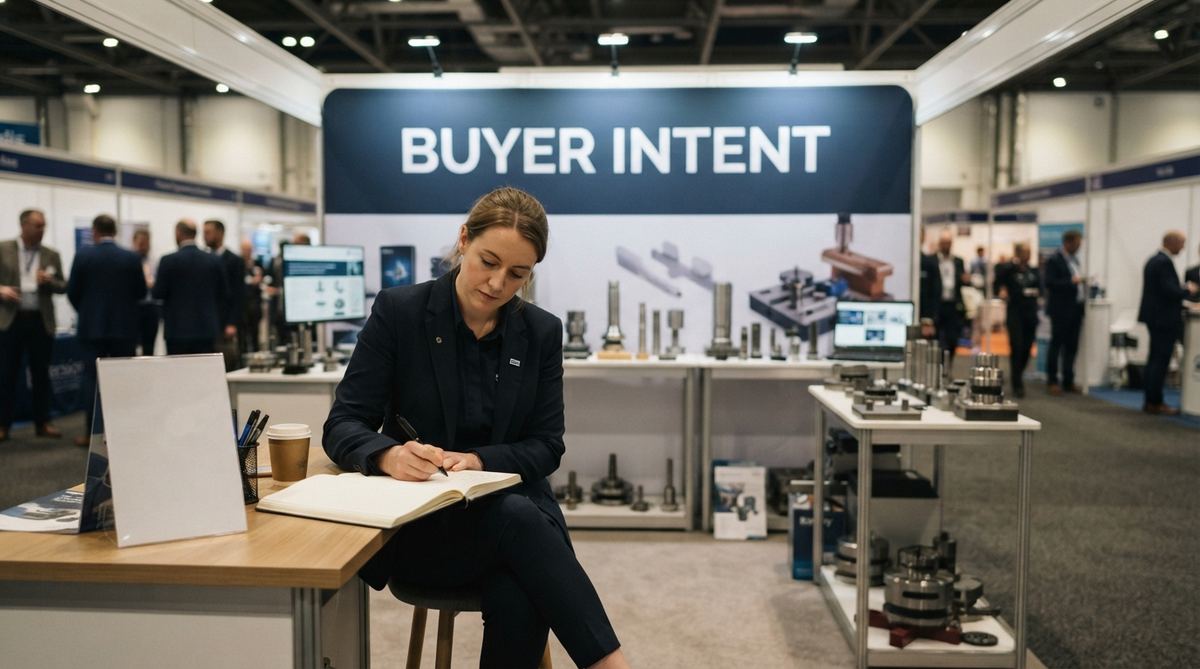
UK manufacturers face a perennial dilemma: should they invest £20,000 in physical trade shows or buyer intent data platforms? Each channel offers distinct advantages, but the right choice depends on your specific sales cycle and target audience.
For a UK industrial tool or machinery manufacturer with £20,000 to spend, most of it belongs in always-on buyer intent capture and qualification, with trade shows kept as targeted activation for accounts already identified as in market. A stand records presence. Intent data records demand-side research. Procurement usually starts months before show season, so the budget should follow the buyer’s timeline, not the exhibition calendar.
Why Does Buyer Intent Data Keep Coming Up?
Exhibitions are the default line in most engineering marketing budgets because they are visible, familiar and easy to justify to a board. The stand is photographed, the badge scans are counted, and the sales team comes home with a list. The problem is what the list represents.
A badge scan tells you that a person attended. It does not tell you whether their company is evaluating your category, how soon a decision is due, or which member of the buying committee you spoke to. For a capital equipment or tooling purchase with a six-to-eighteen-month cycle, the committee has usually formed its requirement and a first shortlist before the show opens. The stand meets buyers late.
Intent data answers the question the stand cannot. It surfaces accounts whose research behaviour shows they are comparing specifications, requesting category information or aligning internal stakeholders, and it does so continuously rather than on two days in the year. The full argument is in why trade shows fail to capture intent before procurement starts.
What does a trade show actually buy?
The visible costs are stand space, build, graphics, travel, accommodation and the days the engineering and sales team spend away from customers. The hidden costs arrive afterwards.
- Re-qualification. Every scanned contact has to be sorted into in-market, not in-market and unknown. That work lands on the sales team in the weeks after the show, when it is already behind on live quotations.
- Follow-up latency. Leads that are not followed up within days lose whatever momentum the conversation created. The buyer’s evaluation does not pause while the stand is packed away.
- Engineering time on the wrong accounts. A curious visitor who asks for a drawing consumes the same applications engineering hours as a buyer with an approved capital request.
What a trade show does buy, and buys well, is face-to-face technical validation with an account that is already evaluating. That is a closing-stage asset, not a discovery engine.
What does intent data buy?
Buyer intent data is demand-side research signal: evidence that an account is investigating a product category before it contacts a supplier. It is not shipment tracking, customs data or any record of goods already moving, which describe transactions that were decided months earlier. The distinction matters because only the first kind of signal can be acted on before a shortlist closes. See buyer intent data versus shipment tracking.
Spent well, intent budget buys three things:
- Coverage. Continuous visibility of which accounts in your target segments are researching your category, across the whole year rather than at events.
- Qualification rules. Written criteria for what counts as a sales-ready signal, so the sales team receives accounts that meet a standard rather than a list to sort.
- Routing. A defined hand-off from signal to technical follow-up, with the latency measured.
The provider is the smaller decision. The rules and routing are what make the data usable. How to compare providers for UK industrial sectors is covered in how to compare intent data providers.
How do the two channels compare?
| Question | Trade show | Intent data with qualification |
|---|---|---|
| What it measures | Presence at a stand | Research behaviour by account |
| Timing against procurement | Fixed dates, usually after the requirement is formed | Continuous, usually before the shortlist closes |
| Lead readiness | Mixed; sorted after the event | Defined by stage-entry criteria before hand-off |
| Follow-up load | High, concentrated in the weeks after the show | Steady, governed by routing rules |
| What the board can see | Scans, meetings, cost of attendance | Qualified opportunities, stage time, cost per qualified opportunity |
| Failure mode | Volume without readiness | Data bought without rules to act on it |
| Best use | Technical validation with accounts already in evaluation | Discovery and qualification across the year |
How should £20,000 be split?
There is no universal percentage, and any article that gives one is guessing. The allocation follows from four decisions, in order.
- Fund the qualification layer first. Stage definitions, routing rules and a way to measure follow-up latency cost time more than money, but they must exist before either channel is worth funding. Without them, intent data becomes a longer list and a trade show becomes a longer spreadsheet.
- Buy intent coverage for the segments that matter. Coverage of the product categories and account types the business actually wants to win, not the widest feed available.
- Keep the one or two shows where technical validation happens. If a particular exhibition is where your buyers expect to see machines running or tooling cut, it earns its place as a closing venue. The rest of the calendar is optional.
- Attend with a target list. Use the intent layer to name the accounts to meet at the stand before the show opens, and measure the show on how many of those conversations happened.
On this logic, the larger share of a £20,000 budget goes to coverage and qualification because that is the part that works every week. The show budget is sized to the number of events that genuinely close business, which for most manufacturers in this segment is small.
What should the board see?
A managing director does not need a report on either channel in isolation. Three lines cover both:
- Cost per qualified opportunity, by source, so a show and the intent layer are judged on the same unit.
- Stage time for opportunities from each source, which shows whether trade show leads take longer to convert because they arrive unqualified.
- Follow-up latency, the days between a new signal or a stand conversation and the next technical action.
Reported this way, the annual “should we exhibit” debate turns into a comparison of cost per qualified opportunity. That is a question the finance director can settle. The standard for what a qualified opportunity should look like is set out in what a qualified pipeline should deliver.
How do the two channels work together?
The working model treats intent as the engine and the exhibition as the amplifier.
- Before the event. Identify in-market accounts from the intent layer, agree who will be invited to the stand and what technical question each meeting should answer.
- At the event. Spend stand time on specification alignment and next-step planning with named accounts, not on educating visitors who are not evaluating.
- After the event. Route every conversation back through the same stage-entry criteria as any other signal, so attendance does not reset qualification.
Where a manufacturer wants an outside view of how its current lead flow maps to revenue stages before committing the budget, CMOxpert runs a fixed-scope pipeline diagnosis that identifies where demand is leaking and which channel is producing qualified movement.
Frequently asked questions
Are trade shows still worth it for UK industrial manufacturers?
Yes, as a closing and technical-validation venue for accounts already in evaluation. They are a poor discovery channel because the buying committee usually forms its requirement and first shortlist before the show, so the stand meets buyers late and the leads need re-qualifying afterwards.
How can a manufacturer identify buyer intent before a trade show?
Use buyer intent data to surface accounts researching your category, then apply written stage-entry criteria to decide which are in market. That produces a named target list for the stand, so conversations happen with accounts that are evaluating rather than with whoever walks past.
What is the difference between a badge scan and buyer intent?
A badge scan records that a person attended a stand. Buyer intent is demand-side evidence that an account is researching a product category, such as comparing specifications or requesting category information. Only the second says anything about procurement readiness or timing.
How much of a £20,000 budget should go to trade shows?
Enough to attend the one or two events where your buyers expect technical validation, and no more. The larger share belongs in intent coverage and the qualification rules that make it usable, because that part of the system works every week rather than on fixed dates.
Can a manufacturer run both without adding marketing headcount?
Yes, if qualification is treated as a system rather than a campaign. Written stage-entry criteria and automated routing reduce the sorting work that trade show leads normally create, so the same team handles both channels with less re-qualification and shorter follow-up latency.
Related guides: How to Compare Intent Data Providers for UK Industrial Sectors: A 2026 Comparison · Tungsten Price Pressure and the UK Tooling Sector: Why Demand Visibility Is Now a Board Issue