Tag: Sales Strategy

  • Fractional CMO or marketing manager: which does a UK manufacturer need?

    Fractional CMO or marketing manager: which does a UK manufacturer need?

    A UK industrial manufacturer needs a marketing manager when the commercial system already works and the gap is execution. It needs a fractional CMO when the gap is the system itself: qualification rules, stage definitions and board reporting on pipeline velocity. The two roles are not substitutes. The common mistake is to hire an execution role and expect it to design the architecture.

    What does each role actually own?

    The titles are used loosely in engineering businesses, so it helps to define them by what each is accountable for.

    Area Marketing manager (full-time) Fractional CMO (part-time, board-facing)
    Core remit Execution across channels: content, events, website, campaigns The commercial system: who to target, what qualifies, how it is reported
    Pipeline accountability Usually indirect, measured on activity or enquiry volume Direct, measured on qualified movement and stage time
    Relationship to sales Hands over leads Defines the hand-over standard with the sales director
    Board interaction Reports through the managing director or sales director Reports to the board on pipeline velocity and cost per acquisition
    Time to first plan Recruitment, notice period and ramp-up Weeks, because the role starts with a diagnosis rather than onboarding
    Cost structure Salary, employer National Insurance, pension, benefits, recruitment fee Fixed monthly fee, no employment overhead

    The first row is the one that matters. A marketing manager executes within a system. A fractional CMO is accountable for whether the system exists.

    Why does the distinction matter in a six-to-eighteen-month sales cycle?

    In a short-cycle business, execution volume and pipeline move together, so a good marketing manager is enough. In industrial tooling and machinery, the buying committee researches, specifies and shortlists over many months, often before any supplier is contacted. Activity that is not aligned to those stages produces enquiries without producing qualified opportunities.

    That is a design problem. It needs someone to decide which accounts are in market, what evidence moves an opportunity from evaluation to specification to procurement, and how the board sees the result. If nobody owns those decisions, the marketing manager is measured on campaigns and the sales team re-qualifies everything by hand. The board sees effort rising and pipeline velocity flat.

    The appetite is there. In the Make UK and PwC Executive Survey 2026, 37% of UK manufacturers named increased marketing as the focus of their strategy to secure growth in 2026, ahead of new products, cost control, AI investment and exporting (Make UK / PwC). The question is what that spend should buy, and who owns the answer.

    One symptom is worth checking for. If the business cannot say, in writing, what makes an opportunity qualified, the gap is architectural and no amount of execution will close it. What a qualified pipeline should look like is set out in what a qualified pipeline should deliver.

    What does each option cost?

    Salary benchmarks for marketing roles vary widely by region and sector, and most published figures come from recruiters with an interest in the number. This article does not quote one. The comparison a finance director can actually make is between cost structures.

    A full-time senior marketing hire carries salary, employer National Insurance contributions, pension contributions under auto-enrolment, benefits, a recruitment fee, and the months between the decision to hire and the point at which the person is productive. That cost is fixed whether or not pipeline moves.

    CMOxpert’s engagement terms are published. As at September 2026, the pricing page lists a fixed-scope 30-day pipeline diagnosis sprint at £3,500 and an ongoing pipeline architecture retainer from £3,000 per month, scoped from the sprint findings. The sprint fee is credited in full against the first retainer month if the client continues within 60 days.

    The point of the published structure is that the board decides in two steps. It buys a diagnosis first, sees a written read-out of where the pipeline leaks, and only then decides whether to fund the architecture. A permanent hire offers no equivalent stage gate.

    How should the board judge return?

    Any return multiple quoted before a diagnosis is invented, and this article does not offer one. The credible test is whether, within an agreed period, the role has produced four things that did not exist before.

    1. A baseline. A written account of where demand is leaking and where qualification fails, drawn from the business’s own CRM and order book.
    2. Stage mapping. Which buyer signals correspond to which stage, and what evidence moves an opportunity forward.
    3. Velocity tracking. Time in stage and conversion between stages, reported monthly against the baseline.
    4. A board cadence. Pipeline movement translated into cost per qualified opportunity and cost per acquisition, in the board pack, every month.

    If a marketing manager can deliver those four with evidence, the business does not need a fractional CMO. If not, the gap is structural, and it will persist however hard the marketing manager works.

    When is a marketing manager the right answer?

    • The business already has written qualification criteria that sales and marketing both use.
    • The board already receives pipeline velocity and cost per acquisition, and trusts the numbers.
    • The constraint is capacity: content is not being produced, events are not being worked, the website is not being maintained.
    • The sales director is willing and able to own the commercial system, and needs an execution partner rather than a strategist.

    In that situation a fractional CMO would be paid to design something that already exists.

    When is a fractional CMO the right answer?

    • Enquiries arrive, but the sales team cannot say which are worth engineering time.
    • Trade show leads and website enquiries are treated the same way as accounts showing genuine buyer intent. The difference between demand-side research signals and other data is explained in buyer intent data versus shipment tracking.
    • The board sees activity reports and asks, every quarter, what marketing is for.
    • A previous marketing manager left, or is about to, and the board is unsure whether to replace the role like for like.
    • The business cannot justify a full-time senior salary but needs senior commercial ownership now.

    Manufacturers in the West Midlands tooling and engineering corridor face a particular version of this: a long cycle, a technical buyer, and a marketing function that has historically been one person and a brochure. The regional offer is described at fractional CMO for West Midlands engineering.

    How do the two roles work together?

    In the businesses where this works best, the fractional CMO owns the commercial architecture: target market, qualification rules, routing, and board reporting. The marketing manager, or a marketing executive, owns execution inside that architecture: content calendar, event logistics, website, CRM hygiene. Neither is asked to do the other’s job.

    The sequence matters. Install the architecture first, then hire or redirect execution into it. Hiring execution first and hoping the system emerges is how most manufacturers end up with a busy marketing department and a static pipeline.

    Where a board wants to settle the question with evidence rather than opinion, the fixed-scope pipeline diagnosis produces a written read-out of where the pipeline leaks. If the read-out shows an execution gap, the recommendation will be a marketing manager. If it shows a design gap, it will not.

    Frequently asked questions

    Is a fractional CMO worth it for a UK tool or machinery manufacturer?

    It is worth it when the gap is the commercial system rather than execution: no written qualification criteria, no stage definitions, and no board reporting on pipeline velocity. Where those already exist and work, a marketing manager is the better use of the budget.

    What does a fractional CMO do that a marketing manager does not?

    A fractional CMO owns the design of the commercial system: which accounts to target, what evidence qualifies an opportunity, how it is routed to sales, and how the board sees the result. A marketing manager executes within that system. The first is accountable for pipeline movement, the second for activity.

    How much does a fractional CMO cost in the UK?

    Fees vary by provider and scope. As at September 2026, CMOxpert publishes a fixed-scope 30-day pipeline diagnosis sprint at £3,500 and a pipeline architecture retainer from £3,000 per month, with the sprint fee credited against the first retainer month if the engagement continues within 60 days.

    Can a marketing manager deliver the same result?

    Only if the role is given ownership of qualification rules and board reporting, and has the seniority to hold the sales director to a hand-over standard. In most manufacturing businesses it is not, so the pipeline gap persists regardless of how well the campaigns are run.

    What should a managing director ask for before deciding?

    A written diagnosis of where the pipeline leaks, how current qualification maps to CRM stages, and what board reporting would look like. That evidence shows whether the gap is execution or design, and it makes the hiring decision a consequence of the facts rather than a guess.


  • Why does a manufacturer’s pipeline need a commercial architecture, not campaigns?

    Why does a manufacturer’s pipeline need a commercial architecture, not campaigns?

    A UK industrial manufacturer’s pipeline needs a commercial architecture because the buyer’s evaluation is continuous and campaigns are not. A tooling or machinery buying committee researches, specifies and shortlists over six to eighteen months. An architecture keeps market intelligence, qualification rules, routing and board reporting running against that cycle, so the business is present when the shortlist forms rather than when a campaign happens to be live.

    What is a commercial architecture?

    A commercial architecture is the standing system that turns engineering capability into qualified pipeline. It is not a rebrand of the marketing department. It is a set of decisions, written down and owned, that stay in force between campaigns.

    Six components make it up:

    1. Objectives. What good looks like in pipeline movement and cost discipline, stated so the board can test it.
    2. Market. The account types and buying committees the business will prioritise, and those it will not.
    3. Message. The technical and commercial case that answers the committee’s questions at each stage, from first research to procurement.
    4. Process. Qualification rules, stage-entry criteria, routing, and the hand-over standard between marketing, sales and engineering.
    5. People. Who owns each decision, and the operating rhythm that keeps them owned.
    6. Tooling. The systems that connect buyer signals to CRM actions and to the board pack.

    A campaign can sit inside this. It cannot replace it. How the components are installed as one operating system is described at how the autonomous pipeline system works.

    Why do campaigns fail against a long buying cycle?

    Campaigns are episodic by design. They are staffed for bursts, measured over weeks, and switched off when the budget line ends. The buyer’s process does not share that rhythm.

    For capital equipment or tooling, the requirement forms internally, a business case is written, specifications are checked and a first shortlist is drawn up, often before any supplier is aware. When a campaign runs, it reaches whichever accounts happen to be researching during its window. When it stops, the accounts that start researching the following month meet silence.

    Three failure patterns follow:

    • Late arrival. The business becomes visible after the shortlist has closed, and is asked to quote as a benchmark rather than a contender.
    • Activity without qualification. The campaign produces enquiries, but nobody has written down what makes an enquiry worth engineering time, so the sales team sorts by instinct.
    • Reporting drift. The board is shown what the campaign measured, such as impressions and enquiry counts, because that is what exists, and pipeline velocity is never on the page.

    None of these is fixed by running the next campaign harder.

    What does an architecture change in practice?

    AreaCampaign modelCommercial architecture
    TimingBursts on the marketing calendarAlways on, aligned to the buyer’s evaluation window
    Demand captureEnquiry forms and event scansBuyer intent signals mapped to accounts and stages
    QualificationJudged case by case by whoever picks up the leadWritten stage-entry criteria applied the same way every time
    Hand-overMarketing passes leads to salesRouting rules move accounts to technical follow-up when evidence is present
    MeasurementOutputs: impressions, clicks, enquiries, badge scansMovement: stage time, conversion between stages, cost per qualified opportunity
    Board viewActivity reportPipeline velocity and cost per acquisition
    Budget logicChannel mixSystem components, funded in order of dependency

    How does intent data fit?

    Buyer intent data is demand-side research signal: evidence that an account is investigating a product category before it contacts a supplier. It is the input that lets the architecture run continuously instead of waiting for an enquiry.

    It is only useful inside the process component. A feed of in-market accounts with no stage-entry criteria and no routing is a longer list that ages badly. The architecture gives the signal somewhere to go: a written definition of what counts as sales-ready, and a rule for who acts on it and how quickly.

    Two boundaries keep it honest. Intent data is not shipment tracking, customs records or any other description of goods already moving, which say nothing about a buyer’s readiness. See buyer intent data versus shipment tracking. And the provider is the smaller decision. Choosing one is covered in how to compare intent data providers for UK industrial sectors.

    What does the board see?

    A manufacturing board does not need more marketing reporting. It needs commercial mechanics it can manage. Four lines, monthly:

    • Stage time by stage, with the trend against the previous quarter.
    • Conversion between stages, so the board can see where opportunities stall.
    • Cost per qualified opportunity, by source, so channels are judged on the same unit.
    • Cost per acquisition, the figure that connects commercial spend to signed revenue.

    Together these make up pipeline velocity: the rate at which qualified opportunities become signed revenue. When the board can see velocity, it can ask where the pipeline leaks and expect an answer in pounds and days rather than in campaign metrics.

    How do you know you need an architecture rather than another campaign?

    Three conditions, usually present together:

    1. The campaign calendar changes often and the pipeline does not. Channels are rotated, agencies are replaced, and stage time stays where it was.
    2. Qualification is subjective. Ask two salespeople what makes an enquiry qualified and get two answers. Ask for it in writing and get none.
    3. The board cannot explain leakage. The business can describe what marketing did last quarter but not where opportunities were lost or what it cost to lose them.

    Where all three hold, the next campaign will produce the same result as the last one, because the system it runs inside has not changed.

    How do you start?

    Not with tooling and not with a campaign brief. Start by writing down the current state: what signals are captured today, where they die, what “qualified” means in practice, and what the board currently sees. That baseline is the first deliverable of the architecture, and it is usually the first time the sales and marketing functions have agreed on a definition.

    CMOxpert runs this as a fixed-scope 30-day pipeline diagnosis with a written read-out of where high-margin buyers are being lost. As at September 2026 the sprint is listed at £3,500 on the pricing page, credited against the first retainer month if the engagement continues within 60 days. The read-out is the board’s evidence for whether to install the architecture, with CMOxpert or internally.

    Frequently asked questions

    What is a commercial architecture in a manufacturing business?

    It is the standing system of objectives, target market, message, process, ownership and tooling that turns engineering capability into qualified pipeline. Unlike a campaign, it stays in force between marketing activity, so the business is present throughout a six-to-eighteen-month buying cycle rather than only when a campaign is live.

    Why do marketing campaigns fail for industrial manufacturers?

    Because campaigns run in bursts and the buyer’s evaluation runs continuously. A campaign reaches accounts that happen to be researching during its window and misses those that start afterwards. Without written qualification and stage definitions, the enquiries it does produce are sorted by instinct and reported as activity rather than pipeline movement.

    Is buyer intent data the same as shipment tracking?

    No. Buyer intent data is demand-side evidence that an account is researching a product category before contacting a supplier. Shipment tracking and customs records describe goods already moving under a decision taken months earlier. Only the first can inform qualification, routing and timing of sales follow-up.

    What should a managing director track instead of enquiry volume?

    Stage time by stage, conversion between stages, cost per qualified opportunity by source, and cost per acquisition. Together these describe pipeline velocity, the rate at which qualified opportunities become signed revenue, which is the figure that connects commercial spend to the management accounts.

    Does a commercial architecture replace trade shows and campaigns?

    No. It gives them somewhere to sit. A trade show becomes an activation event for accounts the architecture has already identified as in market, and a campaign becomes a message delivered to a defined segment at a defined stage. Both are judged on cost per qualified opportunity rather than on attendance or impressions.

    Related guides: How to Compare Intent Data Providers for UK Industrial Sectors: A 2026 Comparison · Tungsten Price Pressure and the UK Tooling Sector: Why Demand Visibility Is Now a Board Issue

  • How to Compare Intent Data Providers for UK Industrial Sectors: A 2026 Comparison

    How to Compare Intent Data Providers for UK Industrial Sectors: A 2026 Comparison

    If you manufacture industrial tools or machinery in the UK, you need a working method for evaluating intent data providers for UK industrial sectors: a 2026 comparison that goes beyond vendor brochures. One enterprise platform in this space starts at $35,000 a year and still needs three to six months of dedicated RevOps resource before it produces a usable signal. That is the reality most manufacturers are not told before they sign.

    Intent Data Providers | How to Compare Intent Data Providers for UK Industrial Sectors: A 2026 Comparison

    Key Takeaways

    Question Direct Answer
    What is intent data, in industrial terms? Signals showing which accounts are researching specification, procurement, or supplier switching before they ever contact you.
    Do UK industrial manufacturers need a specialist provider? Yes. Generic B2B intent tools rarely map committee-level buying behaviour specific to engineering procurement cycles.
    Is enterprise software like 6sense worth it for SMEs? Usually not. The commercial cost and implementation timeline outweigh the pipeline gain for most sub-£20m manufacturers.
    Should we use one provider or several? Multi-source strategies improve signal coverage by 20% to 30% over single-vendor approaches.
    What matters more: the tool or the system around it? The system. A tool without a qualification engine behind it just generates noise, not pipeline.
    Where should we start before buying anything? Request a pipeline diagnosis before you commit budget to any intent platform.
    What is the real cost of getting this wrong? Payroll bloat, wasted retainers, and accounts lost to competitors who reached the specification stage first.

    Why UK Industrial Buyers Are Shortlisting You Before the First Enquiry

    Buying committees in industrial procurement do not start with a phone call. They start with research, specification checks, and AI-assisted shortlisting long before your sales team hears a name.

    This is what we call Share of Model: the degree to which your business shows up when a buyer’s research tools and AI models are compiling a shortlist. If you are absent from that information layer, you are absent from the decision, regardless of how good your engineering is.

    Intent data providers for UK industrial sectors exist to close that gap. They tell you who is researching, what they are researching, and when the window to act is still open.

    How to Compare Intent Data Providers for UK Industrial Sectors in 2026

    Comparison starts with a question most manufacturers never ask: where is the cycle stalling? Specification stage, commercial negotiation, or procurement approval, and what does that tell us about the qualification and messaging infrastructure we need to adjust?

    Use these criteria when comparing any provider:

    • Signal source depth: firmographic, technographic, and content-consumption data, or just one of these.
    • Committee mapping: does the platform track multiple stakeholders, or just a single contact?
    • Implementation timeline: how long before the system produces usable pipeline data.
    • Fully-loaded commercial cost: licence fee plus RevOps hours plus integration work.
    • Industrial relevance: does the provider understand long, multi-stakeholder engineering procurement cycles, or was it built for SaaS?

    The average B2B buying committee for deals over $50,000 now runs to 11.2 stakeholders. A provider that only tracks one contact is not comparing intent, it is guessing.

    Comparison criteria for evaluating intent data providers in industrial procurement

    Intent Data Providers for UK Industrial Sectors: A 2026 Comparison Table

    Below is a straightforward comparison across the three categories most UK manufacturers are choosing between this year.

    Category Typical Starting Cost Implementation Time Best Fit
    Enterprise intent platform (e.g. 6sense) From $35,000/year 3 to 6 months Large manufacturers with dedicated RevOps teams
    Multi-source intent aggregators Varies by vendor and volume Weeks, not months Mid-market firms needing broader signal coverage
    Fractional pipeline architecture retainer From £3,000/month Weeks, integrated with existing CRM UK industrial manufacturers without in-house marketing infrastructure

    Notice the pattern. Cost and complexity climb fast once you move into enterprise territory, and the return only justifies itself at scale.

    Did You Know?
    Multi-source intent strategies improve signal coverage by 20% to 30% compared to relying on a single provider.
    Source: Databar.ai

    6sense and the Enterprise Tier: Is It Right for UK Manufacturers?

    6sense is the name most people mean when they say “intent data platform.” It is powerful, and it is not built for most UK industrial firms.

    Starting price sits around $35,000 a year. Implementation runs three to six months and requires a RevOps function most sub-£20m manufacturers do not have.

    If you are a large machinery group with an existing data team, this may be the right tool. If you are a mid-sized manufacturer trying to shorten a six to eighteen month sales cycle without adding headcount, the fully-loaded commercial cost of this platform will outweigh the pipeline it produces in year one.

    Buying enterprise software before you have a qualification engine to act on the signal is buying a dashboard, not a pipeline.

    Multi-Source Intent Data Providers for UK Industrial Sectors: Why One Vendor Is Never Enough

    No single provider sees the whole buyer journey. One tracks content consumption. Another tracks technographic footprint. A third tracks review-site research behaviour.

    Stack them, and coverage improves by 20% to 30% over any single source. Industrial buying committees average 11.2 stakeholders on larger deals, and no one vendor tracks all of them consistently.

    This is why we do not recommend picking “a provider.” We recommend architecting a stack, then wiring it into your CRM so intent becomes a qualification trigger, not a report nobody reads.

    Multi-source intent data stack feeding CRM qualification triggers

    Turning Intent Signals Into Pipeline Architecture, Not Dashboards

    Data without infrastructure is noise. This is the single biggest failure point we see across UK industrial manufacturers evaluating intent data providers for UK industrial sectors in 2026.

    A signal that an account is researching your product category is worthless if there is no qualification sequence, no lead scoring, and no CRM integration to act on it within hours, not weeks.

    Our own approach is built on three pillars:

    1. Market Intelligence Infrastructure: competitive position mapping and addressable market sizing so you know which high-margin product categories to prioritise.
    2. Pipeline Architecture & Qualification Engine: automated intent-signal tracking with CRM lead scoring filtered by budget and authority.
    3. Commercial Reporting & Attribution: closed-loop attribution from first digital touch to CRM, reported as Pipeline Velocity and Cost Per Acquisition, not impressions.

    Pipeline architecture, not marketing services. That distinction is the entire point.

    What to Ask Before You Buy: The Pipeline Diagnosis Checklist

    Before signing any contract with an intent data provider, ask yourself the questions that actually matter.

    • What is the fully-loaded commercial cost of winning a new account in your highest-margin product categories?
    • Where does your current cycle stall: specification stage, commercial negotiation, or procurement approval?
    • Does your CRM already have the messaging infrastructure to act on a signal within 24 hours?
    • Are you buying a tool, or buying a system that builds your technical authority into the information layer where buying decisions actually originate?

    If you cannot answer these with numbers, not opinions, you are not ready to buy intent software yet. This is exactly why we tell manufacturers to request a pipeline diagnosis before signing anything.

    Did You Know?
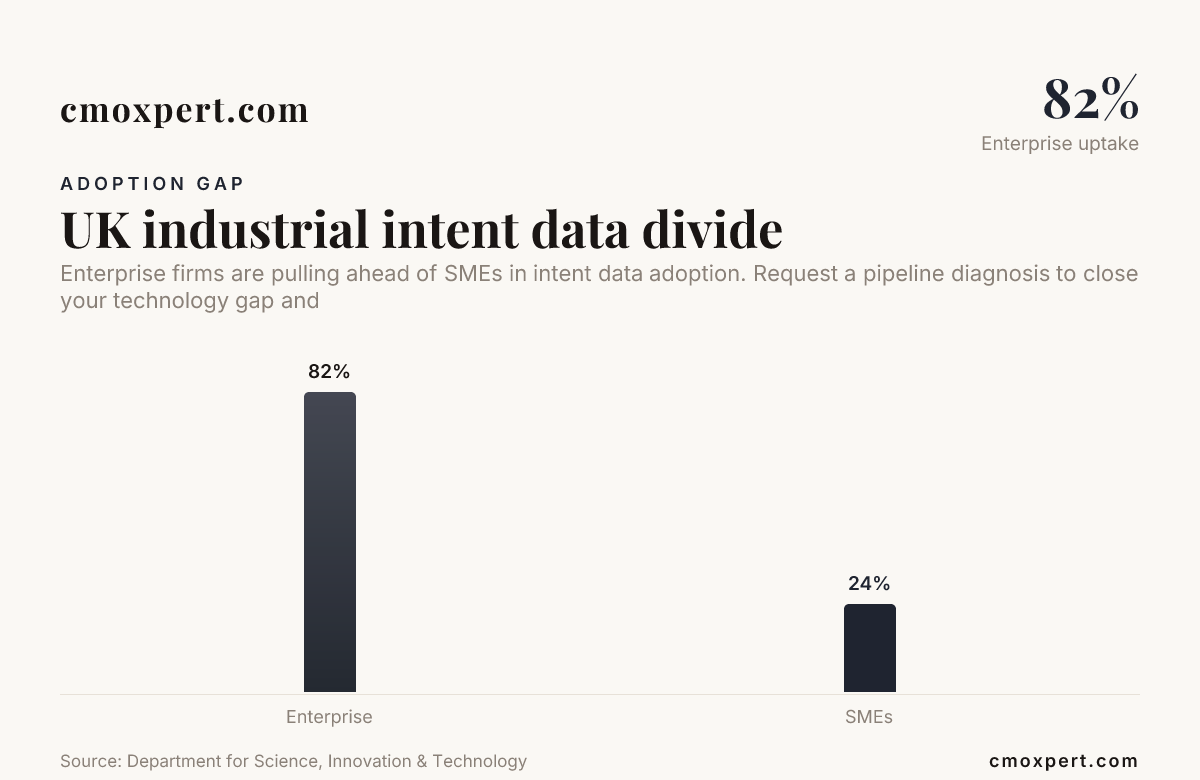
    82% of large UK businesses that have digitised their data now report using AI for at least one business purpose.

    UK industrial intent data divide — data from Department for Science, Innovation & Technology

    Enterprise firms are pulling ahead of SMEs in intent data adoption. Request a pipeline diagnosis to close your technology gap and stay competitive.

    Pipeline architecture reporting on velocity and cost per acquisition

    The Fully-Loaded Commercial Cost of Getting This Wrong

    The manufacturing sector’s median marketing budget sits at 5.7% of revenue in 2026, a clear pivot toward account-based programmes and AI tooling. Spending that budget on the wrong intent stack does not just waste money, it hands the account to a competitor who reached the specification stage first.

    ABM-led programmes generate 2.6x more pipeline per marketing dollar than broad-reach demand generation, with win rates up 41% over traditional methods. Those numbers only hold if the underlying data feeding the ABM programme is accurate and mapped to the right committee members.

    No vanity metrics. No impressions. No reach reports. If your provider cannot show Pipeline Velocity and Cost Per Acquisition, not Cost Per Click, you are paying for noise.

    We are not the right firm for every manufacturer. We are the right firm for the ones who are serious about winning, and serious enough to request a pipeline diagnosis before spending another pound on unverified intent software.

    Conclusion

    Comparing intent data providers for UK industrial sectors in 2026 is not about picking the platform with the most impressive logo wall. It is about matching signal depth, committee mapping, and implementation cost to the reality of your sales cycle.

    Enterprise platforms like 6sense work for firms with the resource to run them. Multi-source stacks close coverage gaps for everyone else. Neither works without pipeline architecture behind it.

    If this does not describe your business, we are not the right firm for you. If it does, request a pipeline diagnosis before you spend another quarter guessing at intent.

    Frequently Asked Questions

    What are intent data providers for UK industrial sectors, and how do they work in 2026?

    They are platforms and data stacks that track digital research behaviour, such as content consumption and technographic signals, to show which accounts are actively researching your product category. In 2026, the strongest providers combine multiple sources rather than relying on one.

    Is 6sense worth it for a UK industrial manufacturer?

    Only if you have the RevOps resource to manage a three to six month implementation and can justify a starting cost around $35,000 a year. For most mid-sized manufacturers, a fractional pipeline architecture retainer delivers better fully-loaded commercial cost outcomes.

    How much does intent data software cost for industrial companies?

    Enterprise platforms start from roughly $35,000 annually, while multi-source aggregators and fractional retainers can start from around £3,000 a month depending on scope. The right comparison always factors in implementation time and internal resource, not just the licence fee.

    Do I need more than one intent data provider?

    Yes, in most cases. Multi-source strategies improve signal coverage by 20% to 30% compared to single-provider setups, which matters when buying committees average 11.2 stakeholders on larger deals.

    What is the difference between intent data and traditional lead generation?

    Traditional lead generation waits for a form fill or a trade show conversation. Intent data identifies research activity before that contact happens, giving you visibility at the moment of intent rather than the moment of enquiry.

    How long does it take to see results from an intent data platform?

    Enterprise platforms typically need three to six months before producing usable signal. Fractional pipeline architecture retainers integrated with your existing CRM can start generating qualified pipeline data within weeks.

    Should industrial manufacturers request a pipeline diagnosis before buying intent software?

    Yes. A genuine pipeline diagnosis identifies where your sales cycle actually stalls, specification stage, commercial negotiation, or procurement approval, before you spend budget on a platform that may not address the real bottleneck.