If you are self-employed, a contractor, or running your own limited company, knowing how to prove affordability using your business bank statements could be the difference between a successful mortgage application and an unnecessary rejection. Research suggests that around 24% of self-employed mortgage applicants experienced at least one rejection in 2025, yet the majority of those applicants had perfectly sound finances that simply were not being read correctly by automated lender systems.

Key Takeaways
- Business bank statements are one of the most powerful tools you can use to demonstrate genuine affordability to specialist lenders, particularly if you have a complex income mortgage UK situation.
- High street lenders often rely on automated checks that cannot interpret self-employed income accurately. Specialist lenders use manual underwriting instead.
- Contractors, freelancers, and Ltd company directors each have slightly different evidence requirements, but bank statements are central to all of them.
- Lenders typically want 3 to 24 months of statements, depending on income type and the complexity of your case.
- Preparation is critical: clean, well-explained statements can significantly improve how a lender views your affordability, particularly for a mortgage with irregular income.
- A specialist mortgage broker can present your statements in a lender-friendly format, framing your income story effectively before submission.
- Your IR35 status, contract length, and income structure all influence which lender is most appropriate for your circumstances.
Why Business Bank Statements Matter for a Self-Employed Mortgage
When you apply for a self-employed mortgage, lenders need to understand how money actually flows through your business. Tax returns and accounts tell part of the story, but business bank statements provide real-time, unfiltered evidence of income regularity, business health, and financial management.
Many high street lenders apply blanket rules that can undervalue a contractor or director’s actual earnings by 50% or more. Specialist lenders who serve the non-standard income mortgage market take a different view, using manual underwriting to interpret what your statements genuinely show.
For those with a freelancer mortgage application or a contractor mortgage UK case, statements showing consistent client payments, manageable outgoings, and clear business income patterns can carry considerable weight. This is particularly relevant in 2026, as more lenders are developing criteria specifically for people with non-PAYE income structures.

What Lenders Look For When Proving Affordability Using Your Business Bank Statements
Understanding what lenders are looking for helps you present your statements in the clearest possible way. Different lenders apply different criteria, but there are common themes across the complex income mortgage UK market.
Income Consistency and Regularity
Lenders may consider how consistently income arrives in your account. For a day rate contractor mortgage, they will often look for regular payments from one or more clients that align with your quoted day rate and working pattern.
Gaps in income are not automatically disqualifying, but lenders will typically want to understand why they occurred. A brief gap between contracts, for example, is common in contracting and can be explained with supporting context.
Business Income vs. Personal Drawings
For a Ltd company director mortgage, lenders often need to see both business and personal bank statements. They may look at salary payments made from the business account to the personal account alongside any dividend distributions.
Some specialist lenders will also consider retained profits within the business as part of the affordability calculation, rather than limiting their view to drawn income alone. This can substantially increase the borrowing potential for directors who choose to leave profits in the company.
Business Expenses and Outgoings
Lenders may examine your regular business outgoings to assess the net position. High, unexplained expenses or erratic outgoings can raise questions. Clean, well-categorised business accounts tend to present more favourably.
VAT Receipts and Client Payment Patterns
For a freelancer mortgage or CIS contractor mortgage, VAT receipts appearing in business statements can confirm the authenticity and scale of income. Regular client payment cycles also help demonstrate that income is sustainable, not sporadic.
79% of self-employed individuals have never missed a payment on their financial commitments, despite being viewed as higher risk by some lenders.

How to Prove Affordability Using Your Business Bank Statements: A Step-by-Step Guide
Following a clear process when preparing your statements can help ensure lenders receive a coherent and complete picture of your finances. The steps below reflect what specialist brokers working in the complex income mortgage UK space typically recommend.
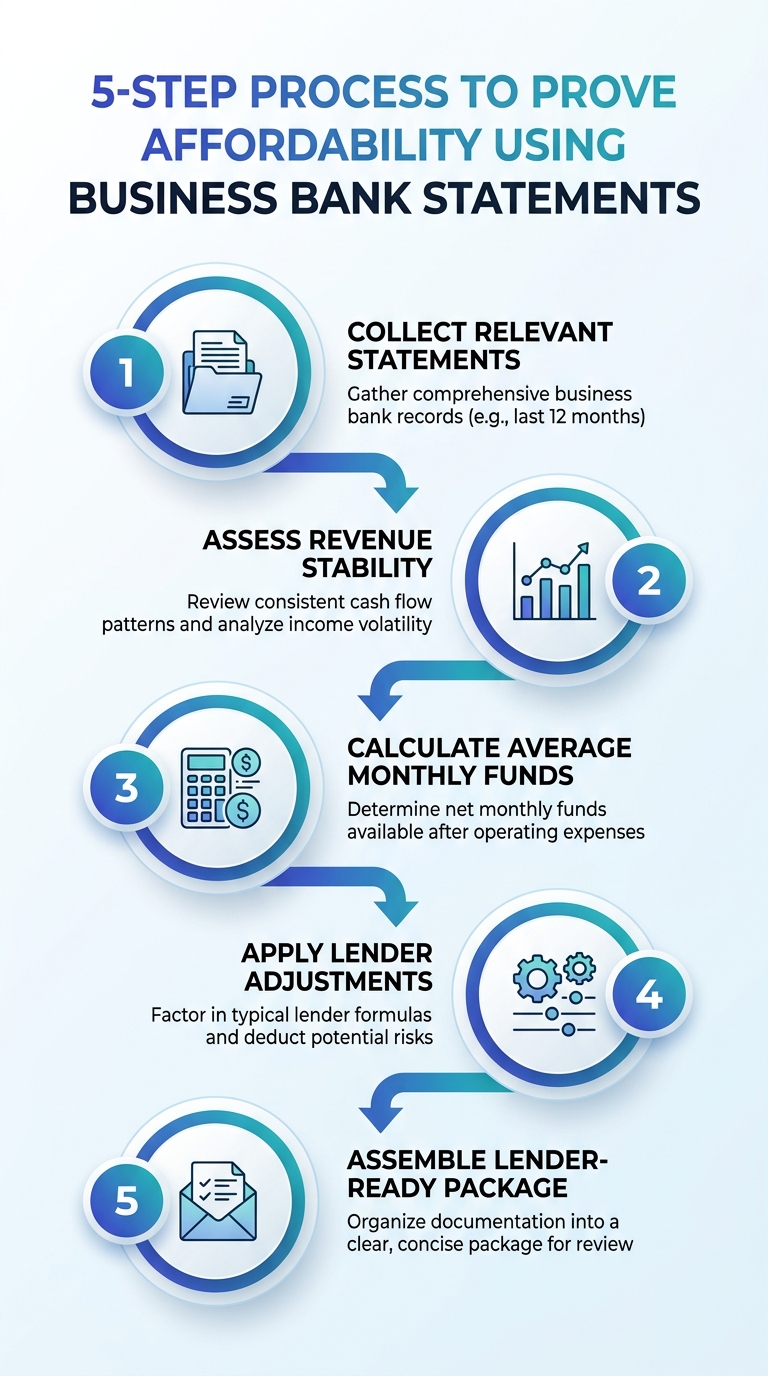
A visual guide outlining a simple five-step method to prove affordability using your business bank statements.
Step 1: Gather the Right Number of Months
Lenders vary in how many months of statements they require. Some may ask for 3 months, while others involved in non-standard income mortgage assessments may want 12 to 24 months to assess income trends across different trading periods.
If your business is relatively new, reading our guide on lenders who work with newer businesses may help identify which lenders are likely to accept a shorter statement history.
Step 2: Ensure Statements Are Complete and Unaltered
Lenders require full, official statements, either downloaded directly from your bank or provided as originals. Edited PDFs or incomplete pages are likely to cause delays or trigger additional queries.
This applies equally to a freelancer mortgage application as it does to a Ltd company director mortgage submission.
Step 3: Reconcile Your Statements With Your Accounts
Lenders may cross-reference your bank statements with your SA302s, tax year overviews, or company accounts. Any significant discrepancies may raise questions, so having a clear explanation ready is useful.
For directors, your statements should align with the salary and dividend figures shown in your dividend and director income records. Any retained profits not drawn as salary or dividends may also need to be addressed separately.
Step 4: Prepare a Supporting Narrative
Business bank statements rarely tell the full story on their own. A brief written explanation, prepared with your broker or accountant, can help lenders understand seasonal variation, income gaps, or unusual transactions.
This is especially relevant for those applying for a mortgage with irregular income or those whose income comes from multiple income sources. A letter from your accountant with income projections can complement your statements effectively.
Step 5: Submit Through a Specialist Broker
A specialist broker with experience in complex income mortgage UK cases will know which lenders are likely to view your statements most favourably. They can package your case before it reaches an underwriter, which may reduce the risk of an unnecessary decline.
If you have previously been turned down by a high street bank, it is worth reading about why mainstream banks often reject self-employed applicants before reapplying elsewhere.
Proving Affordability for Different Types of Complex Income
The way you prove affordability using your business bank statements will differ depending on your income structure. Below, we outline the most common scenarios we encounter in the complex income mortgage UK market.
Contractor Mortgage UK: Day Rate Income
For a day rate contractor mortgage, some lenders will annualise your contract rate rather than relying on drawn income. A contractor earning £500 per day, for example, may have their income assessed on an annualised basis using a methodology such as the 46-week contractor multiplier, which reflects realistic working patterns.
Business bank statements serve as supporting evidence that payments are arriving in line with the contract rate quoted. They also help confirm that there are no extended periods of non-activity that might otherwise concern a lender.
For IT professionals specifically, our guidance on IT contractors with rolling contracts and freelance IT consultant mortgages covers how lenders interpret short-term and rolling arrangements.
CIS Contractor Mortgage
A CIS contractor mortgage presents its own challenges. Construction Industry Scheme workers often have income reported via CIS vouchers rather than traditional payslips, meaning bank statements play a particularly important role in confirming the regularity and volume of income received.
Lenders sympathetic to CIS workers will typically look for consistent weekly or fortnightly credits alongside CIS deduction statements. Some lenders allow gross income (before CIS deductions) to be used for affordability purposes, which can significantly increase borrowing capacity.
Ltd Company Director Mortgage
For a Ltd company director mortgage, bank statements from both the business and personal accounts are usually required. Lenders need to see how salary and dividends flow from the company to the director, and specialist lenders may also consider net profit plus salary as a combined affordability figure.
Some lenders will look at overall company performance rather than just drawn income. Understanding which lenders consider director dividends most favourably can help direct your application to the right place from the outset.
Multiple Income Sources Mortgage
Those applying for a multiple income sources mortgage face the additional challenge of presenting income from several streams in a coherent way. This might include a combination of PAYE employment, self-employed income, rental income, and contract work.
Business bank statements help lenders trace each income stream separately, making it easier for underwriters to assess each component’s reliability. A lender comparison matrix can be useful in identifying which providers are experienced with multi-stream income cases.
Umbrella Company Contractors
Workers paid through umbrella companies occupy an interesting position. They receive payslips, but their actual income depends on contract value and hours worked. Bank statements showing consistent net pay from the umbrella, alongside the underlying contract details, help lenders build a picture of sustainable earnings.
Our dedicated resource on umbrella company contractor mortgages covers how lenders treat this income type in 2026.

Specific Situations Where Bank Statements Play a Critical Role
Applying With One Year of Accounts
If you have only been trading for one year, business bank statements become even more important as they may be the primary evidence of recent income. Some lenders will consider mortgage applications with just one year of accounts, particularly when bank statements demonstrate a strong and consistent trading pattern.
Short-Term Contract Workers
Lenders considering applicants on short-term contracts will often scrutinise bank statements carefully for evidence of gaps. Those with a track record of securing new contracts promptly, visible in the continuity of income credits on their statements, tend to be viewed more positively. Our page on lenders who accept short-term contracts provides further detail on relevant criteria.
IR35 Status and Its Impact
The way income reaches your business account can be affected by your IR35 status. Inside IR35 contractors typically receive income net of tax via their agency or end client, while outside IR35 contractors may invoice directly. This distinction affects how statements read to lenders, and understanding how IR35 status impacts your mortgage application is important before approaching lenders.
Industry Experience as Supporting Evidence
Some lenders factor in your length of experience in a given sector when assessing a contractor mortgage UK application. A contractor with 15 years in their field, for example, may be viewed as carrying lower income risk than someone newly self-employed. This is sometimes referred to as industry experience within mortgage criteria and can complement your bank statement evidence.
24% of self-employed mortgage applicants reported experiencing at least one rejection in 2025, a significant improvement from 45% the previous year, yet still highlighting the gap that well-prepared bank statement evidence can help close.
Common Mistakes That Weaken Your Affordability Case
Even with strong income, certain patterns in business bank statements can raise unnecessary concerns with lenders. Being aware of these in advance allows you to address them proactively.
- Large, unexplained credits: Lenders may question one-off deposits that are not obviously linked to business income. Being prepared to explain these (for example, a loan repayment, asset sale, or inter-account transfer) prevents delays.
- Mixing personal and business expenses: Regular personal spending through a business account can muddy the affordability picture. Separating business and personal accounts well before application is advisable.
- Inconsistent account naming: Statements should be in the name of the business or sole trader as it appears in your application. Discrepancies can cause queries.
- Missing months in a statement sequence: Providing statements with gaps, even accidental ones, can trigger requests for further evidence and delay the process.
- Declining balances over the period reviewed: A consistent downward trend in business account balances may concern lenders about the sustainability of your income. Where this reflects deliberate capital withdrawal or seasonal patterns, a supporting letter from your accountant can help.
- Not disclosing all accounts: Lenders may ask for statements from all business accounts. Providing only your main account while omitting a secondary trading account can create inconsistencies.

How to Prove Affordability Using Your Business Bank Statements With Professional Support
Working with a specialist broker makes a meaningful difference to how your bank statements are presented and interpreted. A broker experienced in self-employed mortgage and complex income mortgage UK cases will know how to package your evidence in a way that suits specific lenders’ underwriting approaches.
This is not simply about submitting documents. It involves understanding which lenders are likely to assess your income type most accurately, knowing how to frame your narrative, and selecting the right product at the right time.
For professionals working in IT contracting and related fields, our resource on complex IT contractor pay structures and top mortgage options for professional contractors outlines lender preferences in that specific sector.
If you are a director considering your options, reading about how to choose a specialist director mortgage broker provides practical guidance on what to look for in an adviser.
Understanding How Your Day Rate Translates to Borrowing Power
One of the most useful steps a contractor can take before applying is to understand how lenders will interpret their day rate. Our day rate mortgage calculator helps illustrate how an annualised day rate figure may translate into a borrowing estimate with appropriate lenders.
This is relevant to both a day rate contractor mortgage and a broader non-standard income mortgage application, as it helps set realistic expectations before approaching lenders.
Preparing Your Accounts and Projections
For newer businesses, or those who have experienced an income shift, preparing your first year accounts carefully can directly support your bank statement evidence. Some lenders may also consider accountant-prepared income projections as supplementary evidence in a mortgage with irregular income case.
“Lenders who engage with complex income cases do not simply count deposits. They assess the quality, consistency, and sustainability of the income your statements evidence. Presentation and context matter as much as the figures themselves.”

Conclusion
Knowing how to prove affordability using your business bank statements is one of the most practical steps you can take as a self-employed professional, contractor, or company director seeking a mortgage in 2026. Your statements are not just a record of transactions, they are evidence of how your business operates, how reliably income arrives, and how well you manage your financial affairs.
Whether you are pursuing a self-employed mortgage, a freelancer mortgage, a CIS contractor mortgage, or a Ltd company director mortgage, the principles are similar: gather complete statements, ensure they align with your other financial evidence, and present them through an adviser who understands the complex income mortgage UK landscape.
Specialist lenders exist specifically for people whose income does not fit a standard PAYE mould. With the right preparation and the right broker, proving affordability using your business bank statements is a manageable and achievable process.
Your home may be repossessed if you do not keep up repayments on your mortgage. This article is intended as general educational information and does not constitute personal financial advice. Mortgage eligibility is subject to individual lender criteria, affordability assessment, and credit checks. Always seek independent advice tailored to your personal circumstances.
Frequently Asked Questions
How many months of business bank statements do I need for a self-employed mortgage in 2026?
The number of months required varies between lenders. Many specialist lenders involved in complex income mortgage UK applications request between 3 and 12 months, while some may ask for up to 24 months for more unusual income structures. Speaking with a specialist broker can help identify which lender’s requirements best match the history you have available.
Can I use my business bank statements instead of tax returns to prove affordability?
Business bank statements are typically used alongside tax returns and accounts, not as a direct replacement. However, for some non-standard income mortgage applicants, particularly those early in their self-employment, statements can carry significant weight when other evidence is limited. Lenders may consider statements in combination with contracts, accountant letters, and other supporting documents.
What if my business bank statements show irregular income? Will lenders reject me?
Irregular income does not automatically prevent you from obtaining a mortgage with irregular income, but it does mean the right lender choice becomes more important. Specialist lenders use manual underwriting to assess patterns over time rather than applying blanket rules. A well-prepared case that explains the nature of income variation can be presented effectively to lenders who understand contractor and freelance income structures.
How does a Ltd company director mortgage work if I leave profits in the business?
Some specialist lenders will consider retained profits within your limited company as part of the affordability assessment, rather than limiting the calculation to drawn salary and dividends alone. Our guide on retained profit mortgages explains how this approach works and which types of lenders are likely to apply it.
Do umbrella company contractors need to provide business bank statements for a mortgage?
Umbrella company workers typically receive income as PAYE through the umbrella, so personal bank statements showing net pay are often the primary evidence. However, some lenders may also want to see the underlying contracts and client payment records to verify the basis of the income. Our resource on umbrella company contractor mortgages provides detail on how lenders handle this in practice.
What can I do if I have been declined because of my business bank statements?
A decline from one lender does not mean no lender will accept your application. High street lenders using automated systems may misread complex income, whereas specialist lenders applying manual underwriting may reach a very different conclusion with the same evidence. Reviewing the common reasons banks reject self-employed applicants can help you understand what went wrong and how to repackage your case.
Is a day rate contractor mortgage assessed differently to a standard self-employed mortgage?
Yes, lenders experienced with day rate contractor mortgages will often annualise the contract rate rather than using drawn income or accounts as the primary affordability metric. This can result in a significantly higher borrowing figure than a standard self-employed assessment would produce. Using a day rate mortgage calculation before applying can give a realistic indication of your potential borrowing capacity with appropriate lenders.