Tag: Mortgage Affordability

  • How to get a mortgage with non-standard income in 2026

    How to get a mortgage with non-standard income in 2026

    Lenders approve non-standard income by verifying it against evidence that matches how the applicant earns. Self-employed applicants are assessed on accounts and tax records, contractors on day rates, and directors on salary plus dividends or profit. Approval depends on documentation quality, income sustainability, and applying to lenders whose criteria fit the income type.

    What counts as non-standard income for UK mortgage lenders?

    Non-standard income is any income that does not arrive as a single, fixed PAYE salary. It is not a barrier to lending. It simply changes the evidence a lender asks for and the way affordability is calculated.

    Common examples include:

    • Self-employed income from a sole trade or partnership.
    • Salary and dividends drawn by a limited company director.
    • Day-rate contracting, whether through a limited company or an umbrella arrangement.
    • Freelance income from multiple clients or platforms.
    • Bonus, commission or overtime that makes up a large share of total pay.
    • Income earned overseas or paid in a foreign currency.
    • Rental income, pension income or investment income used alongside earnings.

    Each of these has an established underwriting route. The guides on complex income mortgages and complex cases cover the categories in more depth.

    What evidence do lenders ask for in 2026?

    The evidence requirement follows the income type. Lenders are less interested in how income is labelled than in whether it can be verified and is likely to continue.

    Income type Typical evidence Common lender approach
    Sole trader / partnership SA302s and tax year overviews, usually two years; business bank statements Average of the last two years’ profit, or the latest year if lower
    Limited company director Company accounts, SA302s, accountant’s reference Salary plus dividends; some lenders use salary plus share of net profit
    Day-rate contractor Current and previous contracts, bank statements, CV Day rate multiplied by contracted days over 46–48 weeks
    Bonus / commission earners Payslips, P60s, employer reference A percentage of variable pay averaged over one to two years
    Foreign currency income Payslips or contracts, bank statements, visa or residency evidence Income converted to sterling, often with a discount for exchange-rate risk

    An SA302 is HMRC’s summary of the income declared on a self assessment tax return. A tax year overview is the companion document confirming the tax due and paid. Lenders normally ask for both together.

    How do lenders assess self-employed applicants?

    Most lenders ask for two years of trading history. They then either average the last two years’ profit or use the latest year if profits are falling. Rising profits are usually averaged; a sharp fall triggers questions rather than automatic decline.

    A shorter trading history narrows the lender pool but does not close it. Some lenders will consider a strong first year, which is covered in the guide to one-year accounts mortgages.

    Consistency matters more than size. Deposits into the business account should reconcile with invoices, and the figures on the SA302 should match the accounts. Unexplained gaps between the two are a common reason files stall, a point expanded in the self-employed mortgage guide.

    How are contractors and company directors assessed?

    Day-rate contractors are often assessed on gross contract value rather than accounts. A typical calculation is the day rate, multiplied by five days, multiplied by 46 to 48 weeks. Lenders look for contract continuity, sensible gaps between contracts, and time remaining on the current contract. The contractor mortgage guide sets out the variations.

    Limited company directors are usually assessed on salary plus dividends over two years. Where profit is deliberately left in the business, some lenders will instead use salary plus the director’s share of net profit. Retained profit is profit kept in the company rather than drawn, and only a minority of lenders count it, which makes lender selection decisive. See the company director mortgage guide and the wider business owner guide.

    Can you get a mortgage with foreign income, expat status or a CCJ?

    Foreign currency income is acceptable to a number of UK lenders. Income is converted to sterling and commonly discounted to allow for exchange-rate movement. Visa status, residency history and the currency itself all affect which lenders will consider the case. The routes are described in the guides to mortgages with overseas income, expat mortgages and foreign national applications.

    A CCJ, or County Court Judgment, is a court order recording an unpaid debt. Lenders assess its age, its value, and whether it has been satisfied. Recent or unsatisfied judgments push a case towards specialist lenders; older, smaller, satisfied ones may be ignored entirely. The CCJ mortgage guide explains how criteria differ.

    Self-build and renovation projects add a further layer, because funds are released in stages against build progress. That route is covered in the self-build and renovation guide.

    How does affordability work when income varies?

    Every UK lender runs an affordability assessment: a calculation of what the applicant can sustainably repay from verified income after committed outgoings. Variable income is usually taken at a discount or as an average, so the figure a lender uses can differ from actual take-home pay.

    Lenders also apply a stress test, checking the mortgage remains affordable if rates rise above the product rate. Where income is irregular, a larger deposit helps, because a lower loan-to-value — the mortgage as a percentage of the property value — widens the choice of lenders and rates.

    What strengthens a non-standard income application in 2026?

    Underwriters approve files they can verify quickly. In practice, the applications that proceed smoothly share the same characteristics regardless of income type.

    • Tax filings that are up to date, with SA302s matching the accounts.
    • Bank statements that reconcile with declared income, free of unexplained large movements.
    • A documented explanation for any one-off dip or spike in income.
    • Evidence of continuity: renewed contracts, repeat clients or a stable trading pattern.
    • An application placed with a lender whose published criteria already fit the income type.

    The last point is where most declined cases go wrong. Criteria vary widely between lenders, and a file that fails one lender’s policy can pass another’s unchanged. A structured review before submission, such as the Complex Income Eligibility Audit, exists to test that fit against the evidence first.

    Frequently Asked Questions

    Can you get a mortgage with only one year of accounts?

    Some UK lenders will consider applicants with one full year of trading, supported by an SA302, a tax year overview and business bank statements. The lender pool is smaller and criteria are stricter, so evidence quality and lender selection matter more than they would with a two-year history.

    How do lenders treat umbrella company contractors?

    Umbrella contractors are assessed either on payslips, like employees, or on the underlying day rate, depending on the lender. Where the day-rate method is used, lenders typically want a contracting history and a current contract with time remaining. The chosen method can change the affordability outcome significantly.

    Do lenders count retained profit in a limited company?

    A minority of lenders will assess salary plus the director’s share of net profit, which captures money left in the company. Most assess only salary and dividends drawn. For directors who deliberately limit dividends, this difference in criteria often determines which lenders are realistic options.

    How long does a CCJ affect a mortgage application?

    A CCJ stays on a credit file for six years from the judgment date. Its practical effect depends on age, value and whether it was satisfied. Many lenders disregard older, satisfied judgments, while recent or unsatisfied ones usually mean specialist lenders and larger deposit requirements.

    Is foreign currency income accepted for UK mortgages?

    Yes, a number of lenders accept income paid in major foreign currencies. The income is converted to sterling and usually discounted to allow for exchange-rate risk. Lenders also consider residency status, the employer, and the currency involved, so acceptable combinations vary considerably between lenders.

    Related guides: The Specialist Mortgage Adviser’s Guide to Complex Income

  • Finding Lenders Who Understand Complex IT Contractor Pay Structures in 2026

    Finding Lenders Who Understand Complex IT Contractor Pay Structures in 2026

    IT contractors face unique challenges when securing mortgages, as lenders complex contractor pay structures remain notoriously difficult to assess. In 2026, finding a lender who genuinely understands fluctuating income and limited company arrangements is essential for approval.

    Finding lenders who understand complex IT contractor pay structures is one of the most common challenges facing technology professionals in the UK today. According to analysis by Your Home Finance and UK Finance, Ltd company directors can borrow an average of £42,000 more by working with lenders who include retained profits in their affordability calculations rather than relying solely on salary and dividends. If you earn through a day rate, umbrella company, limited company, or a combination of contract types, this guide explains which lender approaches are most relevant to your situation and how to improve your chances of a successful application.

    Your home may be repossessed if you do not keep up repayments on your mortgage.

    Blog illustration

    Key Takeaways

    • Not all lenders are equal: Many high street banks use automated systems that struggle to process day rate income, retained profits, or complex IT contractor pay arrangements. Specialist lenders use manual underwriting instead.
    • Day rate assessment matters: Some lenders may calculate affordability using your day rate multiplied by a set number of working weeks (often 46 or 48) rather than asking for three years of accounts. See how this works in our guide to the contractor 46-week multiplier.
    • IR35 status has a direct impact: Whether you sit inside or outside IR35 affects how lenders classify your income. Read more about how IR35 status affects your mortgage application.
    • Ltd company directors have more options than they realise: A Ltd company director mortgage may allow lenders to consider salary, dividends, and in some cases retained profits together. Explore lenders who assess director dividends favourably.
    • One year of accounts may be sufficient: Some lenders will consider applications with just 12 months of trading history. Find out more about getting a mortgage with one year of accounts.
    • A specialist broker is often the most effective route: A broker experienced in non-standard income can match your profile to lenders with appropriate criteria from the outset. Learn about choosing a specialist director mortgage broker.
    • Preparation is critical: Clear, well-presented financial documentation, supported by your accountant, can significantly strengthen your application. Our guide covers how to prove affordability using business statements.

    Why Standard Lenders Struggle with Complex IT Contractor Pay Structures

    High street banks typically rely on automated credit-scoring systems designed around straightforward PAYE employment. When an IT contractor submits an application, their income may arrive from multiple sources including a limited company salary, dividends, rolling contracts, or umbrella payslips.

    These systems often misclassify contractor income as unstable or irregular, leading to declines that do not reflect the applicant’s actual financial strength. This is a well-documented issue, and it is one of the primary reasons why banks frequently reject self-employed and contractor applicants who are otherwise creditworthy.

    A self-employed mortgage or contractor mortgage UK application requires a lender to understand the distinction between personal drawings and business profitability. Lenders who specialise in this area use manual underwriting, meaning a real person reviews your case rather than an algorithm.

    For IT professionals specifically, income structures can involve a blend of contract types, inside and outside IR35 arrangements, and retained company profits. This is why specialist mortgage advice for freelance IT consultants is structured differently from standard mortgage guidance.

    Blog illustration

    How Day Rate Contractor Mortgages Are Assessed by Lenders

    One of the most practical routes for finding lenders who understand complex IT contractor pay structures is to look specifically at lenders who use day rate methodology. Rather than requesting two or three years of self-assessed tax returns, these lenders may take your contracted day rate and multiply it by a standard number of working weeks in the year.

    This approach is particularly relevant for IT contractors on rolling or short-term contracts, where consistent tax return evidence may not be available. You can use our day rate mortgage calculator to understand what your contracting income may support in terms of borrowing.

    The day rate contractor mortgage methodology recognises that a contractor earning £500 per day across 46 working weeks has a meaningful annual income, even if their official HMRC records show a modest salary from their limited company. Some lenders may also factor in rolling IT contracts as evidence of consistent employability rather than treating gaps as a red flag.

    For contractors operating through a Construction Industry Scheme, the picture is slightly different. A CIS contractor mortgage can sometimes be assessed using gross CIS deduction statements rather than full accounts. Learn more about lenders who accommodate short-term contracts for a fuller picture of what is possible.

    Did You Know?
    69% of umbrella company workers in the UK operate through that structure because their client or agency insisted on it, rather than by personal choice.

    Finding Lenders Who Understand Complex IT Contractor Pay: Ltd Company Directors

    A Ltd company director mortgage presents a particular challenge because directors commonly pay themselves a low salary and supplement it with dividends, in order to manage their tax liability efficiently. Standard lenders may only assess the salary element, which can significantly understate actual earnings.

    The most favourable lenders for this group may consider salary plus dividends, or in some cases salary plus retained profits within the business. This approach to a complex income mortgage UK application is not universal, but a number of specialist lenders and private banks do offer it.

    Understanding how retained profits are treated in mortgage applications is a critical step for any director seeking to maximise their borrowing. Some lenders may use net profit after tax rather than director drawings, which can produce a more accurate picture of the business’s financial health. Our net profit plus salary mortgage guide explains this methodology in detail.

    For those who have not yet completed a full year of trading, there is still a pathway available. Some lenders may accept accountant projections as supporting evidence for a mortgage application, particularly when backed by a track record in the same industry. Directors in the early stages of trading can also explore lenders who support new businesses.

    Blog illustration

    The Impact of IR35 on Your Mortgage Application

    IR35 status is increasingly relevant when finding lenders who understand complex IT contractor pay structures. As of 2026, the proportion of contract engagements determined as outside IR35 has fallen to 70%, down from 80% in both 2023 and 2024, according to research from IPSE and Qdos. This means more IT contractors are operating inside IR35 or through umbrella companies, which changes how their income appears on paper.

    When a contractor is inside IR35, they are typically paid via PAYE through either their own limited company or an umbrella company. This can make their payslips look more like those of an employee, which is helpful for some lenders but confusing for others who do not account for the fact that the umbrella margin and employer’s National Insurance have already been deducted.

    Understanding how IR35 status affects a mortgage application is essential before approaching a lender. Some brokers and lenders are familiar with this landscape and can assess income appropriately regardless of IR35 classification.

    For those working through an umbrella structure, the specific income treatment matters significantly. Our guide to umbrella company contractor mortgages sets out which lenders may look beyond the payslip headline figure.

    Umbrella Company Workers and the Non-Standard Income Mortgage Challenge

    Umbrella company workers occupy a complicated position when applying for a mortgage. Their payslips show a gross figure, employer’s NI, holiday pay accrual, and a net figure that may look surprisingly low given their day rate. This can lead some lenders to underestimate their actual earning capacity significantly.

    A non-standard income mortgage approach is often the most suitable for umbrella workers. Lenders who understand this structure will look at the assignment rate or the gross contractor day rate rather than simply reading the net payslip figure. This is a key point of differentiation between specialist lenders and high street banks.

    Self-employed workers as a group represent roughly 15% of the UK workforce but account for approximately 20% of all mortgage applications, according to ONS and UK Finance data. Despite this, the inconsistency in how high street lenders assess non-standard income remains a persistent barrier. A freelancer mortgage application, for instance, may be treated very differently by two lenders reviewing identical documentation.

    IT professionals operating as freelancers often have strong, consistent earnings but struggle to present these in a format that automated underwriting systems accept. This is where mortgages designed for professional contractors and specialist case packaging make the most difference.

    Did You Know?
    The proportion of contract engagements determined as ‘Outside IR35’ fell to 70% in 2025, down from 80% in both 2023 and 2024 — making lender understanding of varied contract status more important than ever.

    Key Criteria Lenders Use When Evaluating Complex IT Contractor Pay

    When finding lenders who understand complex IT contractor pay structures, it helps to know what specialist lenders actually look for. The criteria used by experienced underwriters tends to differ substantially from the automated checklists used by mainstream banks.

    Infographic: Finding Lenders Who Understand Complex IT Contractor Pay Structures — 5 criteria lenders consider for IT contractors.

    A visual guide outlining the top five criteria lenders use when evaluating IT contractor pay structures.

    The five areas specialist lenders commonly examine include:

    1. Contract continuity: A history of back-to-back contracts in the same sector, or with similar clients, may indicate employment stability even without a permanent role.
    2. Day rate and annualised income: The calculation of annualised income from a day rate is a common starting point. Our guide to the 46-week multiplier method covers this in detail.
    3. Industry experience: Some lenders consider the length of time a contractor has worked in their sector as evidence of ongoing demand for their skills. Read about how industry experience is used in mortgage criteria.
    4. Profitability and retained funds: For limited company contractors, net profit and retained profits within the business may both be considered. Our page on net profit plus salary mortgages explains how lenders approach this calculation.
    5. Documentation quality: Clearly prepared accounts, signed by a qualified accountant, can materially affect how a lender views an application. This is covered in our guide to preparing first-year accounts for a mortgage.

    Blog illustration

    Multiple Income Sources and the Mortgage with Irregular Income

    Many IT contractors do not operate on a single contract. They may combine income from a limited company, freelance consultancy, rental income, or even a part-time PAYE role. A multiple income sources mortgage requires a lender who can aggregate these streams fairly rather than relying on the most straightforward one alone.

    A mortgage with irregular income is not an unusual product in itself. What varies is how lenders define “irregular” and whether they penalise it. Some lenders may average two or three years of income, others may use the most recent year, and specialist lenders may consider future contract probability as part of their assessment.

    For IT professionals who have recently changed structure (for example, moving from umbrella to limited company, or shifting from inside to outside IR35), the income picture may appear inconsistent across years. A specialist broker who understands this landscape can present the case in a way that explains rather than obscures these transitions.

    Understanding your full financial picture, including business bank statements, is important before approaching any lender. Our resource on proving affordability through business statements provides practical guidance on what documentation lenders may request.

    How a Specialist Broker Can Support Your Application

    Finding lenders who understand complex IT contractor pay structures is significantly easier when you work with a mortgage broker who specialises in this area. A generalist broker may know one or two lenders who are “contractor-friendly” in a broad sense, but a specialist broker maintains detailed knowledge of lender criteria across the whole market.

    This matters because lender criteria change regularly. A lender who was accepting one-year accounts in 2025 may have tightened their criteria by 2026, while another may have introduced new flexibility for umbrella workers or CIS contractors. A specialist broker tracks these changes as part of their practice.

    Key advantages of working with a specialist broker include access to lenders who do not deal directly with the public, the ability to package your case in a format that matches the lender’s preferred documentation style, and direct contact with underwriters where a case is complex. Read our full guidance on how to choose a specialist director and contractor mortgage broker.

    For IT contractors who have been declined elsewhere, working with a specialist who understands the reasons for that decline and knows which lenders take a different view can be particularly valuable. Our resource covers the main reasons banks decline self-employed applications and what can be done about it.

    If you are a freelance IT consultant specifically, our dedicated page on freelance IT consultant mortgages is worth reviewing before you begin your application process.

    Blog illustration

    Conclusion

    Finding lenders who understand complex IT contractor pay structures in 2026 requires a deliberate approach. High street banks rarely have the tools or criteria to assess day rate income, retained profits, umbrella payslips, or mixed income streams fairly.

    The good news is that the specialist mortgage market in the UK has developed significantly to serve contractors, freelancers, and Ltd company directors. Whether you are seeking a self-employed mortgage, a contractor mortgage UK, a CIS contractor mortgage, or a non-standard income mortgage with multiple income sources, lenders do exist who approach these applications on their merits rather than through a standardised filter.

    The most effective route is to understand your own income structure clearly, prepare your documentation thoroughly with your accountant’s support, and work with a broker who has genuine experience in this market. For further information tailored to your specific situation, you can explore our full resource hub covering everything from retained profits mortgage guidance to using accountant projections in your application.

    Your home may be repossessed if you do not keep up repayments on your mortgage. This article is for general information purposes only and does not constitute regulated financial advice. You should seek advice from a qualified mortgage adviser before making any financial decisions.

    Frequently Asked Questions

    Can I get a mortgage as an IT contractor with no payslips?

    Many IT contractors working through a limited company will not have traditional payslips, but some lenders may assess affordability using day rate contracts, company accounts, or bank statements instead. A specialist broker can identify lenders whose criteria accommodate this type of application for a day rate contractor mortgage or complex income mortgage UK.

    How do lenders calculate income for a limited company IT contractor?

    Lenders who specialise in contractor applications may use your contracted day rate multiplied by a set number of working weeks, typically 46 or 48, to arrive at an annualised figure. Others may assess salary plus dividends, or in some cases salary plus retained profits within the company. Our day rate mortgage calculator illustrates how this works in practice.

    Does my IR35 status affect my mortgage application in 2026?

    Yes, IR35 status can affect how a lender classifies your income, particularly if you have moved between inside and outside IR35 in recent years. Lenders who understand contractor markets will be familiar with this distinction, though it is worth discussing your specific situation with a specialist broker before applying. See our guide on IR35 status and mortgage impact for more detail.

    Can I get a mortgage through an umbrella company?

    It is possible to obtain a mortgage as an umbrella company worker, though the lender needs to understand how umbrella payslips work. Some lenders may consider the assignment rate or gross day rate rather than the net take-home figure shown on the payslip, which can make a significant difference to your borrowing capacity. Our guide to umbrella company contractor mortgages covers which lenders take this approach.

    How many years of accounts do I need for a contractor mortgage UK?

    While many lenders prefer two to three years of accounts, some specialist lenders may consider applications with just one year of trading history, particularly for IT contractors with a strong contract record. Our resource on getting a mortgage with one year of accounts explains the criteria involved and what documentation lenders may expect.

    What is a non-standard income mortgage and do I need one as an IT contractor?

    A non-standard income mortgage is a term used to describe any mortgage where the borrower’s income does not fit the conventional PAYE salary model. Most IT contractors, freelancers, and limited company directors fall into this category, meaning they are likely to benefit from approaching lenders with specialist criteria rather than mainstream high street banks.

    Is it worth using a specialist broker for a complex income mortgage UK application?

    For most IT contractors with complex pay structures, using a specialist broker is likely to be more effective than applying directly to a lender, because the broker can match your specific income profile to lenders whose criteria suit your situation. A good specialist broker will also package your application in a format that makes it easier for underwriters to assess your income accurately. You can read more about how lenders view complex IT contractor pay before deciding on your approach.

  • How to Prove Affordability Using Your Business Bank Statements

    How to Prove Affordability Using Your Business Bank Statements

    If you are self-employed, a contractor, or running your own limited company, knowing how to prove affordability using your business bank statements could be the difference between a successful mortgage application and an unnecessary rejection. Research suggests that around 24% of self-employed mortgage applicants experienced at least one rejection in 2025, yet the majority of those applicants had perfectly sound finances that simply were not being read correctly by automated lender systems.

    Blog illustration

    Key Takeaways

    • Business bank statements are one of the most powerful tools you can use to demonstrate genuine affordability to specialist lenders, particularly if you have a complex income mortgage UK situation.
    • High street lenders often rely on automated checks that cannot interpret self-employed income accurately. Specialist lenders use manual underwriting instead.
    • Contractors, freelancers, and Ltd company directors each have slightly different evidence requirements, but bank statements are central to all of them.
    • Lenders typically want 3 to 24 months of statements, depending on income type and the complexity of your case.
    • Preparation is critical: clean, well-explained statements can significantly improve how a lender views your affordability, particularly for a mortgage with irregular income.
    • A specialist mortgage broker can present your statements in a lender-friendly format, framing your income story effectively before submission.
    • Your IR35 status, contract length, and income structure all influence which lender is most appropriate for your circumstances.

    Why Business Bank Statements Matter for a Self-Employed Mortgage

    When you apply for a self-employed mortgage, lenders need to understand how money actually flows through your business. Tax returns and accounts tell part of the story, but business bank statements provide real-time, unfiltered evidence of income regularity, business health, and financial management.

    Many high street lenders apply blanket rules that can undervalue a contractor or director’s actual earnings by 50% or more. Specialist lenders who serve the non-standard income mortgage market take a different view, using manual underwriting to interpret what your statements genuinely show.

    For those with a freelancer mortgage application or a contractor mortgage UK case, statements showing consistent client payments, manageable outgoings, and clear business income patterns can carry considerable weight. This is particularly relevant in 2026, as more lenders are developing criteria specifically for people with non-PAYE income structures.

    Blog illustration

    What Lenders Look For When Proving Affordability Using Your Business Bank Statements

    Understanding what lenders are looking for helps you present your statements in the clearest possible way. Different lenders apply different criteria, but there are common themes across the complex income mortgage UK market.

    Income Consistency and Regularity

    Lenders may consider how consistently income arrives in your account. For a day rate contractor mortgage, they will often look for regular payments from one or more clients that align with your quoted day rate and working pattern.

    Gaps in income are not automatically disqualifying, but lenders will typically want to understand why they occurred. A brief gap between contracts, for example, is common in contracting and can be explained with supporting context.

    Business Income vs. Personal Drawings

    For a Ltd company director mortgage, lenders often need to see both business and personal bank statements. They may look at salary payments made from the business account to the personal account alongside any dividend distributions.

    Some specialist lenders will also consider retained profits within the business as part of the affordability calculation, rather than limiting their view to drawn income alone. This can substantially increase the borrowing potential for directors who choose to leave profits in the company.

    Business Expenses and Outgoings

    Lenders may examine your regular business outgoings to assess the net position. High, unexplained expenses or erratic outgoings can raise questions. Clean, well-categorised business accounts tend to present more favourably.

    VAT Receipts and Client Payment Patterns

    For a freelancer mortgage or CIS contractor mortgage, VAT receipts appearing in business statements can confirm the authenticity and scale of income. Regular client payment cycles also help demonstrate that income is sustainable, not sporadic.

    Did You Know?
    79% of self-employed individuals have never missed a payment on their financial commitments, despite being viewed as higher risk by some lenders.

    Blog illustration

    How to Prove Affordability Using Your Business Bank Statements: A Step-by-Step Guide

    Following a clear process when preparing your statements can help ensure lenders receive a coherent and complete picture of your finances. The steps below reflect what specialist brokers working in the complex income mortgage UK space typically recommend.
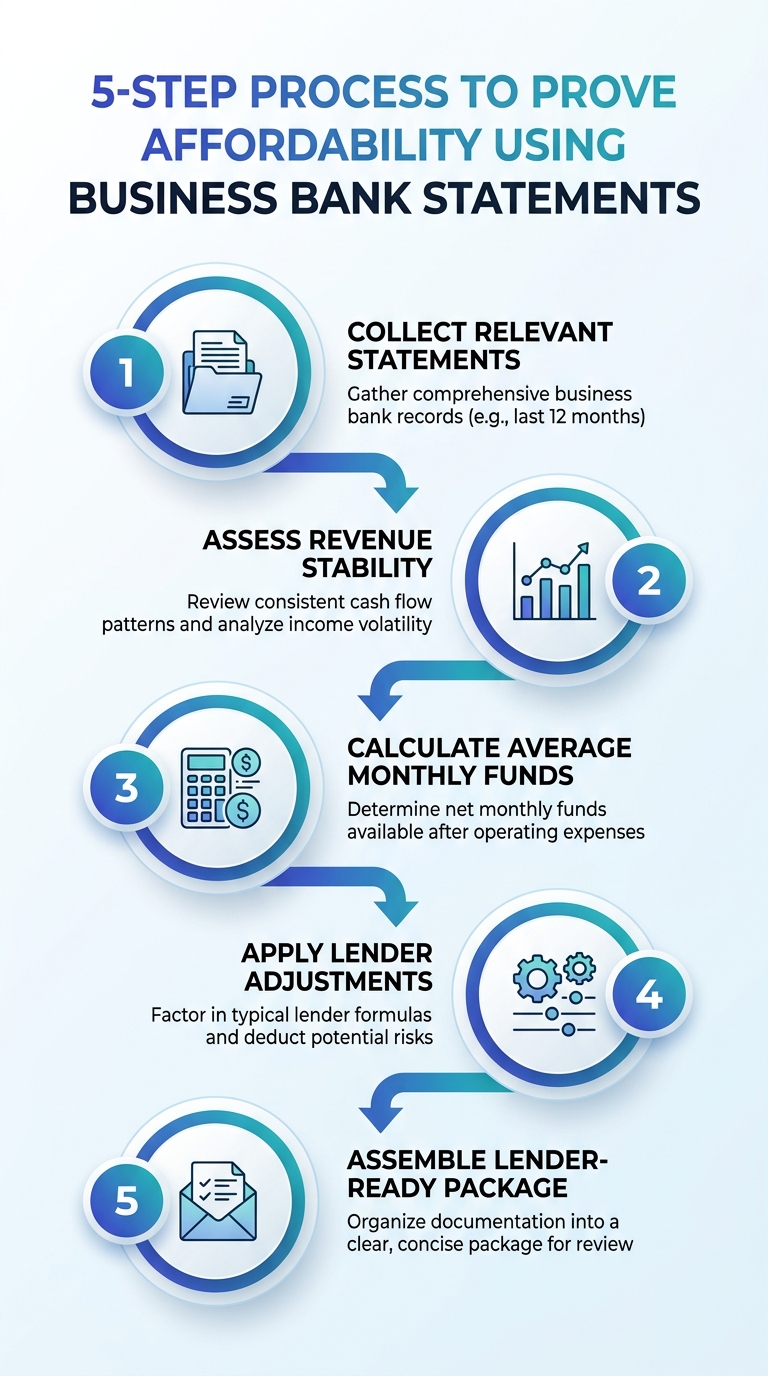

    Infographic detailing a 5-step process to prove affordability using your business bank statements.

    A visual guide outlining a simple five-step method to prove affordability using your business bank statements.

    Step 1: Gather the Right Number of Months

    Lenders vary in how many months of statements they require. Some may ask for 3 months, while others involved in non-standard income mortgage assessments may want 12 to 24 months to assess income trends across different trading periods.

    If your business is relatively new, reading our guide on lenders who work with newer businesses may help identify which lenders are likely to accept a shorter statement history.

    Step 2: Ensure Statements Are Complete and Unaltered

    Lenders require full, official statements, either downloaded directly from your bank or provided as originals. Edited PDFs or incomplete pages are likely to cause delays or trigger additional queries.

    This applies equally to a freelancer mortgage application as it does to a Ltd company director mortgage submission.

    Step 3: Reconcile Your Statements With Your Accounts

    Lenders may cross-reference your bank statements with your SA302s, tax year overviews, or company accounts. Any significant discrepancies may raise questions, so having a clear explanation ready is useful.

    For directors, your statements should align with the salary and dividend figures shown in your dividend and director income records. Any retained profits not drawn as salary or dividends may also need to be addressed separately.

    Step 4: Prepare a Supporting Narrative

    Business bank statements rarely tell the full story on their own. A brief written explanation, prepared with your broker or accountant, can help lenders understand seasonal variation, income gaps, or unusual transactions.

    This is especially relevant for those applying for a mortgage with irregular income or those whose income comes from multiple income sources. A letter from your accountant with income projections can complement your statements effectively.

    Step 5: Submit Through a Specialist Broker

    A specialist broker with experience in complex income mortgage UK cases will know which lenders are likely to view your statements most favourably. They can package your case before it reaches an underwriter, which may reduce the risk of an unnecessary decline.

    If you have previously been turned down by a high street bank, it is worth reading about why mainstream banks often reject self-employed applicants before reapplying elsewhere.

    Proving Affordability for Different Types of Complex Income

    The way you prove affordability using your business bank statements will differ depending on your income structure. Below, we outline the most common scenarios we encounter in the complex income mortgage UK market.

    Contractor Mortgage UK: Day Rate Income

    For a day rate contractor mortgage, some lenders will annualise your contract rate rather than relying on drawn income. A contractor earning £500 per day, for example, may have their income assessed on an annualised basis using a methodology such as the 46-week contractor multiplier, which reflects realistic working patterns.

    Business bank statements serve as supporting evidence that payments are arriving in line with the contract rate quoted. They also help confirm that there are no extended periods of non-activity that might otherwise concern a lender.

    For IT professionals specifically, our guidance on IT contractors with rolling contracts and freelance IT consultant mortgages covers how lenders interpret short-term and rolling arrangements.

    CIS Contractor Mortgage

    A CIS contractor mortgage presents its own challenges. Construction Industry Scheme workers often have income reported via CIS vouchers rather than traditional payslips, meaning bank statements play a particularly important role in confirming the regularity and volume of income received.

    Lenders sympathetic to CIS workers will typically look for consistent weekly or fortnightly credits alongside CIS deduction statements. Some lenders allow gross income (before CIS deductions) to be used for affordability purposes, which can significantly increase borrowing capacity.

    Ltd Company Director Mortgage

    For a Ltd company director mortgage, bank statements from both the business and personal accounts are usually required. Lenders need to see how salary and dividends flow from the company to the director, and specialist lenders may also consider net profit plus salary as a combined affordability figure.

    Some lenders will look at overall company performance rather than just drawn income. Understanding which lenders consider director dividends most favourably can help direct your application to the right place from the outset.

    Multiple Income Sources Mortgage

    Those applying for a multiple income sources mortgage face the additional challenge of presenting income from several streams in a coherent way. This might include a combination of PAYE employment, self-employed income, rental income, and contract work.

    Business bank statements help lenders trace each income stream separately, making it easier for underwriters to assess each component’s reliability. A lender comparison matrix can be useful in identifying which providers are experienced with multi-stream income cases.

    Umbrella Company Contractors

    Workers paid through umbrella companies occupy an interesting position. They receive payslips, but their actual income depends on contract value and hours worked. Bank statements showing consistent net pay from the umbrella, alongside the underlying contract details, help lenders build a picture of sustainable earnings.

    Our dedicated resource on umbrella company contractor mortgages covers how lenders treat this income type in 2026.

    Blog illustration

    Specific Situations Where Bank Statements Play a Critical Role

    Applying With One Year of Accounts

    If you have only been trading for one year, business bank statements become even more important as they may be the primary evidence of recent income. Some lenders will consider mortgage applications with just one year of accounts, particularly when bank statements demonstrate a strong and consistent trading pattern.

    Short-Term Contract Workers

    Lenders considering applicants on short-term contracts will often scrutinise bank statements carefully for evidence of gaps. Those with a track record of securing new contracts promptly, visible in the continuity of income credits on their statements, tend to be viewed more positively. Our page on lenders who accept short-term contracts provides further detail on relevant criteria.

    IR35 Status and Its Impact

    The way income reaches your business account can be affected by your IR35 status. Inside IR35 contractors typically receive income net of tax via their agency or end client, while outside IR35 contractors may invoice directly. This distinction affects how statements read to lenders, and understanding how IR35 status impacts your mortgage application is important before approaching lenders.

    Industry Experience as Supporting Evidence

    Some lenders factor in your length of experience in a given sector when assessing a contractor mortgage UK application. A contractor with 15 years in their field, for example, may be viewed as carrying lower income risk than someone newly self-employed. This is sometimes referred to as industry experience within mortgage criteria and can complement your bank statement evidence.

    Did You Know?
    24% of self-employed mortgage applicants reported experiencing at least one rejection in 2025, a significant improvement from 45% the previous year, yet still highlighting the gap that well-prepared bank statement evidence can help close.

    Common Mistakes That Weaken Your Affordability Case

    Even with strong income, certain patterns in business bank statements can raise unnecessary concerns with lenders. Being aware of these in advance allows you to address them proactively.

    • Large, unexplained credits: Lenders may question one-off deposits that are not obviously linked to business income. Being prepared to explain these (for example, a loan repayment, asset sale, or inter-account transfer) prevents delays.
    • Mixing personal and business expenses: Regular personal spending through a business account can muddy the affordability picture. Separating business and personal accounts well before application is advisable.
    • Inconsistent account naming: Statements should be in the name of the business or sole trader as it appears in your application. Discrepancies can cause queries.
    • Missing months in a statement sequence: Providing statements with gaps, even accidental ones, can trigger requests for further evidence and delay the process.
    • Declining balances over the period reviewed: A consistent downward trend in business account balances may concern lenders about the sustainability of your income. Where this reflects deliberate capital withdrawal or seasonal patterns, a supporting letter from your accountant can help.
    • Not disclosing all accounts: Lenders may ask for statements from all business accounts. Providing only your main account while omitting a secondary trading account can create inconsistencies.

    Blog illustration

    How to Prove Affordability Using Your Business Bank Statements With Professional Support

    Working with a specialist broker makes a meaningful difference to how your bank statements are presented and interpreted. A broker experienced in self-employed mortgage and complex income mortgage UK cases will know how to package your evidence in a way that suits specific lenders’ underwriting approaches.

    This is not simply about submitting documents. It involves understanding which lenders are likely to assess your income type most accurately, knowing how to frame your narrative, and selecting the right product at the right time.

    For professionals working in IT contracting and related fields, our resource on complex IT contractor pay structures and top mortgage options for professional contractors outlines lender preferences in that specific sector.

    If you are a director considering your options, reading about how to choose a specialist director mortgage broker provides practical guidance on what to look for in an adviser.

    Understanding How Your Day Rate Translates to Borrowing Power

    One of the most useful steps a contractor can take before applying is to understand how lenders will interpret their day rate. Our day rate mortgage calculator helps illustrate how an annualised day rate figure may translate into a borrowing estimate with appropriate lenders.

    This is relevant to both a day rate contractor mortgage and a broader non-standard income mortgage application, as it helps set realistic expectations before approaching lenders.

    Preparing Your Accounts and Projections

    For newer businesses, or those who have experienced an income shift, preparing your first year accounts carefully can directly support your bank statement evidence. Some lenders may also consider accountant-prepared income projections as supplementary evidence in a mortgage with irregular income case.

    “Lenders who engage with complex income cases do not simply count deposits. They assess the quality, consistency, and sustainability of the income your statements evidence. Presentation and context matter as much as the figures themselves.”

    Blog illustration

    Conclusion

    Knowing how to prove affordability using your business bank statements is one of the most practical steps you can take as a self-employed professional, contractor, or company director seeking a mortgage in 2026. Your statements are not just a record of transactions, they are evidence of how your business operates, how reliably income arrives, and how well you manage your financial affairs.

    Whether you are pursuing a self-employed mortgage, a freelancer mortgage, a CIS contractor mortgage, or a Ltd company director mortgage, the principles are similar: gather complete statements, ensure they align with your other financial evidence, and present them through an adviser who understands the complex income mortgage UK landscape.

    Specialist lenders exist specifically for people whose income does not fit a standard PAYE mould. With the right preparation and the right broker, proving affordability using your business bank statements is a manageable and achievable process.

    Your home may be repossessed if you do not keep up repayments on your mortgage. This article is intended as general educational information and does not constitute personal financial advice. Mortgage eligibility is subject to individual lender criteria, affordability assessment, and credit checks. Always seek independent advice tailored to your personal circumstances.

    Frequently Asked Questions

    How many months of business bank statements do I need for a self-employed mortgage in 2026?

    The number of months required varies between lenders. Many specialist lenders involved in complex income mortgage UK applications request between 3 and 12 months, while some may ask for up to 24 months for more unusual income structures. Speaking with a specialist broker can help identify which lender’s requirements best match the history you have available.

    Can I use my business bank statements instead of tax returns to prove affordability?

    Business bank statements are typically used alongside tax returns and accounts, not as a direct replacement. However, for some non-standard income mortgage applicants, particularly those early in their self-employment, statements can carry significant weight when other evidence is limited. Lenders may consider statements in combination with contracts, accountant letters, and other supporting documents.

    What if my business bank statements show irregular income? Will lenders reject me?

    Irregular income does not automatically prevent you from obtaining a mortgage with irregular income, but it does mean the right lender choice becomes more important. Specialist lenders use manual underwriting to assess patterns over time rather than applying blanket rules. A well-prepared case that explains the nature of income variation can be presented effectively to lenders who understand contractor and freelance income structures.

    How does a Ltd company director mortgage work if I leave profits in the business?

    Some specialist lenders will consider retained profits within your limited company as part of the affordability assessment, rather than limiting the calculation to drawn salary and dividends alone. Our guide on retained profit mortgages explains how this approach works and which types of lenders are likely to apply it.

    Do umbrella company contractors need to provide business bank statements for a mortgage?

    Umbrella company workers typically receive income as PAYE through the umbrella, so personal bank statements showing net pay are often the primary evidence. However, some lenders may also want to see the underlying contracts and client payment records to verify the basis of the income. Our resource on umbrella company contractor mortgages provides detail on how lenders handle this in practice.

    What can I do if I have been declined because of my business bank statements?

    A decline from one lender does not mean no lender will accept your application. High street lenders using automated systems may misread complex income, whereas specialist lenders applying manual underwriting may reach a very different conclusion with the same evidence. Reviewing the common reasons banks reject self-employed applicants can help you understand what went wrong and how to repackage your case.

    Is a day rate contractor mortgage assessed differently to a standard self-employed mortgage?

    Yes, lenders experienced with day rate contractor mortgages will often annualise the contract rate rather than using drawn income or accounts as the primary affordability metric. This can result in a significantly higher borrowing figure than a standard self-employed assessment would produce. Using a day rate mortgage calculation before applying can give a realistic indication of your potential borrowing capacity with appropriate lenders.