Tag: complex income

  • Director Mortgage Accounts: Why Do Company Profit and Drawings Differ for UK Lenders?

    Director Mortgage Accounts: Why Do Company Profit and Drawings Differ for UK Lenders?

    Director mortgage accounts help explain why UK mortgage lenders distinguish taxable personal drawings from retained company net profits: salary and dividends reach the director personally, while retained profit stays in the company after expenses, tax, debts and cash-flow needs. Specialist underwriters assess the chosen income method, ownership share, business sustainability and evidence against their criteria.

    Hayden Richards, CeMAP — Senior Mortgage & Protection Specialist

    Mortgage Accounts | Director Mortgage Accounts: Why Do Company Profit and Drawings Differ for UK Lenders?

    What is the difference between company profit and director drawings for a mortgage?

    Company profit and director drawings are different figures. Salary is paid to a director through payroll, while dividends are distributions to shareholders from profits available for distribution. Both can form part of the director’s personal income, but the company’s net profit is calculated before deciding how much, if any, to distribute.

    Retained profit remains in the business rather than automatically becoming the director’s personal income. The company may need to meet tax bills, repay debts, pay operating costs or maintain working capital, so the full accounting profit may not be available to draw.

    A director’s access to company profit also depends on their shareholding and the company’s obligations. If other shareholders own part of the business, the entire profit cannot simply be treated as one applicant’s income.

    Can you get a mortgage as a company director? Yes, but the affordability assessment depends on the lender’s criteria and the evidence supporting personal income or eligible company profit. Our guide to mortgages for limited company directors explains why different lenders can reach different assessments from the same accounts.

    A strong company bank balance on its own does not establish what the director can personally afford to repay. Underwriters need to understand both the business’s position and the income available to the applicant.

    How do UK mortgage lenders assess salary and dividends versus retained profit?

    Some lenders assess salary plus dividends shown in personal tax evidence. Others may consider salary plus the director’s share of net profit, which can produce a different affordability figure when the company retains profit rather than paying it out.

    Retained-profit assessment is not automatic. A specialist underwriter may consider the director’s ownership, the company’s performance, its obligations and whether using some profit for personal borrowing is consistent with the business’s ongoing financial needs.

    The table summarises common assessment approaches, not rules that apply to every lender. The documentation and limitations vary, so confirm which method a lender will use before relying on an affordability estimate.

    Comparison Salary + Dividends Salary + Share of Net Profit Director Loan / Drawings
    Assessment Method Salary and dividends received personally Salary plus the applicant’s eligible share of company net profit Review of director loan movements and drawings, not treating a loan as earnings
    Lender Type High-Street Banks Specialist Mortgage Lenders Commercial / Private

    The Limited Company Director Mortgage service is relevant when comparing these approaches because specialist lenders may assess salary, dividends, a share of net profit or retained profits. The method used still depends on the lender’s criteria and the evidence presented.

    For a lender-by-lender view of how assessment methods differ, use a lender comparison matrix that considers income structure alongside trading history and company evidence. A method that suits one director’s accounts may not suit another’s.

    An open ledger, calculator and mortgage paperwork arranged on a white office desk, with a grey London skyline beyond the

    Why do high-street banks decline directors who leave profit in their business?

    Where a lender bases affordability mainly on personal income, retained reserves may not increase the figure used in its assessment. The director has not received those funds as salary or dividends, so the company’s profit can look strong while the income shown in personal tax records remains comparatively low.

    Some specialist lenders may assess an eligible share of net profit or retained profit instead. They still examine the company’s financial position, the director’s ownership and whether profits are sustainable, rather than treating every pound in the accounts as personal income.

    Taking extra dividends solely to raise a mortgage income figure can have tax and business consequences. It also does not ensure that a lender will assess the new drawings in the way the director expects, so discuss the wider implications with an accountant before changing how income is taken.

    Our guide to director retained-profit mortgages focuses on accumulated company reserves and how some specialist assessments may take them into account. It helps explain why retained reserves and personal drawings should be presented as separate parts of the affordability picture.

    bd6a7c73 1097 4cb0 b036 daf04eccef20
    Did You Know?
    The average UK loan-to-income ratio for mortgage sales overall was 3.5 in 2025.

    Which documents prove director drawings and company profit to underwriters?

    Prepare personal income evidence and company evidence separately: they support different parts of the assessment. Personal documents may show taxable salary and dividends, while company records show profit, liabilities and recent trading.

    • Personal income: SA302 tax calculations, Tax Year Overviews, payslips and dividend vouchers.
    • Company performance: finalised company accounts and, where relevant, an accountant’s certificate or reference.
    • Recent trading: management accounts and business bank statements to explain current performance, cash flow or a change since the last completed accounts.
    • Director’s loan account: a record of movements, the balance and any repayment arrangements.

    SA302s and Tax Year Overviews provide evidence of figures submitted for personal tax purposes. HMRC provides information and services relating to these records through its official website.

    Management accounts can help explain what has happened since the latest finalised accounts, but they are current-period figures, not a replacement for completed accounts. If filed accounts, management figures and bank activity differ, ask the accountant to reconcile the periods and explain the reasons clearly.

    For example, an apparent change may relate to when income or costs were recorded, a shift in the company’s year-end, or a change in cash flow. Give the underwriter a consistent timeline rather than submitting figures that appear to contradict one another.

    A director’s loan account is not earned income. An overdrawn balance may affect the director’s personal liabilities and the company’s cash position, so explain its current balance and repayment clearly rather than presenting it as salary or dividend income.

    The Director Logic Check analyses salary, dividends and company performance against lender criteria using the latest accounts or estimates. It is relevant when figures need to be assessed together before an application is prepared.

    A wide view of a contemporary British home at dusk, with a closed financial folder and keys on a foreground table suggesting

    How does corporate shareholding percentage determine allowable borrowing?

    Shareholding can affect whether a lender treats an applicant as a director with influence over company income or assesses them more like an employee. Lenders use different criteria and thresholds, so establish how the applicant’s ownership will be classified before interpreting an affordability figure. The limited company director mortgage FAQ also covers director classification.

    Where a lender assesses a share of net profit, the applicant’s ownership proportion matters. The underwriter also considers company debts and obligations, and whether the profit appears sustainable, because the accounting figure alone does not show how much is available to support personal borrowing.

    For a recently incorporated business, a conversion from sole-trader status or a short trading history, organise the evidence into a timeline. Include earlier accounts, current performance and relevant industry experience, with contracts or accountant-supported projections where they help explain the business’s position.

    Projections and contracts can provide context, but they do not replace the lender’s required evidence. Explain how the business moved from its previous structure to the current company, and ensure the dates and income figures align across the documents.

    Losses or falling profits can weaken the affordability picture even when personal drawings appear stable. Set out the trend and any material changes using consistent figures so that an underwriter can assess the direction of the business as well as its latest result.

    Director mortgage accounts can therefore depend on more than the amount drawn personally. Ownership, trading history and the company’s ability to sustain its profits all influence which evidence and assessment method may be relevant.

    Did You Know?
    The UK median loan-to-value ratio for first-time buyers was 85.6% in 2025.

    See also: Self-Employed Mortgages UK – Sole Traders, Directors & Contractors, Contractor Mortgages, Complex Cases, Complex Income, One Year Accounts Mortgage, Buy a House Through a Limited Company – Business Owner Mortgages UK, Overseas Income, Foreign National Complex Income Mortgage Advice, Dual Income Households, Cis Contractor Mortgage, Ir35 Contractor Mortgage, Zero Hours Contract Mortgage, Portfolio Landlord Mortgage, Foreign National Mortgage, Self Employed Mortgage Faq, Director Salary and Dividend Mortgage FAQ – How UK Lenders Assess the Mix, Day Rate Contractor Mortgage Faq, Ir35 Mortgage Faq, Umbrella Company Mortgage Faq, Mortgage Underwriting Faq, Contractor Mortgages, Cis Worker Mortgages, Mortgage Without Payslips Faq, Freelancer Mortgage Faq, Overseas Income Mortgage Faq, Expat Mortgages Uk.

    Two account statements showing company profit and personal drawings lie side by side on a stone office table, with a blurred

    Frequently asked questions about director mortgage accounts

    Can you get a mortgage if you are a director of a company?

    Yes, a company director can apply for a mortgage, and the lender will assess the full application rather than the job title alone. The outcome depends on its income criteria, household commitments, credit history and the property being purchased, together with evidence that supports the director’s stated income.

    Can a director apply for a mortgage before the first full set of company accounts is filed?

    In some cases, a lender may consider an application before the first full accounts are filed, but it will need other evidence to understand the business. An accountant’s information, current trading records and relevant contracts may help explain the case, while the lender decides whether those materials meet its requirements.

    How can a changed company year-end affect a director’s mortgage application?

    A changed year-end can leave accounts covering periods of different lengths, making direct year-on-year comparisons less clear. Ask the accountant to set out the dates each set of accounts covers and reconcile the periods so that the underwriter can distinguish a genuine change in performance from a difference in accounting period.

    Can a partner’s PAYE income be combined with a director’s income for a mortgage?

    Yes, a joint application can include a partner’s PAYE earnings alongside director income if the lender accepts both applicants and their respective evidence. The lender assesses the applicants’ combined income and commitments under its criteria, so the partner’s payslips do not change how the director’s company figures are assessed.

    Can a director use accounts from a sole-trader business after incorporating?

    Earlier sole-trader accounts may help explain the business’s trading history after incorporation, particularly where the activity and customers continued under the company. The underwriter will need a clear account of what changed at incorporation, which assets or contracts transferred, and how the old and new figures relate without treating the two legal structures as identical.

    For more detail on retained-profit evidence and lender questions, see our frequently asked questions about director retained-profit mortgages.

    What should directors prepare before discussing a mortgage?

    Start by separating personal taxable drawings from company profit, then identify which assessment method fits the accounts and ownership structure. Reconcile personal tax records, finalised accounts, current management figures and business banking before relying on an affordability estimate.

    Director mortgage accounts can produce different outcomes with different lender criteria. An accountant can help make the financial records consistent, while a mortgage adviser can assess which evidence and income method may be relevant to the application.

    Mortgage advice is regulated in the UK. Consumers can use the Financial Conduct Authority website to find information about financial services and regulation.

    YOUR HOME MAY BE REPOSSESSED IF YOU DO NOT KEEP UP REPAYMENTS ON YOUR MORTGAGE.
    The guides and articles on this website are provided for general information only.
    Mortgage advice is provided by Hayden Richards, CeMAP-qualified, as a Registered Individual of Marklay Mortgages Ltd, authorised and regulated by the Financial Conduct Authority (FRN 930490). Richards & Logic is a trading style of MarketMedia Ltd (07765565).

    Related guides: Specialist Director Mortgage Broker Guide for Limited Company Directors in 2026 · Top Mortgage Options for Professional Contractors and Consultants in 2026


  • Remortgaging with Complex Income: How UK Lenders Assess Your Application

    Remortgaging with Complex Income: How UK Lenders Assess Your Application

    Remortgaging with Complex Income: How UK Lenders Assess Your Application

    Remortgaging with complex income means showing how each income source is earned, evidenced and likely to continue. A product transfer with your current lender and a remortgage to a new lender can involve different assessments.

    This is general information, not personal advice.

    Remortgaging Complex Income | Remortgaging with Complex Income: How UK Lenders Assess Your Application

    What counts as complex income when you remortgage?

    Complex income can include overtime, commission, bonuses, several income sources, self-employed earnings, company-director income and contractor pay. These sources may vary in amount or be evidenced in different ways, so lenders can assess each under different criteria.

    For a full remortgage to a new lender, expect an assessment against that lender’s affordability and underwriting criteria. A product transfer, which means changing your mortgage deal with your existing lender, may follow that lender’s own process. Both routes can involve different income checks, particularly if you are asking to borrow more.

    The remortgage complex-income FAQ explains how the route can affect an application. For a wider explanation of income, affordability and lender decisions, see the UK mortgage underwriting FAQ.

    How variable and additional income may be assessed

    For overtime, commission and bonuses, lenders may consider the payment pattern, how consistently the income has been received and whether it appears sustainable. An occasional payment can be treated differently from ongoing income. A lender may average variable pay or use only a proportion of it, but the method depends on the lender, income type and evidence.

    The Bonus Income Mortgage FAQ covers how lenders may assess bonus calculations, payment timing, supporting evidence and discretionary awards. It is relevant if a bonus forms part of your affordability picture, because the amount paid and its pattern can matter as much as the headline figure.

    Commission should be shown as income actually received, not simply as potential earnings in a remuneration plan. For commission, the Commission Income Mortgage FAQ sets out the evidence and calculation approaches lenders may use. Overtime is another variable source; the overtime income guidance covers how its pattern may be assessed.

    Rental, pension, investment and benefit income may be considered where relevant. The treatment depends on the source, its continuity and the lender’s criteria. When income comes from PAYE, freelance, rental or dividends, lenders may assess the combination differently from a single salary; the multiple-income-sources FAQ sets out evidence and assessment for different income streams.

    Separate regular contractual pay from discretionary or irregular earnings. That gives the lender a clearer account of the income available for mortgage repayments and avoids presenting occasional bonus, overtime or commission as dependable future income.

    A contemporary British townhouse with a subtle home-office window, photographed alone in soft overcast light, its clean

    How lenders assess self-employed people, directors and contractors

    For a sole trader, lenders may assess taxable profit shown in accounts or tax records. Turnover is the business’s revenue before costs; it is not the same as personal income available for mortgage repayments.

    For a limited company director, distinguish salary and dividends from company turnover and retained profits. Company accounts and personal tax records can help show how the figures relate. Some lender criteria may allow retained profits to be considered in particular circumstances, but money held in a company is not automatically treated as personal income.

    A director remortgage therefore needs a clear explanation of how income is drawn and what remains in the company. The figures on company accounts, tax calculations and personal bank statements may differ because they record different things.

    A day-rate contractor, a fixed-term contractor and someone working through a limited company or umbrella company have different working arrangements. Lenders may assess a contractor’s income using the contract structure and evidence of ongoing work; they may use an annualised day rate in some cases. An applicant’s IR35 position can also relate to how the work is structured, so keep the description consistent rather than combining different contractor categories.

    Contractors working through a limited company, umbrella company or fixed-term contract are the focus of the Contractor mortgages FAQ. It suits this part of the assessment because it distinguishes those arrangements and explains why the contract and income evidence matter. For every category, trading-history requirements and income calculations vary by lender.

    How affordability, outgoings and borrowing amount fit together

    Lenders typically assess income alongside household spending, credit commitments and other financial responsibilities. These affect the amount available for mortgage repayments. They may also assess creditworthiness and the property being mortgaged, so a high stated income alone does not determine borrowing capacity.

    Lenders may consider gross income supported by payslips, accounts or tax records. Their affordability assessment also takes account of tax, regular spending and commitments. Gross income is therefore not the same as the amount left to meet mortgage payments.

    If you request additional borrowing or equity release through a remortgage, the total loan and property value determine the loan-to-value (LTV) calculation. Affordability and LTV are separate considerations: a requested amount may fit one measure but still be outside the lender’s affordability assessment or other criteria. LTV limits vary by lender and are subject to change.

    Repayment and interest-only mortgages have different repayment structures. With a repayment mortgage, regular payments cover interest and reduce the amount borrowed over the term. With interest-only borrowing, the capital remains outstanding, so the lender also assesses the proposed repayment strategy alongside affordability.

    An empty professional office meeting table holds neatly organised income documents and a calculator, with a softly blurred

    What evidence can support a complex-income application?

    Do you have to prove income when remortgaging? For an application to a new lender, expect to provide evidence that supports the income and affordability figures. The documents requested vary with the income source and the lender’s process.

    Commonly requested records include payslips, bank statements, tax returns, SA302 tax calculations, tax year overviews and business accounts. A lender may also ask for a current contract, an accountant’s reference or other evidence relevant to your work. For presenting income structure, retained profits, dividends and contractor earnings, see the self-employed mortgage advice page. It is relevant when your personal and business figures need to be read together.

    For a sole trader or company director, use records that distinguish personal income from business turnover, profit and retained funds. Explain how salary, dividends or drawings relate to the figures in the accounts and tax records. The self-employed mortgage FAQ covers commonly requested tax, account and bank records.

    For variable pay, arrange the available evidence so the timing and pattern of overtime, commission or bonuses are clear. A single unusually high payment does not show whether the income is recurring. If payslips, bank statements, accounts and tax records show different totals, explain the timing, deductions or income category behind the difference and keep the application figures consistent.

    For a comparison of how lender criteria can differ across complex-income types, consult the lender comparison matrix. Criteria can change, so a comparison is a starting point for understanding assessment methods, not a substitute for checking the relevant lender’s current requirements.

    How income changes and future stability can affect the assessment

    A recent fall in income can reduce the amount a lender considers affordable. Explain why the change occurred and support your current position with relevant evidence; higher past earnings alone may not represent the income available now.

    A history of variable income can help show its pattern, but lenders may also consider whether it is likely to continue and whether expected changes could affect your ability to maintain repayments. Disclose a new role, a gap between contracts or a change in business earnings. Unexplained differences make the income picture harder to assess.

    Do not present occasional bonuses, overtime or commission as dependable future income. Set out what you have received, how often it has been paid and whether there is evidence it may continue.

    If you have a short trading history, the guidance on applying with one year of self-employed accounts explains why lenders may assess continuity, trading history and the supporting evidence differently.

    A modern British apartment building at blue hour, warmly lit windows contrasting with a cool city skyline, seen from a quiet

    How to prepare and compare remortgage options

    Before comparing routes, write down each income source, the evidence supporting it, regular outgoings and credit commitments. That gives you a consistent account to use when a lender asks how the figures were calculated.

    Compare the amount you want to borrow and the total costs involved. Include product fees and any early repayment charge (ERC) on your existing mortgage. These costs can affect whether a new deal or additional borrowing makes sense; do not judge an option by its headline interest rate alone.

    Ask how the proposed route treats your specific income structure and any additional borrowing. A self-employed remortgage in the UK, a contractor remortgage and an application with several income sources can each raise different evidence questions. Lender criteria and assessment methods vary.

    When a broker may be useful

    A broker experienced in complex income may be useful where your accounts, contracts and personal income figures need to be reconciled before an application is submitted. The process should begin with a feasibility assessment: validate the figures, identify questions an underwriter may raise and decide which lender criteria fit the case. The complex-cases page explains the type of cases covered.

    Common pitfalls

    • Assuming every lender treats variable or secondary income in the same way.
    • Confusing business turnover or company profits with personal income available for repayments.
    • Leaving out an income source, credit commitment or unusual transaction that needs explaining.
    • Relying on a single high payment to represent ongoing variable income.
    • Starting a new-lender application without checking fees and any ERC on the existing mortgage.

    Practical checklist

    • List each income source and separate contractual pay from variable or discretionary earnings.
    • Gather the relevant payslips, bank statements, tax records, accounts and contracts.
    • Reconcile differences between personal and business records, and explain the reason for them.
    • Set out regular household spending, credit commitments and the borrowing amount requested.
    • Compare the product transfer and new-lender route, including fees, ERCs and any additional borrowing.
    • Allow time to answer lender questions and provide a consistent explanation of the figures.

    Frequently asked questions

    How long can a complex-income remortgage take from application to completion?

    Manual underwriting can take 2–6 weeks from a full application to an offer when documents are supplied promptly and there are no complications, as outlined in the underwriting guidance. Completion takes place after the offer and can take longer depending on the legal and lender processes involved.

    Can I remortgage while I am in a probationary period at work?

    A probationary period does not produce one outcome across all lenders; the employment terms and wider affordability assessment matter. Be ready to explain your start date, contract and probation status if the lender asks for clarification.

    Can I remortgage while on maternity or parental leave?

    A lender may assess income during leave alongside the confirmed terms of your return to work, but its criteria determine how those figures are treated. Evidence of leave pay and the agreed return-to-work arrangement may help explain the income position.

    Can income from renting a room to a lodger count towards affordability?

    Lender treatment of lodger income varies, and it may be assessed differently from rent received from a separate property. Ask whether the lender includes income from your specific arrangement and what evidence it requires.

    Will applying for a remortgage affect my credit score?

    A lender may review your creditworthiness as part of underwriting, and an application can involve a credit search. The effect depends on the search process and how it is recorded, so ask the lender what type of search it will carry out before submitting a full application.

    Your home may be repossessed if you do not keep up repayments on your mortgage. Mortgage advice is provided by Hayden Richards, CeMAP-qualified, as a Registered Individual of Marklay Mortgages Ltd, authorised and regulated by the FCA (FRN 930490).

    Related guides: The Specialist Mortgage Adviser’s Guide to Complex Income · Finding Lenders Who Understand Complex IT Contractor Pay Structures in 2026

  • Inside IR35 Mortgage: How It Affects Borrowing Capacity (2026 Guide)

    Inside IR35 Mortgage: How It Affects Borrowing Capacity (2026 Guide)

    Inside IR35 Mortgage: How It Affects Your Borrowing Capacity (2026 Guide)

    Applying for an inside IR35 mortgage directly affects how UK lenders calculate your borrowing capacity, rather than your eligibility. High-street lenders assess net umbrella payslip income after statutory employment deductions. Conversely, specialist lenders assessing an inside IR35 mortgage annualise gross contract day rates, which can significantly increase borrowing power. All applications remain subject to underwriting and status.

    Inside IR35 mortgage affordability assessment paperwork and contractor day rate calculations on desk
    Inside IR35 mortgage affordability is determined by whether an underwriter uses net umbrella pay or annualised day rates.

    How Do UK Lenders Assess an Inside IR35 Mortgage?

    Securing an inside IR35 mortgage involves navigating how your earnings are paid and evidenced, rather than proving whether you qualify. In the UK, mortgage providers evaluate inside-IR35 applicants through one of two distinct routes: standard employment payslip assessment or specialist contract-based underwriting.

    The HMRC off-payroll working rules on GOV.UK establish tax status and deemed employment for contractors. However, HMRC rules do not dictate how mortgage underwriters determine affordability. The Prudential Regulation Authority (PRA) and the FCA MCOB responsible lending standards require providers to ensure borrowing is sustainable, leaving specific calculation models to individual lender criteria.

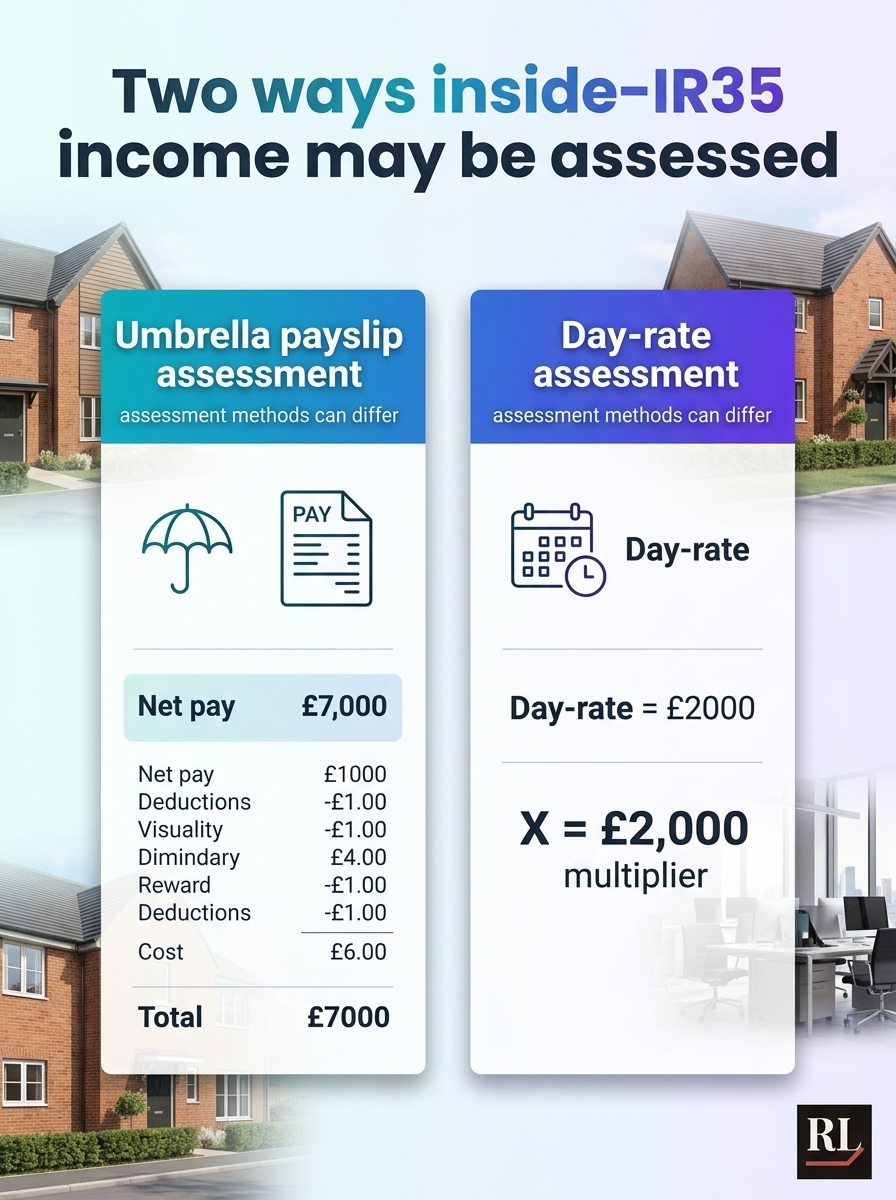
    Mainstream high-street lenders typically treat you as a fixed-term employee or agency worker. They assess the net pay figures reported on umbrella payslips. Because umbrella deductions reduce your visible net salary, this route frequently leads to a compressed borrowing figure.

    By contrast, specialist contractor lenders evaluate your application as an independent professional. They look past the payroll mechanics to calculate an inside IR35 mortgage using the gross contract assignment value. For further context on contract criteria, see our dedicated guide to IR35 contractor mortgages.

    Why Does Umbrella Net Pay Reduce Inside IR35 Mortgage Borrowing Capacity?

    When working through an umbrella company, your top-line invoice amount is the assignment rate. Crucially, this rate does not represent pure personal salary.

    Before your taxable pay is calculated, statutory employer costs are deducted from the assignment rate. These include Employer National Insurance Contributions (NICs), the Apprenticeship Levy, and the umbrella margin fee. Only after these deductions are made are employee NICs, PAYE income tax, and pension contributions subtracted from your taxable pay.

    High-street mortgage calculators input the net or basic taxable pay shown on umbrella payslips. They do not recognise that the contract rate was structured to absorb employment overheads. Consequently, an inside IR35 mortgage assessed on the high street is calculated against an artificially suppressed baseline.

    To understand how umbrella deductions are treated by underwriters, consult our umbrella company mortgage FAQ.

    How Does Day-Rate Underwriting Work for an Inside IR35 Mortgage?

    Specialist contractor underwriting determines your inside IR35 mortgage borrowing capacity using the top-line gross contract rate rather than net payslips. Lenders in this sector convert your agreed day rate into an annualised gross income figure.

    The established industry formula takes your day rate, multiplies it by the contracted days per week (typically five), and then multiplies by a standard working year, commonly 46 or 48 weeks. This standard deduction builds in allowance for unpaid annual leave and expected gaps between projects.

    For example, a contractor earning £500 per day over five days per week across 46 weeks is assessed as having an annualised gross income of £115,000. Specialist lenders apply standard borrowing multiples (typically 4.5 times income) directly to this gross figure, subject to credit score and personal liabilities.

    This underwriting methodology ensures your genuine earning capability is reflected when applying for an inside IR35 mortgage. You can explore contractor affordability mechanics in our contractor mortgage guide and our day-rate contractor FAQ.

    Comparison: Umbrella Payslip vs Day-Rate Multiplier Routes

    Assessment Factor High-Street Umbrella Route Specialist Day-Rate Multiplier Route
    Income Baseline Net or basic taxable pay from umbrella payslips. Gross contract day rate annualised across 46–48 weeks.
    Borrowing Capacity Impact Compressed borrowing limit due to employer taxes and fees. Substantially higher borrowing power reflecting gross earnings.
    Contract Requirements Standard employment proof; contract may be treated as fixed-term. Formal contract showing day rate and minimum remaining term.
    Track Record Needed Typically 3 to 6 months of continuous payslips. Usually 12 to 24 months of continuous contracting history.
    Comparison of umbrella payslip assessment vs day rate multiplier assessment for inside IR35 mortgages

    What Documents Are Required for an Inside IR35 Mortgage Application?

    Packaging an inside IR35 mortgage application requires clear documentation reconciling both your contractual terms and payroll receipts. Thorough evidence preparation prevents underwriting delays.

    To qualify for a day-rate calculation, you must provide your current signed contract detailing the day rate, start date, and contracted hours. If the assignment has under six weeks remaining, an extension letter or email confirmation from your end client or agency is generally necessary.

    Specialist lenders will also request your last three months of consecutive umbrella payslips together with matching bank statements. This allows underwriters to verify that contract billing aligns with actual deposits.

    If you recently switched from an outside-IR35 limited company to an inside-IR35 assignment, submit your previous company accounts and SA302 calculations. This documents uninterrupted career continuity in your sector.

    Modern British townhouse with mortgage worksheet on window desk for inside IR35 contractor home purchase
    Contract continuity allows inside IR35 contractors to secure high-value residential mortgages across the UK market.

    Can Gaps Between Contracts Affect an Inside IR35 Mortgage?

    Contract continuity is a primary consideration for underwriters assessing an inside IR35 mortgage. Planned gaps between contracts for holidays or professional development are standard practice and widely accepted within limits.

    Most specialist mortgage lenders comfortably accommodate assignment gaps of up to four to six weeks. For gaps exceeding eight weeks, underwriters examine your broader sector experience, accumulated savings reserves, and ongoing market demand for your skillset.

    A proven track record of twelve to twenty-four months in contracting reassures lenders that gaps are voluntary. Applying while an active contract is in place ensures the strongest borrowing assessment.

    Frequently Asked Questions

    Does changing from outside to inside IR35 affect a remortgage?

    Switching from an outside IR35 limited company to an inside IR35 umbrella contract changes the documentary evidence required. A straightforward product transfer with your existing lender rarely triggers fresh affordability checks. However, remortgaging to a new lender or raising extra capital requires a full reassessment based on current contract or umbrella terms.

    Can umbrella company pension contributions reduce mortgage borrowing?

    Salary-sacrifice pension contributions reduce the taxable net pay displayed on umbrella payslips. On high-street affordability models, this lower net income directly restricts borrowing. Specialist lenders assessing an inside IR35 mortgage calculate affordability before pension deductions, protecting your borrowing capacity.

    How soon after starting an inside IR35 contract can I apply?

    Specialist lenders can consider an inside IR35 mortgage application immediately upon signing a new contract, provided you have at least twelve months of continuous contracting history in the same profession. High-street lenders typically require a minimum of three consecutive months of umbrella payslips before considering an application.

    Can a joint applicant’s salary be combined with inside IR35 day-rate income?

    Yes. Specialist lenders regularly assess joint applications where one borrower is an inside IR35 contractor and the other is an employed or self-employed earner. The contractor’s day rate is annualised, the secondary applicant’s verified income is added, and household commitments are subtracted to determine joint borrowing capacity.

    YOUR HOME MAY BE REPOSSESSED IF YOU DO NOT KEEP UP REPAYMENTS ON YOUR MORTGAGE.

    The guides and articles on this website are provided for general information only. They are not tailored to your personal circumstances and should not be treated as financial advice or a personal recommendation. If you would like advice based on your individual circumstances, please speak to an adviser.

    Mortgage advice is provided by Hayden Richards, CeMAP-qualified, as a Registered Individual of Marklay Mortgages Ltd, which is authorised and regulated by the Financial Conduct Authority (FRN 930490). Richards & Logic is a trading style of MarketMedia Ltd (registered in England and Wales, 07765565).

  • How do UK lenders assess a first-time buyer with complex income?

    How do UK lenders assess a first-time buyer with complex income?

    In the United Kingdom, a first-time buyer with complex income is assessed on two fronts at once. The lender must verify non-standard earnings, such as a short self-employed record, and accept a buyer with no mortgage history. Deposit size and source also carry more weight. Specialist lenders assess these cases manually, subject to status, valuation and underwriting.

    Hayden Richards, CeMAP — Senior Mortgage & Protection Adviser
    Last reviewed: 17 September 2026
    Written for: The One-Year-Accounts Applicant

    Why is a first-time buyer with complex income harder to assess?

    A first-time buyer with a salaried job fits standard lending rules well. So does an established self-employed homeowner moving house. The difficulty comes when both unfamiliar factors sit in the same application.

    A lender assessing complex income — earnings that do not follow a simple PAYE pattern — looks for a track record. A first-time buyer has no mortgage track record to offer. Each gap makes the other harder to look past.

    Many first-time buyers with complex income are also early in their working pattern. Someone who moved from employment to self-employment recently may have both a short trading history and no prior mortgage.

    Why does a short trading history matter so much?

    Self-employed income is usually evidenced through tax records. The key document is the SA302, with its matching tax year overview. An SA302 is the tax calculation HMRC produces from a Self Assessment return. HMRC explains how to obtain these on its SA302 guidance page.

    Many mainstream lenders ask for two or more years of this evidence. With only one year, the application falls outside their rules before affordability is considered. The lender is not doubting the income. Its rules simply cannot assess it.

    Some specialist lenders will consider one year of accounts. They typically look for continuity with previous work, such as the same trade carried on as an employee. Our page on mortgages with one year of accounts covers that assessment in more detail.

    How does having no mortgage history affect the assessment?

    A homeowner remortgaging or moving has a record of mortgage payments. That record is strong evidence of how they manage a secured debt. A first-time buyer cannot provide it.

    Lenders instead rely on the wider credit file held by UK credit reference agencies: Experian, Equifax and TransUnion. Rent, utility, credit card and loan conduct all contribute. A thin file, with few accounts, gives an underwriter less to work from.

    A thin file is not the same as a poor one. It can, however, narrow the lenders willing to combine it with non-standard income.

    Why do deposit size and source carry more weight?

    Loan to value is the loan as a proportion of the property’s value. First-time buyers often borrow at higher loan to value, because their deposit has come from savings rather than equity.

    Specialist criteria for complex income tend to be widest at lower loan to value. As the deposit shrinks, fewer lenders offer products for non-standard income. A larger deposit does not remove the income question, but it can widen the lender pool.

    The source of the deposit is checked as well. UK anti-money laundering rules require lenders to verify where the funds came from. Savings need a visible trail, and a gifted deposit usually needs a signed letter confirming it is not a loan.

    Affordability evidence files for a first-time buyer with complex income

    How do the main types of complex income compare for a first-time buyer?

    The table below sets out, in general terms, where each income type tends to meet friction. Criteria differ between lenders, so this describes common patterns rather than fixed rules.

    Income type Common friction point Evidence usually requested Constraint to weigh
    Newly self-employed sole trader Short trading record SA302s, tax year overviews, accountant’s reference Smaller lender pool with one year of figures
    Limited company director Low salary and retained profit SA302s, company accounts, accountant’s reference Profit-based lenders are fewer and may ask for more documents
    Day-rate contractor Contract length and gaps between contracts Current contract, contract history, bank statements Some lenders annualise the day rate, others use tax records
    Mixed employed and self-employed One stream may be discounted Payslips plus self-employed tax records The weaker stream can limit the combined assessment
    Foreign currency income Exchange rate risk and verification Overseas payslips or accounts, bank statements, residency evidence Lenders may reduce the income figure to allow for currency movement

    How does manual underwriting help in these cases?

    Manual underwriting means a person reviews the application rather than an automated rule alone. It suits cases where the evidence needs reading in context.

    An underwriter can weigh a short trading record against prior experience in the same field. They can review a thin credit file alongside consistent rent payments. Automated systems generally cannot make those judgements.

    Manual review is not a softer standard. It is usually slower, and it often involves more questions and more documents. The general mechanics are covered in our mortgage underwriting FAQ.

    What are the trade-offs of specialist lending for a first-time buyer?

    Specialist criteria can make an application assessable where mainstream rules cannot. That benefit comes with constraints.

    • Narrower choice. Fewer lenders assess complex income at higher loan to value.
    • Potential added cost. Some lenders in this segment price for the extra assessment work.
    • Longer timescales. Manual review and additional evidence usually add time to an application.
    • Heavier documentation. Tax records, accounts, deposit trail and identity checks all need to be consistent.

    A decline from one lender is not a decline from all. Each lender applies its own criteria, and a case outside one set of rules may sit within another. For a wider view of how income types are assessed, see complex income mortgages.

    Frequently asked questions

    Can a first-time buyer be self-employed with only one year of accounts?

    Some specialist lenders consider one year of accounts, including for first-time buyers. They usually look for continuity with earlier work in the same field and a clear credit file. Many mainstream lenders ask for a longer record. With one year of figures, the lender pool is narrower, and deposit size can further limit it.

    Do lenders treat first-time buyers with complex income differently from home movers?

    Income is assessed in much the same way. The difference is the supporting evidence. A home mover has mortgage payment history and usually equity for a deposit. A first-time buyer relies on the wider credit file and on savings or a gift. That can reduce the lenders willing to accept the combination.

    Is a gifted deposit accepted alongside complex income?

    Many lenders accept gifted deposits, subject to their criteria. The giver usually signs a letter confirming the money is a gift. It states that no repayment is expected and no share in the property is held. Some lenders restrict who can gift. Anti-money laundering checks apply to the giver’s funds as well as the buyer’s.

    Does a thin credit file stop an application?

    Not necessarily. A thin file has limited history rather than negative history. Lenders review what is available, such as bank accounts, credit cards and regular bills. Combined with complex income, a thin file may reduce the number of lenders willing to proceed, particularly at higher loan to value.

    Why might a larger deposit help with complex income?

    Specialist criteria for non-standard income are generally widest at lower loan to value, because the lender’s risk is lower. A larger deposit can therefore open more of the market. It does not change how income is verified, and affordability rules still apply to the amount borrowed.

    YOUR HOME MAY BE REPOSSESSED IF YOU DO NOT KEEP UP REPAYMENTS ON YOUR MORTGAGE.

    The guides and articles on this website are provided for general information only. They are not tailored to your personal circumstances and should not be treated as financial advice or a personal recommendation. If you would like advice based on your individual circumstances, please speak to an adviser.

    Mortgage advice is provided by Hayden Richards, CeMAP-qualified, as a Registered Individual of Marklay Mortgages Ltd, which is authorised and regulated by the Financial Conduct Authority (FRN 930490). Richards & Logic is a trading style of MarketMedia Ltd (registered in England and Wales, 07765565).

  • How to get a mortgage with non-standard income in 2026

    How to get a mortgage with non-standard income in 2026

    Lenders approve non-standard income by verifying it against evidence that matches how the applicant earns. Self-employed applicants are assessed on accounts and tax records, contractors on day rates, and directors on salary plus dividends or profit. Approval depends on documentation quality, income sustainability, and applying to lenders whose criteria fit the income type.

    What counts as non-standard income for UK mortgage lenders?

    Non-standard income is any income that does not arrive as a single, fixed PAYE salary. It is not a barrier to lending. It simply changes the evidence a lender asks for and the way affordability is calculated.

    Common examples include:

    • Self-employed income from a sole trade or partnership.
    • Salary and dividends drawn by a limited company director.
    • Day-rate contracting, whether through a limited company or an umbrella arrangement.
    • Freelance income from multiple clients or platforms.
    • Bonus, commission or overtime that makes up a large share of total pay.
    • Income earned overseas or paid in a foreign currency.
    • Rental income, pension income or investment income used alongside earnings.

    Each of these has an established underwriting route. The guides on complex income mortgages and complex cases cover the categories in more depth.

    What evidence do lenders ask for in 2026?

    The evidence requirement follows the income type. Lenders are less interested in how income is labelled than in whether it can be verified and is likely to continue.

    Income type Typical evidence Common lender approach
    Sole trader / partnership SA302s and tax year overviews, usually two years; business bank statements Average of the last two years’ profit, or the latest year if lower
    Limited company director Company accounts, SA302s, accountant’s reference Salary plus dividends; some lenders use salary plus share of net profit
    Day-rate contractor Current and previous contracts, bank statements, CV Day rate multiplied by contracted days over 46–48 weeks
    Bonus / commission earners Payslips, P60s, employer reference A percentage of variable pay averaged over one to two years
    Foreign currency income Payslips or contracts, bank statements, visa or residency evidence Income converted to sterling, often with a discount for exchange-rate risk

    An SA302 is HMRC’s summary of the income declared on a self assessment tax return. A tax year overview is the companion document confirming the tax due and paid. Lenders normally ask for both together.

    How do lenders assess self-employed applicants?

    Most lenders ask for two years of trading history. They then either average the last two years’ profit or use the latest year if profits are falling. Rising profits are usually averaged; a sharp fall triggers questions rather than automatic decline.

    A shorter trading history narrows the lender pool but does not close it. Some lenders will consider a strong first year, which is covered in the guide to one-year accounts mortgages.

    Consistency matters more than size. Deposits into the business account should reconcile with invoices, and the figures on the SA302 should match the accounts. Unexplained gaps between the two are a common reason files stall, a point expanded in the self-employed mortgage guide.

    How are contractors and company directors assessed?

    Day-rate contractors are often assessed on gross contract value rather than accounts. A typical calculation is the day rate, multiplied by five days, multiplied by 46 to 48 weeks. Lenders look for contract continuity, sensible gaps between contracts, and time remaining on the current contract. The contractor mortgage guide sets out the variations.

    Limited company directors are usually assessed on salary plus dividends over two years. Where profit is deliberately left in the business, some lenders will instead use salary plus the director’s share of net profit. Retained profit is profit kept in the company rather than drawn, and only a minority of lenders count it, which makes lender selection decisive. See the company director mortgage guide and the wider business owner guide.

    Can you get a mortgage with foreign income, expat status or a CCJ?

    Foreign currency income is acceptable to a number of UK lenders. Income is converted to sterling and commonly discounted to allow for exchange-rate movement. Visa status, residency history and the currency itself all affect which lenders will consider the case. The routes are described in the guides to mortgages with overseas income, expat mortgages and foreign national applications.

    A CCJ, or County Court Judgment, is a court order recording an unpaid debt. Lenders assess its age, its value, and whether it has been satisfied. Recent or unsatisfied judgments push a case towards specialist lenders; older, smaller, satisfied ones may be ignored entirely. The CCJ mortgage guide explains how criteria differ.

    Self-build and renovation projects add a further layer, because funds are released in stages against build progress. That route is covered in the self-build and renovation guide.

    How does affordability work when income varies?

    Every UK lender runs an affordability assessment: a calculation of what the applicant can sustainably repay from verified income after committed outgoings. Variable income is usually taken at a discount or as an average, so the figure a lender uses can differ from actual take-home pay.

    Lenders also apply a stress test, checking the mortgage remains affordable if rates rise above the product rate. Where income is irregular, a larger deposit helps, because a lower loan-to-value — the mortgage as a percentage of the property value — widens the choice of lenders and rates.

    What strengthens a non-standard income application in 2026?

    Underwriters approve files they can verify quickly. In practice, the applications that proceed smoothly share the same characteristics regardless of income type.

    • Tax filings that are up to date, with SA302s matching the accounts.
    • Bank statements that reconcile with declared income, free of unexplained large movements.
    • A documented explanation for any one-off dip or spike in income.
    • Evidence of continuity: renewed contracts, repeat clients or a stable trading pattern.
    • An application placed with a lender whose published criteria already fit the income type.

    The last point is where most declined cases go wrong. Criteria vary widely between lenders, and a file that fails one lender’s policy can pass another’s unchanged. A structured review before submission, such as the Complex Income Eligibility Audit, exists to test that fit against the evidence first.

    Frequently Asked Questions

    Can you get a mortgage with only one year of accounts?

    Some UK lenders will consider applicants with one full year of trading, supported by an SA302, a tax year overview and business bank statements. The lender pool is smaller and criteria are stricter, so evidence quality and lender selection matter more than they would with a two-year history.

    How do lenders treat umbrella company contractors?

    Umbrella contractors are assessed either on payslips, like employees, or on the underlying day rate, depending on the lender. Where the day-rate method is used, lenders typically want a contracting history and a current contract with time remaining. The chosen method can change the affordability outcome significantly.

    Do lenders count retained profit in a limited company?

    A minority of lenders will assess salary plus the director’s share of net profit, which captures money left in the company. Most assess only salary and dividends drawn. For directors who deliberately limit dividends, this difference in criteria often determines which lenders are realistic options.

    How long does a CCJ affect a mortgage application?

    A CCJ stays on a credit file for six years from the judgment date. Its practical effect depends on age, value and whether it was satisfied. Many lenders disregard older, satisfied judgments, while recent or unsatisfied ones usually mean specialist lenders and larger deposit requirements.

    Is foreign currency income accepted for UK mortgages?

    Yes, a number of lenders accept income paid in major foreign currencies. The income is converted to sterling and usually discounted to allow for exchange-rate risk. Lenders also consider residency status, the employer, and the currency involved, so acceptable combinations vary considerably between lenders.

    Related guides: The Specialist Mortgage Adviser’s Guide to Complex Income

  • Finding Lenders Who Understand Complex IT Contractor Pay Structures in 2026

    Finding Lenders Who Understand Complex IT Contractor Pay Structures in 2026

    IT contractors face unique challenges when securing mortgages, as lenders complex contractor pay structures remain notoriously difficult to assess. In 2026, finding a lender who genuinely understands fluctuating income and limited company arrangements is essential for approval.

    Finding lenders who understand complex IT contractor pay structures is one of the most common challenges facing technology professionals in the UK today. According to analysis by Your Home Finance and UK Finance, Ltd company directors can borrow an average of £42,000 more by working with lenders who include retained profits in their affordability calculations rather than relying solely on salary and dividends. If you earn through a day rate, umbrella company, limited company, or a combination of contract types, this guide explains which lender approaches are most relevant to your situation and how to improve your chances of a successful application.

    Your home may be repossessed if you do not keep up repayments on your mortgage.

    Blog illustration

    Key Takeaways

    • Not all lenders are equal: Many high street banks use automated systems that struggle to process day rate income, retained profits, or complex IT contractor pay arrangements. Specialist lenders use manual underwriting instead.
    • Day rate assessment matters: Some lenders may calculate affordability using your day rate multiplied by a set number of working weeks (often 46 or 48) rather than asking for three years of accounts. See how this works in our guide to the contractor 46-week multiplier.
    • IR35 status has a direct impact: Whether you sit inside or outside IR35 affects how lenders classify your income. Read more about how IR35 status affects your mortgage application.
    • Ltd company directors have more options than they realise: A Ltd company director mortgage may allow lenders to consider salary, dividends, and in some cases retained profits together. Explore lenders who assess director dividends favourably.
    • One year of accounts may be sufficient: Some lenders will consider applications with just 12 months of trading history. Find out more about getting a mortgage with one year of accounts.
    • A specialist broker is often the most effective route: A broker experienced in non-standard income can match your profile to lenders with appropriate criteria from the outset. Learn about choosing a specialist director mortgage broker.
    • Preparation is critical: Clear, well-presented financial documentation, supported by your accountant, can significantly strengthen your application. Our guide covers how to prove affordability using business statements.

    Why Standard Lenders Struggle with Complex IT Contractor Pay Structures

    High street banks typically rely on automated credit-scoring systems designed around straightforward PAYE employment. When an IT contractor submits an application, their income may arrive from multiple sources including a limited company salary, dividends, rolling contracts, or umbrella payslips.

    These systems often misclassify contractor income as unstable or irregular, leading to declines that do not reflect the applicant’s actual financial strength. This is a well-documented issue, and it is one of the primary reasons why banks frequently reject self-employed and contractor applicants who are otherwise creditworthy.

    A self-employed mortgage or contractor mortgage UK application requires a lender to understand the distinction between personal drawings and business profitability. Lenders who specialise in this area use manual underwriting, meaning a real person reviews your case rather than an algorithm.

    For IT professionals specifically, income structures can involve a blend of contract types, inside and outside IR35 arrangements, and retained company profits. This is why specialist mortgage advice for freelance IT consultants is structured differently from standard mortgage guidance.

    Blog illustration

    How Day Rate Contractor Mortgages Are Assessed by Lenders

    One of the most practical routes for finding lenders who understand complex IT contractor pay structures is to look specifically at lenders who use day rate methodology. Rather than requesting two or three years of self-assessed tax returns, these lenders may take your contracted day rate and multiply it by a standard number of working weeks in the year.

    This approach is particularly relevant for IT contractors on rolling or short-term contracts, where consistent tax return evidence may not be available. You can use our day rate mortgage calculator to understand what your contracting income may support in terms of borrowing.

    The day rate contractor mortgage methodology recognises that a contractor earning £500 per day across 46 working weeks has a meaningful annual income, even if their official HMRC records show a modest salary from their limited company. Some lenders may also factor in rolling IT contracts as evidence of consistent employability rather than treating gaps as a red flag.

    For contractors operating through a Construction Industry Scheme, the picture is slightly different. A CIS contractor mortgage can sometimes be assessed using gross CIS deduction statements rather than full accounts. Learn more about lenders who accommodate short-term contracts for a fuller picture of what is possible.

    Did You Know?
    69% of umbrella company workers in the UK operate through that structure because their client or agency insisted on it, rather than by personal choice.

    Finding Lenders Who Understand Complex IT Contractor Pay: Ltd Company Directors

    A Ltd company director mortgage presents a particular challenge because directors commonly pay themselves a low salary and supplement it with dividends, in order to manage their tax liability efficiently. Standard lenders may only assess the salary element, which can significantly understate actual earnings.

    The most favourable lenders for this group may consider salary plus dividends, or in some cases salary plus retained profits within the business. This approach to a complex income mortgage UK application is not universal, but a number of specialist lenders and private banks do offer it.

    Understanding how retained profits are treated in mortgage applications is a critical step for any director seeking to maximise their borrowing. Some lenders may use net profit after tax rather than director drawings, which can produce a more accurate picture of the business’s financial health. Our net profit plus salary mortgage guide explains this methodology in detail.

    For those who have not yet completed a full year of trading, there is still a pathway available. Some lenders may accept accountant projections as supporting evidence for a mortgage application, particularly when backed by a track record in the same industry. Directors in the early stages of trading can also explore lenders who support new businesses.

    Blog illustration

    The Impact of IR35 on Your Mortgage Application

    IR35 status is increasingly relevant when finding lenders who understand complex IT contractor pay structures. As of 2026, the proportion of contract engagements determined as outside IR35 has fallen to 70%, down from 80% in both 2023 and 2024, according to research from IPSE and Qdos. This means more IT contractors are operating inside IR35 or through umbrella companies, which changes how their income appears on paper.

    When a contractor is inside IR35, they are typically paid via PAYE through either their own limited company or an umbrella company. This can make their payslips look more like those of an employee, which is helpful for some lenders but confusing for others who do not account for the fact that the umbrella margin and employer’s National Insurance have already been deducted.

    Understanding how IR35 status affects a mortgage application is essential before approaching a lender. Some brokers and lenders are familiar with this landscape and can assess income appropriately regardless of IR35 classification.

    For those working through an umbrella structure, the specific income treatment matters significantly. Our guide to umbrella company contractor mortgages sets out which lenders may look beyond the payslip headline figure.

    Umbrella Company Workers and the Non-Standard Income Mortgage Challenge

    Umbrella company workers occupy a complicated position when applying for a mortgage. Their payslips show a gross figure, employer’s NI, holiday pay accrual, and a net figure that may look surprisingly low given their day rate. This can lead some lenders to underestimate their actual earning capacity significantly.

    A non-standard income mortgage approach is often the most suitable for umbrella workers. Lenders who understand this structure will look at the assignment rate or the gross contractor day rate rather than simply reading the net payslip figure. This is a key point of differentiation between specialist lenders and high street banks.

    Self-employed workers as a group represent roughly 15% of the UK workforce but account for approximately 20% of all mortgage applications, according to ONS and UK Finance data. Despite this, the inconsistency in how high street lenders assess non-standard income remains a persistent barrier. A freelancer mortgage application, for instance, may be treated very differently by two lenders reviewing identical documentation.

    IT professionals operating as freelancers often have strong, consistent earnings but struggle to present these in a format that automated underwriting systems accept. This is where mortgages designed for professional contractors and specialist case packaging make the most difference.

    Did You Know?
    The proportion of contract engagements determined as ‘Outside IR35’ fell to 70% in 2025, down from 80% in both 2023 and 2024 — making lender understanding of varied contract status more important than ever.

    Key Criteria Lenders Use When Evaluating Complex IT Contractor Pay

    When finding lenders who understand complex IT contractor pay structures, it helps to know what specialist lenders actually look for. The criteria used by experienced underwriters tends to differ substantially from the automated checklists used by mainstream banks.

    Infographic: Finding Lenders Who Understand Complex IT Contractor Pay Structures — 5 criteria lenders consider for IT contractors.

    A visual guide outlining the top five criteria lenders use when evaluating IT contractor pay structures.

    The five areas specialist lenders commonly examine include:

    1. Contract continuity: A history of back-to-back contracts in the same sector, or with similar clients, may indicate employment stability even without a permanent role.
    2. Day rate and annualised income: The calculation of annualised income from a day rate is a common starting point. Our guide to the 46-week multiplier method covers this in detail.
    3. Industry experience: Some lenders consider the length of time a contractor has worked in their sector as evidence of ongoing demand for their skills. Read about how industry experience is used in mortgage criteria.
    4. Profitability and retained funds: For limited company contractors, net profit and retained profits within the business may both be considered. Our page on net profit plus salary mortgages explains how lenders approach this calculation.
    5. Documentation quality: Clearly prepared accounts, signed by a qualified accountant, can materially affect how a lender views an application. This is covered in our guide to preparing first-year accounts for a mortgage.

    Blog illustration

    Multiple Income Sources and the Mortgage with Irregular Income

    Many IT contractors do not operate on a single contract. They may combine income from a limited company, freelance consultancy, rental income, or even a part-time PAYE role. A multiple income sources mortgage requires a lender who can aggregate these streams fairly rather than relying on the most straightforward one alone.

    A mortgage with irregular income is not an unusual product in itself. What varies is how lenders define “irregular” and whether they penalise it. Some lenders may average two or three years of income, others may use the most recent year, and specialist lenders may consider future contract probability as part of their assessment.

    For IT professionals who have recently changed structure (for example, moving from umbrella to limited company, or shifting from inside to outside IR35), the income picture may appear inconsistent across years. A specialist broker who understands this landscape can present the case in a way that explains rather than obscures these transitions.

    Understanding your full financial picture, including business bank statements, is important before approaching any lender. Our resource on proving affordability through business statements provides practical guidance on what documentation lenders may request.

    How a Specialist Broker Can Support Your Application

    Finding lenders who understand complex IT contractor pay structures is significantly easier when you work with a mortgage broker who specialises in this area. A generalist broker may know one or two lenders who are “contractor-friendly” in a broad sense, but a specialist broker maintains detailed knowledge of lender criteria across the whole market.

    This matters because lender criteria change regularly. A lender who was accepting one-year accounts in 2025 may have tightened their criteria by 2026, while another may have introduced new flexibility for umbrella workers or CIS contractors. A specialist broker tracks these changes as part of their practice.

    Key advantages of working with a specialist broker include access to lenders who do not deal directly with the public, the ability to package your case in a format that matches the lender’s preferred documentation style, and direct contact with underwriters where a case is complex. Read our full guidance on how to choose a specialist director and contractor mortgage broker.

    For IT contractors who have been declined elsewhere, working with a specialist who understands the reasons for that decline and knows which lenders take a different view can be particularly valuable. Our resource covers the main reasons banks decline self-employed applications and what can be done about it.

    If you are a freelance IT consultant specifically, our dedicated page on freelance IT consultant mortgages is worth reviewing before you begin your application process.

    Blog illustration

    Conclusion

    Finding lenders who understand complex IT contractor pay structures in 2026 requires a deliberate approach. High street banks rarely have the tools or criteria to assess day rate income, retained profits, umbrella payslips, or mixed income streams fairly.

    The good news is that the specialist mortgage market in the UK has developed significantly to serve contractors, freelancers, and Ltd company directors. Whether you are seeking a self-employed mortgage, a contractor mortgage UK, a CIS contractor mortgage, or a non-standard income mortgage with multiple income sources, lenders do exist who approach these applications on their merits rather than through a standardised filter.

    The most effective route is to understand your own income structure clearly, prepare your documentation thoroughly with your accountant’s support, and work with a broker who has genuine experience in this market. For further information tailored to your specific situation, you can explore our full resource hub covering everything from retained profits mortgage guidance to using accountant projections in your application.

    Your home may be repossessed if you do not keep up repayments on your mortgage. This article is for general information purposes only and does not constitute regulated financial advice. You should seek advice from a qualified mortgage adviser before making any financial decisions.

    Frequently Asked Questions

    Can I get a mortgage as an IT contractor with no payslips?

    Many IT contractors working through a limited company will not have traditional payslips, but some lenders may assess affordability using day rate contracts, company accounts, or bank statements instead. A specialist broker can identify lenders whose criteria accommodate this type of application for a day rate contractor mortgage or complex income mortgage UK.

    How do lenders calculate income for a limited company IT contractor?

    Lenders who specialise in contractor applications may use your contracted day rate multiplied by a set number of working weeks, typically 46 or 48, to arrive at an annualised figure. Others may assess salary plus dividends, or in some cases salary plus retained profits within the company. Our day rate mortgage calculator illustrates how this works in practice.

    Does my IR35 status affect my mortgage application in 2026?

    Yes, IR35 status can affect how a lender classifies your income, particularly if you have moved between inside and outside IR35 in recent years. Lenders who understand contractor markets will be familiar with this distinction, though it is worth discussing your specific situation with a specialist broker before applying. See our guide on IR35 status and mortgage impact for more detail.

    Can I get a mortgage through an umbrella company?

    It is possible to obtain a mortgage as an umbrella company worker, though the lender needs to understand how umbrella payslips work. Some lenders may consider the assignment rate or gross day rate rather than the net take-home figure shown on the payslip, which can make a significant difference to your borrowing capacity. Our guide to umbrella company contractor mortgages covers which lenders take this approach.

    How many years of accounts do I need for a contractor mortgage UK?

    While many lenders prefer two to three years of accounts, some specialist lenders may consider applications with just one year of trading history, particularly for IT contractors with a strong contract record. Our resource on getting a mortgage with one year of accounts explains the criteria involved and what documentation lenders may expect.

    What is a non-standard income mortgage and do I need one as an IT contractor?

    A non-standard income mortgage is a term used to describe any mortgage where the borrower’s income does not fit the conventional PAYE salary model. Most IT contractors, freelancers, and limited company directors fall into this category, meaning they are likely to benefit from approaching lenders with specialist criteria rather than mainstream high street banks.

    Is it worth using a specialist broker for a complex income mortgage UK application?

    For most IT contractors with complex pay structures, using a specialist broker is likely to be more effective than applying directly to a lender, because the broker can match your specific income profile to lenders whose criteria suit your situation. A good specialist broker will also package your application in a format that makes it easier for underwriters to assess your income accurately. You can read more about how lenders view complex IT contractor pay before deciding on your approach.

  • HNW Mortgage Specialist UK: Why High-Net-Worth Borrowers Need Forensic Case Packaging in 2026

    HNW Mortgage Specialist UK: Why High-Net-Worth Borrowers Need Forensic Case Packaging in 2026

    A HNW mortgage specialist UK is not a luxury add-on for people with complicated money. It is a necessity, and the numbers explain why: under MCOB 1.2.10R, the Financial Conduct Authority defines a high net worth individual as someone with an annual net income of at least £300,000 or net assets of at least £3 million, a threshold that pushes most borrowers straight out of standard high-street affordability models.

    Once you cross that line, your income rarely looks like a payslip. It looks like retained profits, dividends, day rate contracts, overseas earnings, or a mix of all four, and that is exactly where a specialist approach to complex income mortgage UK cases becomes essential rather than optional.

    Your home may be repossessed if you do not keep up repayments on your mortgage. This article is general information for UK readers and does not constitute regulated financial advice.

    High Net Worth Individual | HNW Mortgage Specialist UK: Why High-Net-Worth Borrowers Need Forensic Case Packaging in 202

    Key Takeaways

    Question Short Answer
    Who needs a HNW mortgage specialist UK? Directors, contractors, freelancers, and anyone with income the High Street cannot read from a single payslip.
    Does it replace a mortgage broker? No. It is a specialist form of complex income broking, focused on manual underwriting rather than automated scoring.
    What income counts? Retained profits, day rate contracts, dividends, bonuses, overseas earnings, and multiple income streams combined.
    Is a bigger deposit always required? Not necessarily. Some lenders may consider higher loan-to-value ratios for high-value cases with strong income evidence.
    What about adverse credit or CCJs? Some specialist lenders may still consider applications from borrowers with older complex mortgage cases, including historic CCJs or defaults.
    How long does it take? Specialist HNW cases typically take between 4 and 8 weeks from feasibility check to completion.
    Does the process protect my credit file? A structured pre-application audit is designed to avoid unnecessary hard searches before a lender is confirmed as viable.

    High Net Worth Individual Mortgages: Why You Need a Specialist

    Most brokers fill in forms and wait for a computer to say yes or no. That works fine if your income is one salary, one payslip, one straight line on a spreadsheet.

    It falls apart the moment your income has more than one source. A HNW mortgage specialist UK does not rely on computer-score lending.

    Instead, the case is built manually, argued to a human underwriter, and backed by evidence the automated systems never see. That is the difference between a declined application and an approved one, and it is why our 2026 lender comparison matrix exists: to map which lenders actually read complex income the way it deserves to be read.

    Up to 90% LTV on high-value mortgages — data from Fox Davidson / UK Finance

    HNW specialists may consider large loans with as little as a 10% deposit

    Self-Employed Mortgage UK: How an HNW Mortgage Specialist Reads Retained Profits

    Most lenders see your tax return. We see your retained profits, director’s loans, and growth trajectory.

    A standard self-employed mortgage assessment looks at three years of dividends and averages them down. That penalises exactly the borrowers who reinvest profit into their business rather than draw it out.

    Our approach to self-employed and sole trader mortgages is built around what your accounts actually show, not what a spreadsheet template expects them to show.

    Where trading history is short, some lenders may still consider a case built on one year of accounts and a credible forecast. We cover the mechanics of this in our guide to mortgages with one year of accounts, which is often the first document a specialist reviews before anything else.

    Freelancer mortgage cases sit in the same category. Irregular invoicing, staggered payment terms, and multiple clients are not red flags to a HNW mortgage specialist UK. They are simply data points that need forensic case packaging before an underwriter sees them.

    Blog illustration

    Contractor Mortgage UK: Day Rate, CIS and IR35 Assessments

    The bank said no because your payslip does not reflect your contract value. We use your day rate to say yes.

    A contractor mortgage UK case is assessed on contract value rather than take-home pay. Whether you work inside or outside IR35, the calculation should start from your rate and your renewal history, not from a single month’s drawings.

    We cover the full range of arrangements through our dedicated day rate mortgage assessment, which is built specifically to translate contract terms into a lender-ready income figure.

    A day rate contractor mortgage is not the same product as a standard employed mortgage, and it should never be underwritten as one. Neither should a CIS contractor mortgage, where income arrives after deductions at source and rarely maps cleanly onto a P60.

    Our contractor mortgage specialist service is built around both scenarios, whether your contract sits inside or outside IR35, and whether your income runs through CIS, PAYE umbrella, or a limited company.

    Ltd Company Director Mortgage: Why an HNW Mortgage Specialist UK Looks Beyond Salary

    The High Street sees a low salary and assumes low affordability. We argue the opposite case.

    A Ltd company director mortgage should be built on retained profits, not just the modest salary many directors draw for tax efficiency. Retained profits left inside the business represent real financial strength, and a specialist case should present them that way.

    This is the exact gap our company director retained profits assessment is designed to close, and it is one of the clearest examples of where forensic case packaging changes an outcome.

    Did You Know?
    Certain high-street large-loan desks may apply a 6x income multiple for high-earning professionals, well above the standard 4.5x used by many mainstream lenders.

    For directors who purchase property through their trading entity, our business owner mortgage guidance sets out how lenders treat limited company purchases differently from personal ones, and what evidence an underwriter will expect to see first.

    Multiple Income Sources Mortgage: Complex Income Mortgage UK Cases We Package

    Complex income requires forensic case packaging, direct underwriter engagement, and a bespoke lender strategy. That statement applies most clearly when a borrower has more than one income stream feeding the same application.

    A multiple income sources mortgage might combine a salary, a rental portfolio, a dividend stream, and freelance invoicing all in one case. Automated systems struggle to reconcile four inputs at once, so they default to the lowest, most conservative figure.

    Manual underwriting does not have that limitation. It looks at the full picture and asks whether the combined position supports the loan, which is precisely how genuine complex income mortgage UK cases should be assessed.

    Where a household has one employed partner and one self-employed partner, the same logic applies. Our guidance on dual income mortgages for mixed employed and self-employed couples walks through how lenders blend two very different income structures into a single affordability figure.

    Blog illustration

    Overseas Income, Expat and Foreign National Cases for HNW Borrowers

    High-net-worth borrowers rarely earn in one currency alone. Many hold assets abroad, draw income from overseas businesses, or split their time between the UK and another jurisdiction entirely.

    Our overseas income and foreign currency mortgage service is built around exactly this profile, engaging private banks and specialist lenders who are comfortable underwriting cross-border earnings.

    Expats returning to buy in the UK face a related challenge: a thin or non-existent UK credit footprint. We set out the practical route through this in our expat and foreign national mortgage guidance.

    Foreign nationals living and earning in the UK, meanwhile, often need a lender who will look past a short residency history. Our foreign income mortgage page covers how that income is verified and presented.

    For a fuller breakdown of the documentation lenders expect from non-UK earners, our complete foreign national mortgage guide is worth reading before you approach any lender directly.

    Mortgage With Irregular Income: Credit History and CCJs

    A declined application from a lender who should never have seen your case is not just a disappointment. It is a mark on your file that makes the next attempt harder.

    That risk is highest when income is irregular and the borrower approaches the wrong lender first. A mortgage with irregular income needs pre-application validation before any formal submission goes anywhere near a credit search.

    Historic credit issues compound the problem if they are not framed correctly. Some specialist lenders may still consider applications where older CCJs or defaults sit on file, provided the wider case is strong, and our CCJ and defaults mortgage guidance explains how that evidence-based case is built.

    Did You Know?
    Around 1.8 million fixed-rate mortgages in the UK are due to end in 2026, making this a significant year for HNW borrowers to review their existing lending structure.
    Source: UK Finance

    Interest-Only and Self-Build Mortgages for HNW Borrowers

    Standard interest-only rules assume a straightforward repayment vehicle and a retirement age that fits a mainstream lending model. HNW borrowers often need something more flexible than that.

    Some lenders may consider interest-only structures for suitable borrowers well past the age brackets a high-street lender would apply, provided a credible repayment strategy is in place. Our interest-only mortgage guidance covers how that strategy is assessed.

    Self-build and renovation projects present a different problem entirely: staged funding rather than a single lump sum. Our self-build and renovation mortgage guidance sets out how lenders release funds against build stages rather than a completed valuation alone.

    Blog illustration

    The Logic Check: How an HNW Mortgage Specialist UK Validates Your Case

    We need to validate your data before we argue your case to underwriters. That is not a slogan. It is the actual first step in every case we take on.

    The Logic Check is a structured feasibility assessment, not a rate comparison tool. It exists to answer one question honestly: does your income structure pass lender criteria before you risk a credit search on a lender who was never going to say yes?

    Every case is treated as bespoke, and the next steps are only outlined once that audit is complete. You can run through the process directly via our complex income eligibility audit, which sits ahead of any formal application.

    The High Street does not have the tools to handle this. A HNW mortgage specialist UK does, because the entire model is built around manual review rather than an automated decision engine.

    Conclusion

    Finding the right complex income mortgage advisor is not a minor administrative task. It is the single most decisive factor in whether your application succeeds or fails.

    Your accounts tell a story. We make lenders listen, and that is the core function of a genuine HNW mortgage specialist UK: translating retained profits, day rate contracts, overseas earnings, and multiple income streams into a case an underwriter can actually approve.

    If your income does not fit a standard payslip, treat that as a starting point, not an obstacle. This article is general information and does not constitute regulated financial advice, so speak to a qualified mortgage broker or solicitor about your own circumstances before making any lending decision.

    Frequently Asked Questions

    What counts as an HNW mortgage specialist UK client in 2026?

    Under FCA rules, a high net worth borrower typically has an annual net income of at least £300,000 or net assets of at least £3 million. In practice, a HNW mortgage specialist UK also works with directors, contractors, and multi-income households whose finances simply do not fit a standard payslip model.

    Is a HNW mortgage specialist UK worth it for self-employed borrowers?

    For most self-employed borrowers with retained profits or short trading histories, yes. A specialist self-employed mortgage assessment looks at the whole financial picture rather than an averaged dividend figure from a standard lender.

    Can a contractor mortgage UK be assessed on day rate alone?

    Many lenders working with a HNW mortgage specialist UK will assess a day rate contractor mortgage on contract value and renewal history rather than payslips. This applies to both inside and outside IR35 contracts, and to CIS contractor mortgage cases where income arrives after deductions at source.

    Do HNW mortgage specialists in the UK accept retained profits instead of salary?

    Some lenders working through a specialist route will consider retained profits and director’s loans as evidence of affordability for a Ltd company director mortgage, rather than relying solely on the salary drawn for tax efficiency. This is one of the clearest advantages of manual underwriting over computer-score lending.

    What is the Logic Check and why does it matter before I apply?

    The Logic Check is a feasibility assessment that reviews your income structure before a formal application reaches a lender. It is designed to protect your credit file from unnecessary searches and to confirm which lenders are actually likely to consider a non-standard income mortgage before you commit to one.

    Can I get a mortgage with irregular income and a CCJ on file?

    Some specialist lenders may still consider a mortgage with irregular income where historic CCJs or defaults appear on file, provided the wider case is presented with supporting evidence. This is exactly the kind of complex income mortgage UK scenario that benefits from forensic case packaging rather than a standard high-street application.

    How long does an HNW mortgage specialist UK application take in 2026?

    Specialist cases handled through a HNW mortgage specialist UK typically take between 4 and 8 weeks from the initial feasibility review to completion. Timescales vary depending on the complexity of your income sources and how quickly supporting documentation can be gathered.

    Related guides: HNW Mortgages: Best Options for High Net Worth Borrowers in 2026